CS:GO’s massive popularity eclipses its bizarre history. More than 8 million people play Counter-Strike every month. The average number of people playing CS:GO in August (357,535) was an incredible 14 times greater than it was two years ago (25,961). Even Team Fortress 2, at the peak of its popularity, drew less than one-fifth of the concurrent players that CS:GO does today.
But if you crane your neck around the massive conga line of people who have discovered Global Offensive, you’ll remember that, oh right, it was born as a port—partly meant to put Counter-Strike onto the previous generation of consoles before the end of their lifespan. When Valve and Hidden Path brought CS:GO to PAX in 2011 they demoed it exclusively on Xbox 360 and talked up, no joke, cross-platform play between PC and PS3 as a major feature (which was cut before release).
In 2012 it wasn’t especially clear that Valve, who did not reply to a request for comment for this story, intended to dedicate significant resources to Global Offensive post-launch (memes about the seemingly modest size of Valve’s CS:GO team were still being kicked around six months ago). Most of the production of CS:GO was done by Hidden Path, also known for the Defense Grid series, who had about 30 people working on it before release. “Valve’s involvement grew continually during the final pre-launch phase,” as Hidden Path CEO Jeff Pobst told me.
The Glock Fade skin is worth about $260

When I reached out to Hidden Path to talk about CS:GO’s origins, Pobst shed light on the biggest challenge that CS:GO faced before release: how to unify the deeply entrenched Source and CS 1.6 communities under a single game. “Initially we started working with the Valve folks to bring CS:S to console. The project grew over time to become something much larger because the folks at Valve were really interested in exploring if there was anything that could be done to try to bring together the two existing groups of CS players,” said Pobst.
Hidden Path and Valve faced a daunting task: making everyone happy. Appeasing not one, but two communities who are resistant to change is difficult enough without also having to woo people who didn’t grow up on Counter-Strike. “There were players who felt that CS 1.6 was a superior experience for their play style and there were other players who felt like CS:S was the best game for their play style,” says Pobst. “Sadly those two groups were very segmented and didn’t play together. We started having a lot of discussions with Valve about what a product might look like—if it was even possible—that would become the favorite version of Counter-Strike for both existing player groups as well as for new players. And that was the main design focus behind most every decision that went into the development of CS:GO.”
Fresh paint

Plenty of people did play CS:GO when it came out, but it did not show hints of becoming the sensation that it is today for some time. For a year after release, CS:GO wasn’t even the most popular version of Counter-Strike—some players were still actively debating the merits of GO against its thirteen- and nine-year-old predecessors. What changed?
Weapon Skins
Almost exactly a year after release, Valve introduced Team Fortress 2-style weapon drops to CS:GO, an event that coincides with the game permanently overtaking its older siblings. This design decision put CS:GO on the trajectory to being the most popular game on Steam that isn’t Dota 2. As ex-pro Tomi ‘lurppis’ Kovanen puts it, “Without the item economy Counter-Strike would be smaller. We would likely be at a level slightly above that of late 2013, and one similar to the peak years of Counter-Strike 1.6. There would be less money, no Valve-sponsored majors, and no one-million-viewer grand finals,” says Kovanen, who contributes to PC Gamer. “In hindsight, the addition of the skins has been the most important development in CS:GO’s history, bar none.”
”The addition of the skins has been the most important development in CS:GO’s history.”
But why? After all, plenty of other FPSes have booster pack-like item systems or weapon customization that you don’t have to pay to unlock. How has the addition of ultra-rare knives and questionable anime guns lured so many people to Counter-Strike?
Part of the explanation lies in how elegantly these decorated guns and knives integrate with fundamental aspects of Counter-Strike despite being purely cosmetic things. Something mostly unique to Counter-Strike, for example, is how much time you spend watching others play it. Death comes easily, and once slain you’ve pushed into someone else’s eye sockets, where you’re forced to gaze upon the ballistic eye candy of their painted guns.
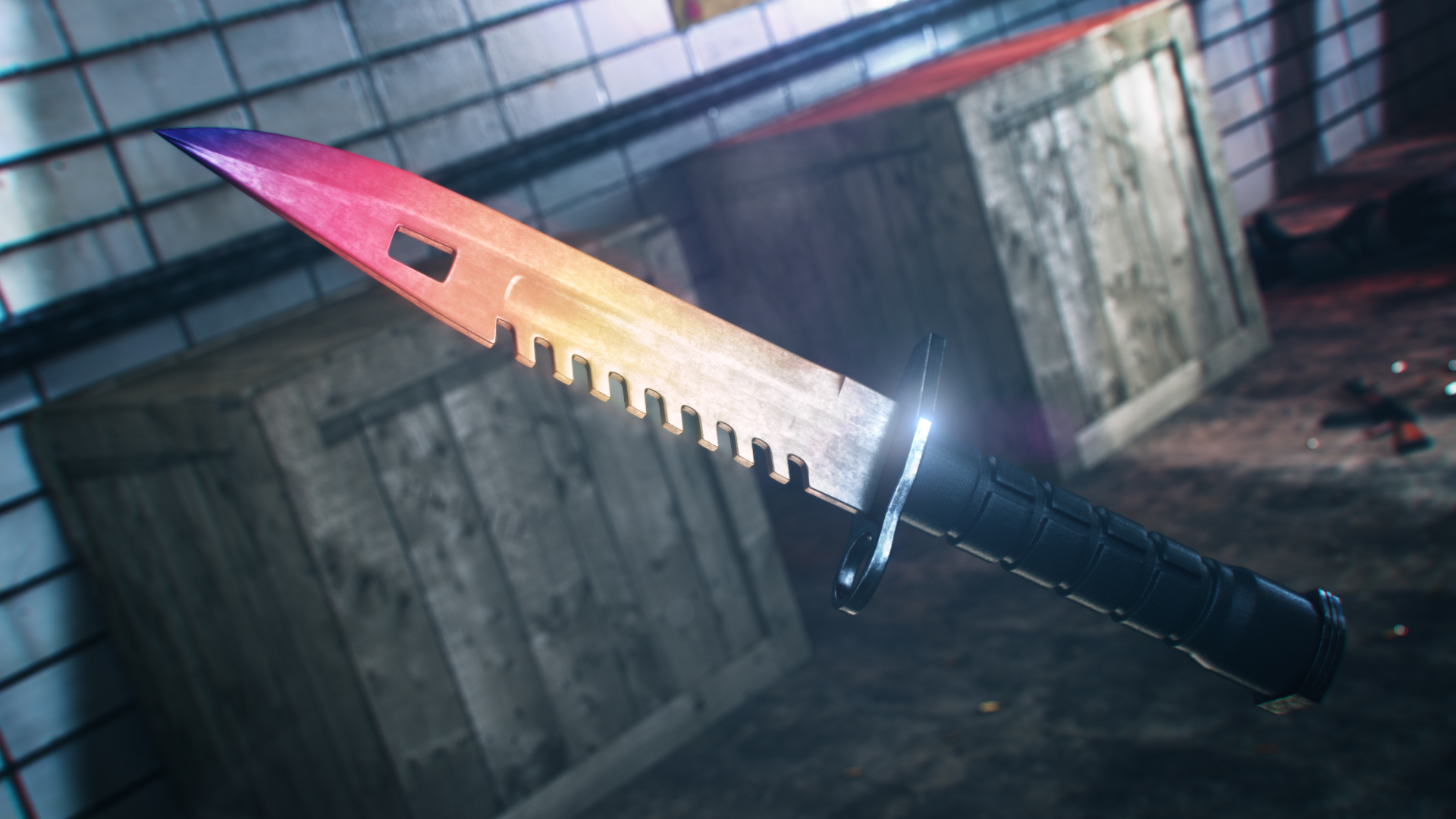
Csgo Knives

If that wasn’t enough, Valve directly incentivized the act of watching CS:GO majors in-game or through Twitch with a linked Steam account: spectators of the biggest tournaments can win special edition “Souvenir” skins. Souvenir versions of rare weapons are some of the most valuable in the game—a Souvenir Cerebus Galil, the second-tier Terrorist rifle, might fetch $230.
Likewise, picking up other players’ guns is a strategically valuable move—grabbing a dropped AWP saves your team from spending those resources from their own virtual pockets. (Any primary or secondary weapon will be automatically forced into your hands if you aren’t carrying one, even.) But after weapon skins were added, taking your opponent’s AWP or AK-47 took on a new meaning: it became a visual trophy. Spectators could see, presented in the UI, the gun owner’s name. Killing someone with their own, bedazzled rifle became the ultimate insult. Valve even added a command that plays a custom “look at my fancy weapon” animation. Checking out your gun mid-match became a kind of taunt, especially if it was an opponent’s.
Conspicuous Consumption-Strike
There’s an even simpler explanation for the popularity that skins brought to Counter-Strike: they put money directly in the game. A lot of it. Not only did Counter-Strike have a persistent element for the first time, it had a form of progression that was worth real money. How much you’d accumulated in CS:GO became a measure of how serious of a player you were.
Skins became status symbols, bling that says something about you as a player. Holding a $2100 Dragon Lore AWP, the CS:GO equivalent of a gold-plated Lamborghini, instantly validates you as a savvy or ultra-dedicated player—not only do you have taste, but you have the means or the passion to acquire something unavailable ‘in stores’—the Steam Market places a $400 limit on listings.
No one could have predicted what would happen when one of the world’s most skill-driven FPSes made fashion a feature. But it has had a substantial impact on Counter-Strike’s competitive scene. Several third-party sites that allow players to bet skins on CS:GO esports matches have sprung up, one among them claiming to draw a million visitors each day.
After weapon skins were added, taking your opponent’s AWP or AK-47 took on a whole new meaning: it became a visual trophy.
Stickers Csgo
Just as significantly, professional teams have gained a steady source of revenue outside of sponsors and tournament winnings. Teams that play in major tournaments (like the ESL One Cologne) receive a share of the sales of disposable in-game stickers associated with their team, and recently-added pro autograph stickers contribute even more to the pot. “Making $150,000 in pure sticker money—more than the tournament itself—is currently possible,” says Kovanen, who analysed these ‘Stickernomics’ last year.
And despite match-fixing incidents made possible by item gambling, most people in the scene will tell you that the addition of weapon skins has been extremely positive. “[Skins] have allowed for large betting companies and sites to be founded and existing ones to begin pouring money into the game,” says Kovanen. “Most importantly, beyond the visual improvements and the fun that is betting, it has made Counter-Strike incredibly much larger—it’s been proven viewership grows exponentially when betting is available, and therefore the game as a whole would be a lot worse off without the item economy that has allowed for the game to flourish.”
“The combination of being the best FPS game and a purely cosmetic item economy was what pushed CS to where it is today. Change or take either of those away and you would mess with success,” says Kyle ‘Ksharp’ Miller, a veteran professional CS player and co-founder of Team 3D. “The true hardcore fans would still be there because they grew up on Counter-Strike, but I don’t know if it would have attracted the next generation of players.”
The Hyperbeast skin for the M4A1-S

If you got it, brandish it.
When most people have something valuable, they want to flaunt it. They want to wear it out in public and have strangers ask about its origin or authenticity. Oh, this old thing? Owning a rare or expensive CS:GO skin became a status symbol, and an invitation to make videos, screenshots, or GIFs. CS:GO’s most passionate skinthusiasts were, whether they knew it or not, highly-effective marketers.
A mundane round of CS:GO’s deathmatch mode can draw hundreds of thousands of eyeballs if it showcases a hyper-rare variant of an already hyper-rare skin. Almost 3 million people have heard the inspirational tale of “From Nothing to A Knife,” one player’s saga of turning a $0.16 skin to a sub-$100 blade (set to some choice motivational speeches). CS:GO even has its equivalent to the depressingly popular Kinder Egg opening videos: case opening videos. Millions of people, as it turns out, will vicariously operate a slot machine that spits out virtual guns. And if you want to experience the thrill of opening virtual boxes without spending $2.50 a pop, you can poke around in a crate-opening simulator. Real-life replicas of CS:GO are up for grabs on eBay or Etsy (and are cheaper than their in-game equivalents).
CS:GO went from being a mostly outsourced project meant to bring Valve’s series to PS3 and Xbox 360 to the most popular competitive FPS of our generation. The money, popularity, and esports growth that skin mania has brought to Counter-Strike is immense, measurable, and will have a long-lasting impact not only on CS but on other multiplayer games.
But even players who are indifferent, or even critical of the way skins have altered a once-pure competitive game have benefited from their introduction. The wave of attention has encouraged Valve to make significant improvements to CS:GO. An influx of new players brought more cheaters (even in the higher levels of competitive play), but Valve has done a lot more to mitigate and ban them. Classic maps like Train that were initially flawed in CS:GO have been reworked. And although CS:GO’s tournaments don’t yet reach the pomp and level of reward as The International, Valve puts up $250,000 for multiple majors throughout the year.
Even earlier this week Valve rebuilt CS:GO’s hitboxes, animations, and netcode work together, a seemingly mundane update that in fact addresses a long-standing complaint from hardcore players. Take or leave its luxury items, Counter-Strike has never been a better or more beloved game.