The evolution of online gaming has turned gaming into something that goes well beyond simply playing video games. There is a whole complex system of industries, companies, communities, digital economies and technology that is interacting with each other, and all of which constantly extends the meaning of a game.
Internet gaming has played a big role in this transformation. Connection has turned individual or local experiences into shared spaces where millions can play, compete, cooperate, create content and build communities.
From this inter-connectedness developed new domains like e-sports, streaming, in-game economies, and innumerable digital platforms and services. And all the while mobile and cloud computing technology has changed this world, and is forcing it to evolve.
From Local Multiplayer to a Connected Gaming World
Before the time when connecting to players all over the world became a simple matter, multiplayer gaming required a lot more work.
LAN parties became one of the first major social events for PC gaming. Games like Quake, StarCraft, Doom and Counter-Strike gathered particularly active communities there. They required lugging along a heavy desktop machine, a monitor, a keyboard and a jumble of cables to a friend’s house, a university, or an event just to be able to play for a few hours.
The Rise of Multiplayer Gaming
A LAN connection allowed several players to play the same game together without the need for outside help. The growth of the internet gradually eliminated the need for players to be in the same physical location, laying the groundwork for competitive online gaming, esports, and global gaming communities.
Distance was no longer a problem, and the world of communities stretched far beyond any single city or group of friends. A player could form a team with people they’d never met and play against them regularly, people they would probably never see in real life.
It’s as if the Internet has taken the things that made LAN parties so special—competition, collaboration, and community—and turned them into a sort of daily, everyday experience.
Persistent Online Worlds
With the increasing growth of the network and the improved game technology, the next stage in the evolution was the creation of large, persistent, almost living virtual worlds.
In MMOs, a virtual world kept running after the game was closed. Virtual characters, items, relationships, and achievements could be maintained for months and even years, giving players a reason to return to this virtual world.
The community, instead of forming around a product that would finish, starts to share an experience that is always evolving. Cross-platform connectivity blurs the boundaries between different platforms, making it possible to share games, communities, and progress across all of them.
How Technology Changed the Gaming Experience
The evolution of gaming goes beyond a mere improvement in graphics and processing power. Broadband has made online games more reliable, hardware has made for greater complexity of environments, and the cloud has changed the way we store, distribute and access games.
Mobile and Cross-Platform Gaming
The mobile phone is an example of how new technology has expanded who can play, where they can play and what is considered a gaming device.
The same phone was able to play games from the most simple like Flappy Bird to the most complicated and difficult like Fortnite. This versatility led to the migration of games from their traditional sites on consoles and personal computers.
The market is massive. According to the Entertainment Software Association’s 2026 report, mobile will be the most popular way for US players to play, with 80% playing on their mobile device.
Mobile gaming has also introduced new ways to encourage long-term player engagement. Daily challenges, achievement systems, progression milestones, and unlockable rewards have become important features of modern mobile games. These developments highlight how reward systems in mobile games influence player motivation and encourage continued participation, making mobile gaming more engaging beyond the core gameplay experience.
Cross-platform games further reduce the importance of borders. For example, Fortnite lets players on different devices share the same experience, which means that the choice of machine no longer automatically limits who we can play with.
Cloud Gaming and New Access Models
For the vast majority of the history of gaming, one had either to possess the game physically or to install it on the hardware directly.
Digital distribution began to free us from this bond and cloud gaming offers yet another possibility, that of running the game on a remote server and streaming the experience to the player’s device.
Some titles, like those from Xbox Cloud Gaming or NVIDIA GeForce NOW, can be played via streaming without it being necessary for them to run on powerful machines.
Something else has changed besides the cloud, something less visible but as essential: continuity.
The profiles, saved games and progress can be synchronized on the network. So switching devices is no longer necessarily to start over from scratch; depending on the game and the platform, one can start playing a game on one platform and continue on another.
Cloud services have also brought new access modes. Instead of buying games separately, membership services like Xbox Game Pass provide unlimited access to entire catalogs by paying a subscription.
This moves gaming ever closer to the on-demand model that has transformed other entertainment industries.
A suggested media object: A graphic depiction of the main phases of gaming technology: LAN, broadband, online consoles, smartphones, cloud gaming, and cross-platform environments.
Gaming Is Now a Social Ecosystem
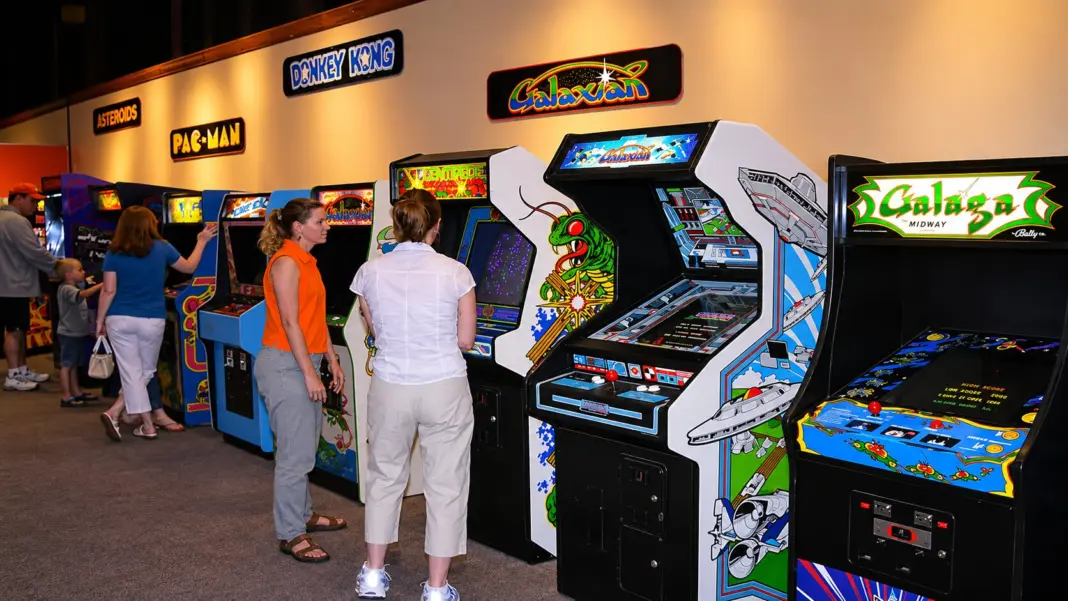
Long have the games been played in company. In the arcades people used to gather, or they shared consoles in the home, or came to a LAN party and competed against each other. The only thing that changed was the scale.
Interaction is no longer dependent on occupying the same physical space.
Streaming, Content Creators, and Gaming Communities
Thanks to technology and the network, games were granted new voices and new ways of being consumed.
The gamer no longer necessarily has to play for himself alone; he can also perform for the public. Platforms such as Twitch and YouTube allow the public to participate in a game by chat, comments, and other means of interactivity.
These creators further expand the ecosystem of their favorite games with walkthroughs, analyses, tutorials, challenges, streams, and all sorts of entertainment content. For some games, players even spend as much time watching content about a game as playing it.
And communities don’t have to remain inside the game either. Discord servers, social networks, various forums and the like allow you to chat, organize matches or share content while the game is off.
Esports and Competitive Gaming
The world of games seems to have arrived at a peak with esports. Initially, in the arcades, there was competition between players for the highest scores, and then at LAN parties, they organized tournaments; then came the internet and streaming, which allowed these competitions to become spectacles with global audiences.
For example, League of Legends, Counter-Strike, Dota 2, and Valorant now have competitive ecosystems of professional players, organizations, coaches, commentators, broadcasters, sponsors, and major esports tournaments.
The Business Behind Modern Gaming
The evolution of online gaming changed how we play, and it also profoundly transformed how companies across the online gaming industry make money. For decades, the dominant model was relatively simple: develop a game, sell a copy, and hope enough people bought it. Today, several different models exist side by side.
| Gaming Model | How It Works | How It Makes Money |
| Premium games | The player buys the complete game | One-time main purchase; depends on sales and volume |
| Free-to-play | Free access to the base game | Optional in-game purchases; depends on a large user base |
| Subscription | Access through a membership | Recurring monthly or annual payments |
| Live service | Continuous content and updates | Recurring revenue through seasons, passes, content, and purchases |
| Digital economies | Purchase and exchange of virtual goods | Microtransactions for skins, cosmetics, items, or other digital assets |
| Advertising | The game incorporates ads | Revenue from impressions, videos, clicks, or rewarded ads |
One thing to keep in mind is that the performance in conventional video games and esports is usually linked to the players’ actions and skill, but gambling involves financial risks and outcomes that can be wholly or partly dependent on chance. As with any form of gambling, it must be considered as entertainment, kept in strict limits, and engaged in where legal.
Emerging Trends Shaping the Future of Gaming
Future gaming trends will probably depend on the absence of any single revolutionary innovation but on the simultaneous appearance of new developments that keep lowering the barriers between platforms, games, and players.
AI and Personalized Experiences
Artificial intelligence has potential applications across practically the entire gaming chain.
Creators can also use generative tools for asset creation, dialogue, testing and prototyping. Moreover, more complex AI can also be used in games themselves to allow NPCs with less predictable responses or to adapt certain elements of the experience to the player’s behaviour.
However, this does not necessarily mean that all games will have to be set up differently for each player. The more important applications of AI will probably be less visible.
VR, AR, and Immersive Gaming
However, it is a long way from a Ready Player One-like experience. Current headsets have improved in terms of resolution, tracking, controls and computing power.
VR enables experiences that cannot be given on a conventional screen, especially when physical movement and the perception of space are part of the game.
Augmented reality goes another way. It can bring digital elements into the real world by using devices that people already own. Pokémon GO is an early example of the use of location, smartphone and virtual elements without the player being completely isolated from reality.
This is why the future of immersion may not look like the complete replacement of reality. It may be nothing more than a way to combine the two spaces better.
Greater Connectivity Between Platforms
It is clear that there was a time when, once you had purchased a console, you were tied to it exclusively, especially when it came to online gaming.
Cross-play allows players on different platforms to play against each other in the same match. Cross-progression lets the player’s items, progress, and characters persist when they change platforms. Cloud services move some of the game’s computing and data storage away from the player’s equipment.
All these advances point to the same direction: an entertainment system where a player’s identity is no longer so closely linked to any one console, personal computer or mobile phone.
A recommended visual: a diagram showing a contemporary gamer’s ecosystem in which games, platforms, creators, esports, communities, and digital services are interconnected.
What the Evolution of Online Gaming Means for Players
All this evolution mainly involves for the player more possibilities where the future of online gaming is more and more interactive.
Today, a variety of experiences that would have been impossible to imagine during the first years of gaming have appeared.
One can now spend dozens of hours with a single AAA production, jump in for a few minutes in a mobile game, compete in countless multiplayer matches, explore a game developed by a small studio, or simply watch a stream and chat with the community.
Because of digital distribution, better development tools and the online gaming environment, new games, updates and new content can be directly delivered to the players rather than having to rely on physical releases.
Large companies can distribute their products to millions of people at the same time, while smaller studios have platforms from which to reach global audiences.
A few things stand out from all of this:
- Gaming is more social and connected than it has ever been.
- Competitive gaming has grown into a major spectator activity.
- Mobile and cross-platform access have opened gaming up to far more people.
- Creators and communities now shape gaming culture alongside the games themselves.
- New technologies keep widening what an online gaming experience can include.