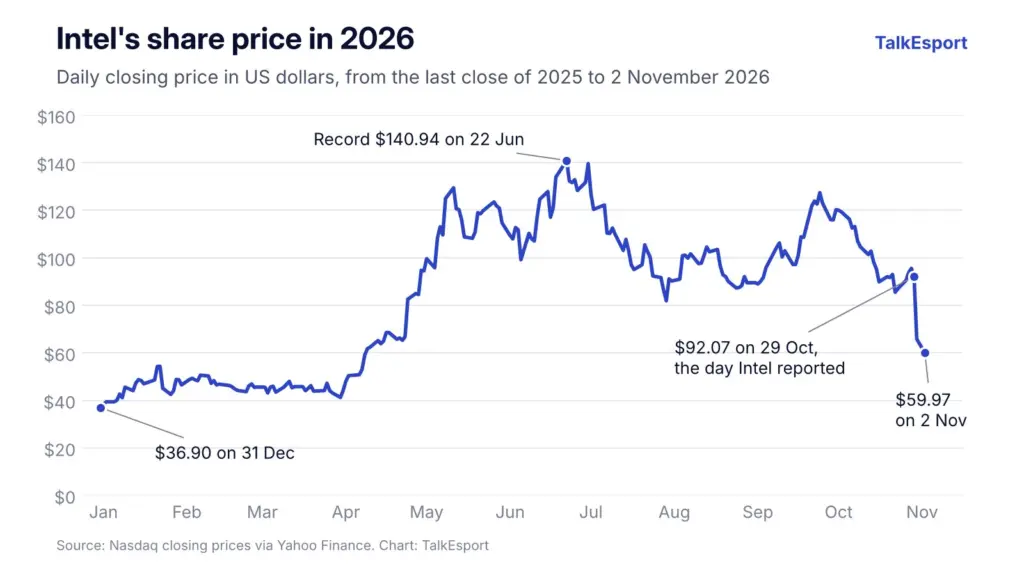
Intel beat Wall Street’s forecasts on 29 October, reporting its fastest data centre growth in 15 years, and within two trading days it had lost more than a third of its market value. The shares fell almost 29% on Friday 30 October, their worst day since 1974, and then slid another 8.8% on Monday to close at $59.97. That leaves Intel worth roughly half of what it was at the end of September, and the selling has carried on well after the first shock of the forecast.
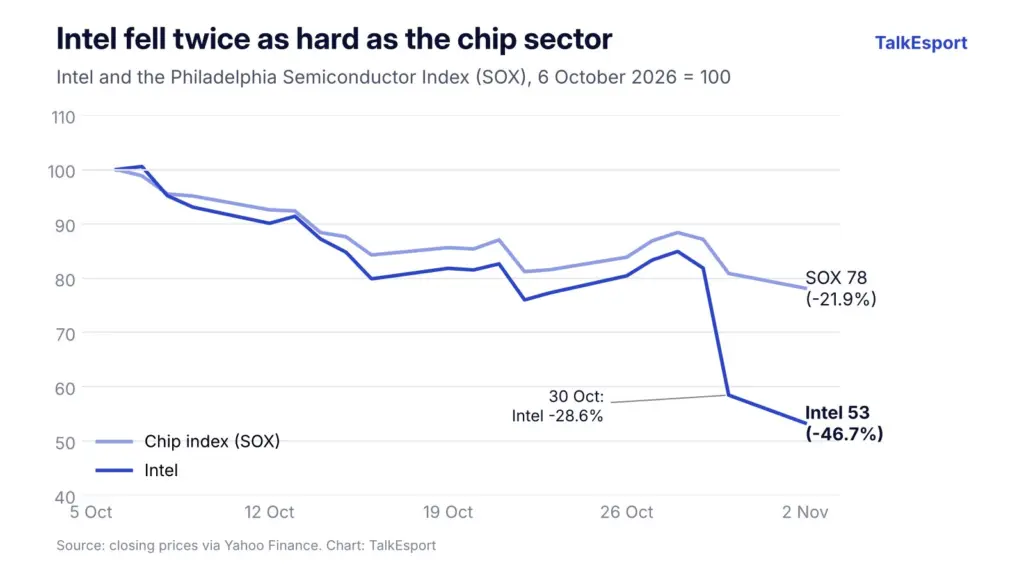
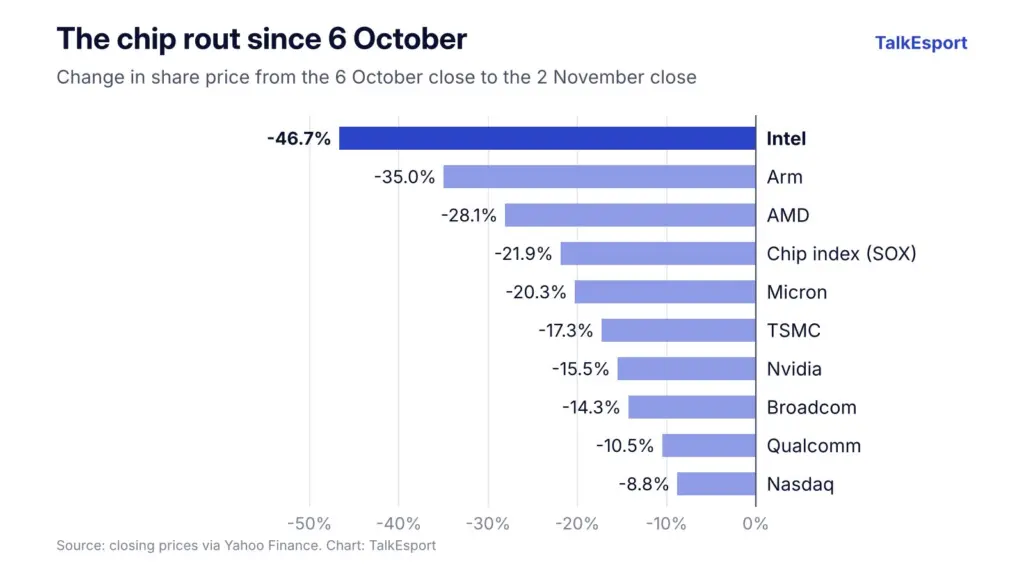
Moreover, the damage is no longer confined to Intel. Chip and memory stocks have now lost about $3.7 trillion in combined market value since 6 October, according to Yahoo Finance calculations, and the selling deepened on Monday even though most of the wider US market rose.
A quarter that beat expectations
On paper, the quarter gave investors little to complain about. According to Intel’s third-quarter results, revenue rose 21% from a year earlier to $16.5 billion, and adjusted earnings more than doubled to 52 cents a share, comfortably ahead of the roughly 40 cents analysts had pencilled in. Adjusted gross margin improved by four percentage points to 44.1%, a sign that Intel is keeping more of every dollar it earns.
The standout was the Data Center and AI division, whose revenue jumped 78% to $7.3 billion as demand for server processors in AI workloads continued to climb. Chief financial officer David Zinsner described it as the strongest data centre revenue growth the company had seen in 15 years. Intel Foundry, the contract manufacturing business at the heart of chief executive Lip-Bu Tan’s turnaround plan, grew 58% to $6.7 billion. The one weak spot was the PC business, now called the Client Computing and Physical AI Group, where revenue slipped 5% to $8.1 billion.
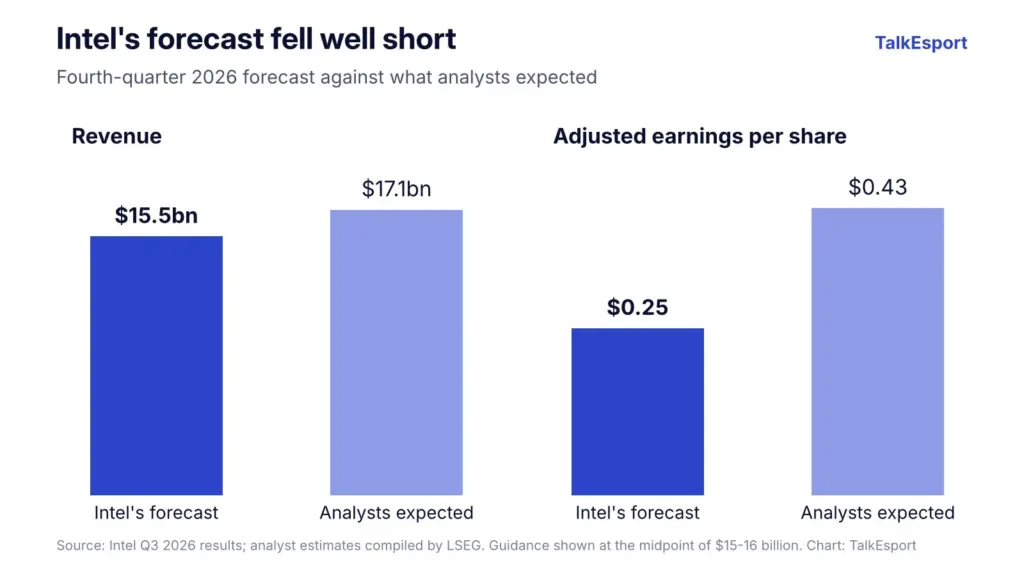
The trouble lay in what Intel said about the next three months. The company expects fourth-quarter revenue of $15 billion to $16 billion and adjusted earnings of 25 cents a share, whereas analysts had been looking for about $17.1 billion and 43 cents. In addition, adjusted gross margin is expected to fall back to around 38%, which would undo much of the progress the third quarter had just shown.
Two problems sit behind that weaker outlook. The first is the PC market, which Intel expects to keep shrinking for some time. “We see the PC slowdown continuing at least through the first half of next year,” Zinsner said, and the company now expects PC shipments to fall by around 12% this year and by roughly 10% in 2027. AI data centres are absorbing a growing share of the world’s memory chips, which is pushing up the cost of laptops and desktops and, in turn, putting buyers off. Intel has also flagged industry-wide shortages of memory and chip substrates as a risk to its business.
The second problem is an explosion on 14 October at Intel’s factory in Kiryat Gat, Israel, which mainly produces data centre processors. Local reports said two workers were killed and a third was seriously injured, and the plant was shut for about two weeks. Zinsner told analysts the incident would cost around $300 million in fourth-quarter revenue and about 200 basis points of gross margin, with a similar revenue hit expected in the first quarter of 2027, although the full damage will not be clear until Intel finishes checking which wafers can be saved.
Tan, for his part, said demand for Intel’s processors “remains robust” despite what he called “near-term headwinds across the PC industry”, and described rebuilding the company as a multiyear journey. Wall Street was far less forgiving. Bernstein analyst Stacy Rasgon called the outlook “(in a word) terrible” and cut his price target to $75 from $110, a level the shares had already fallen well below by Monday’s close.
The worst day since 1974, and then another fall
Intel closed at $92.07 on the day it reported, and by Friday evening the stock had fallen 28.6% to $65.76, erasing roughly $140 billion of market value in a single session. Only one day in the company’s history has been worse: on 5 July 1974 the shares dropped close to 30%. The previous runner-up, a 26% fall on 2 August 2024, came when Intel was losing money and cutting thousands of jobs, which makes this collapse all the more striking, since it followed a quarter that beat expectations.
There was no relief on Monday. Intel fell another 8.8% to $59.97, taking its losses since 6 October to about 47% and wiping out roughly $279 billion of market value over that stretch. Over the past month the shares have lost close to half their value, and they now trade about 57% below the record close of $140.94 they reached on 22 June. Even so, the stock remains around 62% higher than where it ended 2025, which shows just how far it had climbed during the first half of the year, when investors bet that Intel’s server chips and foundry business would finally benefit from the AI boom.
The fall has also cost the US government, which bought a 9.9% stake in Intel in August 2025 at $20.47 a share. That holding lost more than $10 billion in value on Friday alone, although it is still worth roughly three times what Washington paid for it.
How the sell-off spread across the chip sector
The selling quickly reached Intel’s rivals and suppliers. On Friday, Qualcomm, AMD and Arm each fell by around 10% to 11%, while TSMC, Broadcom and Micron lost between 5% and 6% and Nvidia dropped 4.2%. The Philadelphia Semiconductor Index, which tracks the largest US-listed chip companies, fell 7.2%, and the Nasdaq Composite lost 2.9%. PC makers Dell and HP slid as well, which reflects how closely investors now link Intel’s warning to the health of the wider PC market.
Monday brought a second leg down, and this time memory and storage companies took the brunt of it. Micron fell 5.8%, Sandisk and Seagate dropped between 6% and 8%, and the chip group as a whole shed more than $400 billion in a day on which roughly seven in ten S&P 500 stocks actually rose. Since 6 October, Nvidia has lost about $896 billion of market value, TSMC about $435 billion and AMD about $298 billion. Furthermore, AMD reports its own third-quarter results after the US market closes on Tuesday, which makes it the next test of whether the sell-off deepens or steadies.
Though not everyone thinks the rout will last. Adam Johnson of Bullseye Brief argued that “the market kitchen-sinked it”, meaning investors have already priced in the worst, which he said typically marks a bottom. Jeff Hirsch of the Stock Trader’s Almanac, who bought into Friday’s sell-off, pointed out that chip stocks have risen from the last October close to the following June in all eight midterm-election cycles since 1994, although in 2002 and 2018 they first fell by about another 11%. Former Cisco chief executive John Chambers was more cautious, warning that the gap between winners and losers in the sector will widen and that there “will be major train wrecks”, even though he said he would not bet against Nvidia.
For gamers and hardware enthusiasts like myself, the most telling part of Intel’s warning is the reason behind it. The same AI build-out that is driving Intel’s data centre sales is draining memory supply from the consumer market, and that is making gaming PCs, laptops and upgrades more expensive. Valve has already blamed rising component costs for pricing the Steam Machine well above its original target, and Intel’s forecast suggests prices are unlikely to ease soon. Intel said the PC slump will not lift until memory supply and prices return to normal, which on its own estimate means at least the first half of 2027.