
Only 35 of France’s 577 deputies took part when the National Assembly voted, shortly after 9 AM on Friday, the 30 October, to tax the internet by the gigabyte. The count was 11 for, 10 against and 14 abstentions. Amendment I-1358 to the 2027 budget would charge companies €0.055 for every gigabyte of data they send to homes and phones in France.
The measure is a long way from becoming law, and it may never even get there, the government and the budget’s general rapporteur both has opposed it. But it puts a price on the thing every online game, patch and esports stream is made of, and South Korea has already shown where that road can lead: Twitch left the country rather than keep paying for its traffic.
What France’s deputies voted for
The Socialist amendment, led by deputy Laurent Lhardit, creates a taxe sur les producteurs de données numériques, a tax on producers of digital data. Internet providers would count how much data each sender delivers to their customers and report the totals to the tax office every quarter, supervised by the telecoms regulator Arcep. The text lets providers record who sent the data and how much of it, but never what it contained or where it went.
The bill goes to whoever sends the traffic. For content delivery networks, the companies that store other firms’ files on servers close to users, everything leaving their network counts. The tax is capped at 15% of the sender’s turnover in France or 2% of its worldwide turnover.
The government expects about €10 billion additional revenue a year. They cite an Arcep estimate that around 200 billion gigabytes reach French subscribers each year, and say Google, Meta, Amazon, Netflix and Akamai send about half of it. Arcep’s latest annual report backs up that concentration: those five accounted for 49% of the traffic relayed to French users at the end of 2025. Public accounts minister David Amiel disputed the €10 billion figure and argued that half of the money would come from smaller providers, many of them French.
What a gigabyte tax means for players
Games are among the biggest files people download, so the numbers add up quickly. At €0.055 per GB:
- A 100 GB game download carries €5.50 in tax.
- Call of Duty: Modern Warfare 4 needs 115 GB of storage on PC, about €6.33 per install before a single patch.
- An hour of live streaming at 6 Mbps, a common bitrate for 1080p, is about 2.7 GB, or roughly €0.15 per viewer. A five-hour best-of-five like Karmine Corp’s Worlds quarter-final against T1 on 6 November would come to about €0.74 for every French viewer watching at that quality.
- Cloud gaming at 25 Mbps uses about 11 GB an hour, which works out at around €0.62 an hour.
Valve says Steam delivered more than 100 exabytes of games and updates worldwide in 2025. At France’s rate, every exabyte that reaches French players would cost €55 million.
Players however, would never receive this bill. The tax falls on whoever sends the data, which for most downloads means Valve, Sony, Microsoft or the delivery network (similae to CloudFlare, Akamai) carrying their files. Those companies would decide how much of it comes back to players through prices, subscriptions and download speeds, and the amendment says nothing on that.
How much data France uses compared with Germany, the UK, the US and India
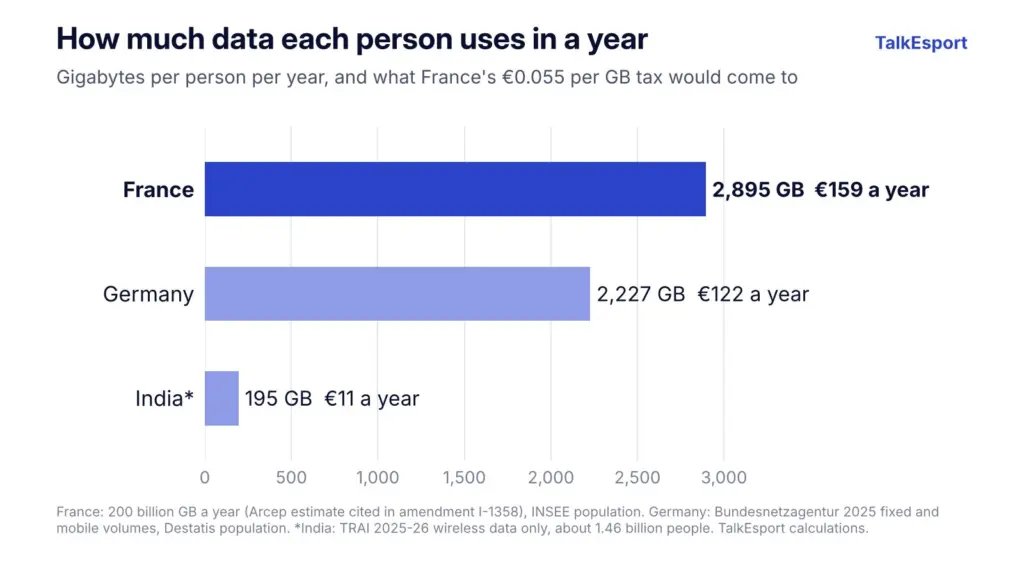
Spread across France’s 69.1 million people, 200 billion gigabytes works out at about 2,895 GB per person a year, or 241 GB a month. That is about €159 per person in tax every year. Germany’s telecoms regulator counted about 175 billion GB on fixed lines and 10.9 billion GB on mobile in its 2025 report, or about 2,227 GB for each of its 83.5 million people. The same tax there would come to about €122 a head.
| Country | Home broadband, per line per month | Mobile, per user per month | Source |
|---|---|---|---|
| United States | 711 GB | n/a | OpenVault, Q2 2026 |
| United Kingdom | 583 GB | 11.8 GB | Ofcom, 2025 |
| France | about 460 GB* | 18.3 GB | Arcep, Q4 2025 |
| Germany | 376 GB | 8.4 GB | Bundesnetzagentur, 2025 |
| India | not published | 25.5 GB | TRAI, 2025-26 |
Applied to an average home line, a €0.055 tax would come to about €25 a month in France, €21 in Germany, €32 in the UK and €39 in the US. The turnover caps would limit what the largest senders actually pay, but the numbers show why critics expect some of the cost to reach households.
India’s mobile users already out-download France’s
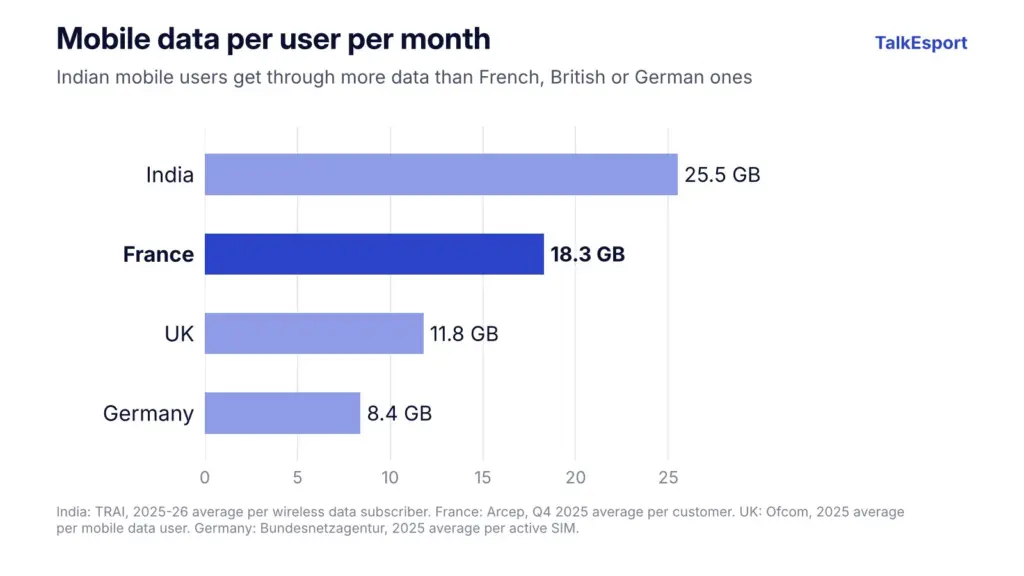
India is the outlier. TRAI’s figures for 2025-26 show 1.03 billion wireless data subscribers using an average of 25.51 GB a month, more than users in France (18.3 GB), the UK (11.8 GB) or Germany (8.4 GB). India’s wireless networks carried about 285 billion GB in the year, more than reaches French users. Spread across about 1.46 billion people, though, it comes to roughly 195 GB per person, about a fifteenth of France.
A tax like France’s would land much harder in India. At about ₹106.55 to the euro, €0.055 is about ₹5.86 per GB. Indian operators earned ₹8.02 for every gigabyte of wireless data in 2025-26, according to TRAI, so the levy alone would equal about 73% of what a gigabyte sells for. For an average Indian data user, it would add up to about ₹1,794 a year, against the ₹2,948 they spend on mobile data.
Indian telcos have asked for something along these lines. In May 2025, operators asked the Department of Telecommunications for a levy on large platforms such as Netflix, WhatsApp, Amazon Prime, Facebook, Instagram and Zoom, modelled on the Universal Service Obligation charge, to help pay for networks. Industry groups IAMAI and BIF have opposed such fees in the past, warning they would raise costs for users and break net neutrality.
Other countries have tried this before
South Korea pushed Twitch out
South Korea is the clearest warning for gaming, its internet providers have pushed content companies to pay for the traffic they send, and in June 2021 a Seoul court sided with SK Broadband against Netflix in a dispute over network fees. The two companies settled in September 2023 without saying who would pay what.
Twitch could not make the numbers work, their chief executive Dan Clancy wrote that its network fees in Korea were “10 times more expensive than in most other countries”. Twitch first capped Korean streams at 720p, then closed its Korean business on 27 February 2024. Korean streamers and their audiences moved to local platforms.
Europe’s “fair share” fight
Europe’s largest telecom operators have spent years asking for a “fair share” of network costs from the biggest traffic senders. The European Commission’s Digital Networks Act, proposed in January 2026, stops short of mandatory fees but adds a conciliation process between operators and content providers, overseen by national regulators. The Internet Society and digital rights groups have warned that it could bring network fees in through the back door. The European Parliament and member states are still working on their own versions.
Fair-share fees would be paid to telecom operators, and the money from France’s gigabyte tax would go to the state. And mind you, this is not the first, France has taxed big tech before. Its 3% digital services tax on large platforms has applied since 2019, and in October 2025 deputies voted to double it to 6% during the 2026 budget debate. The government said it would try to reverse the increase, and Jason Smith, who chairs the US House Ways and Means Committee, threatened retaliation.
The amendment’s authors make a fairness argument that deserves a hearing. They say global platforms earn heavily from French users while paying far less tax in France than local businesses do. Profits can be moved to another country on paper, but data volume cannot. The text counts traffic without reading it, and the authors argue that a price on each gigabyte would push companies to compress video and files more efficiently, which would also cut energy use.
From the perspective of the government, the goal is reasonable but the method is wrong for gaming. A gigabyte measures size, and size has little to do with how much a company earns. A free Twitch stream, a patch for a game players already own and a paid film are all taxed the same, so the bill lands hardest on the parts of the internet that are heavy by nature: game downloads, updates, cloud gaming and live esports.
The minister’s own warning should worry the games industry most. If half the money comes from smaller providers, many of them French, then services like Shadow, the French cloud PC service that streams full gaming sessions to its users, are exactly the kind of company that would pay. They do not have Netflix’s room to absorb a new cost. Korea shows the other risk. It pushes the market to make traffic expensive enough, which results to platforms cut quality and quietly depart, leaving players and creators with no choice. France’s esports scene runs on live streams, from the LFL to Karmine Corp’s co-streams.
If France wants the biggest platforms to pay more, a tax on what they earn in France does that more fairly than a tax on how much data they send. Each data sent or spent doesn’t necessarily equate to making money.
And well, all this can still be put to hold by the regulatory. The amendment only survives if the Assembly adopts the whole revenue half of the 2027 budget bill, which it has to finish by 17 November before the text moves to the Senate. The government can then ask deputies for a second vote to remove it, or use Article 49.3 to pass the budget with only the amendments it chooses to keep. We will update this piece as the vote moves.