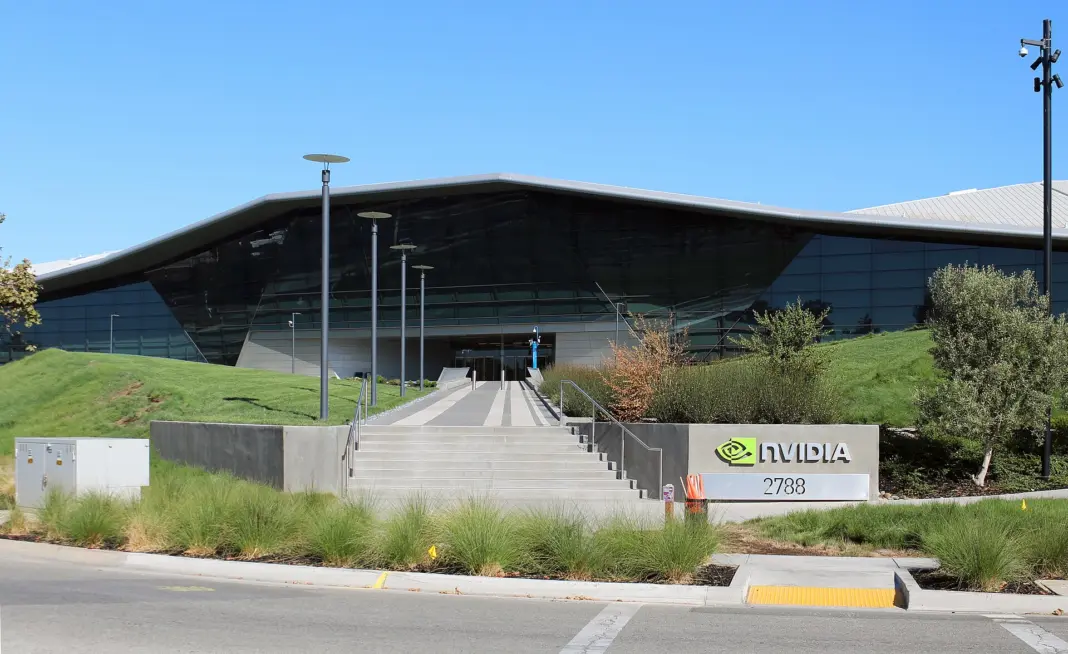
Nvidia had one of the worst days in its recent history on Thursday, as a brutal selloff in AI and chip stocks wiped out gains that had taken months to build. The world’s most valuable chipmaker closed at $181.60 on the Nasdaq, down $18.53 or 9.26%, which erased roughly $450 billion of market value in a single session. That left Nvidia worth about $4.4 trillion, and its shares are now down nearly a quarter from their record close on 6 October.
Measured from that peak, roughly $1.4 trillion has disappeared from Nvidia’s valuation in a month. The damage was not limited to one company, though, because Nvidia is also a member of the Dow Jones Industrial Average, which plunged 1,833.06 points. Across the wider tech sector, the Nasdaq-100 lost about $2.3 trillion in value during the day, according to Yahoo Finance’s market coverage.
How bad Thursday’s chip selloff really was
Every major US index closed sharply lower, and all three of the best-known benchmarks recorded their worst day since April 2025. The Dow finished at 51,523.06, down 3.44%, while the S&P 500 fell 4.36% to 7,353.73. The Nasdaq Composite dropped 5.52% to 24,315, a fall that pushed it into correction territory, more than 10% below its own record close on 6 October.
The real carnage, however, was concentrated in semiconductor stocks. The PHLX Semiconductor Index fell 12.25% to 9,011.14, and the iShares Semiconductor ETF had its worst day since March 2020, according to CNBC. Wall Street’s fear gauge, the VIX, also jumped to around 28 during the session, its highest level since 31 March.
Several of Nvidia’s peers fared even worse in percentage terms. Micron fell 17.46% to $656.39 and AMD dropped 17.26% to $404.40, while Arm lost 13.08%, Broadcom 10.43% and Intel 10.33%. For Intel, it extends a slide that had already cut its value almost in half in the space of a few weeks.
Qualcomm added a company-specific problem to the mix. Its quarterly results showed phone chip sales down 26%, missing Wall Street estimates on weak demand and lower Apple-related revenue, and the stock closed 9.49% lower. AMD chief executive Lisa Su struck a philosophical tone as her company’s shares tumbled, telling Yahoo Finance that “the market can sometimes be a little bit short-sighted.”
Why the midterm results hit the AI trade so hard
The trigger for Thursday’s rout was political rather than technical. Democrats won control of both the House and the Senate in Tuesday’s midterm elections, according to AP race calls, and investors spent Thursday repricing what that could mean for the data centre boom. Candidates from both parties had criticised the electricity demands and local effects of data centre construction during the campaign, and some Democrats have called for restrictions or pauses.
Analysts quoted across the day pointed to the same fear, which is that the AI infrastructure buildout could become slower and more expensive. Jakub Rochlitz, a market analyst at eToro, said markets were “pricing in the midterm results” as the political risk premium unwound. UBS strategists estimated that about 30% of the data centre additions expected for 2028 are now at risk, according to CNBC.
Others argued that the scale of the move went beyond the fundamentals. “This feels like the capitulation phase for the data center capex beneficiary stocks, especially the semiconductors,” Argent Capital Management portfolio manager Jed Ellerbroek told Reuters, adding that he thought the size of the moves was outsized. Nomura cross-asset strategist Charlie McElligott put it more bluntly, saying of the selling in the market’s biggest winners: “They’re shooting the generals.”
Nvidia also faced fresh scrutiny in Washington on the same day. Three Republican committee chairs, Brian Mast, John Moolenaar and Eric Crawford, asked chief executive Jensen Huang for a closed-door briefing on 18 November, Reuters reported. The request follows a New York Times report about a US investigation linked to Singapore-based chip buyer Megaspeed. Nvidia has not been accused of wrongdoing, and it said that it “often receive[s] updates from the U.S. government regarding parties and entities of concern and always act[s] accordingly.”

What gamers and investors are watching before 17 November
The next big test for the stock arrives very quickly. Nvidia reports its third-quarter results on Tuesday 17 November, with its conference call at 2pm Pacific time, a day before the requested briefing on Capitol Hill. The company has guided for revenue of about $108 billion, plus or minus 2%, after a second quarter in which sales more than doubled year on year.
Those numbers explain why the AI trade matters so much more than gaming to Nvidia’s share price today. In its second-quarter results, Data Center revenue reached $89.0 billion out of a total of $96.2 billion, which works out to roughly 92% of the business. Huang said at the time that “the AI infrastructure buildout is at full steam”, which is precisely the claim the market started to question on Thursday.
For PC gamers, the more relevant question is whether a slower buildout would eventually ease the component squeeze of the past year. AI demand has pushed up memory prices sharply, a crunch that sparked the recent “Ram Altman” row with OpenAI’s Sam Altman and helped push up the price of Valve’s Steam Machine. Nothing in a single day of trading changes that supply picture overnight, however, and the 17 November results will be the first hard evidence of whether AI spending is really slowing.
This article is for information only and is not investment advice.