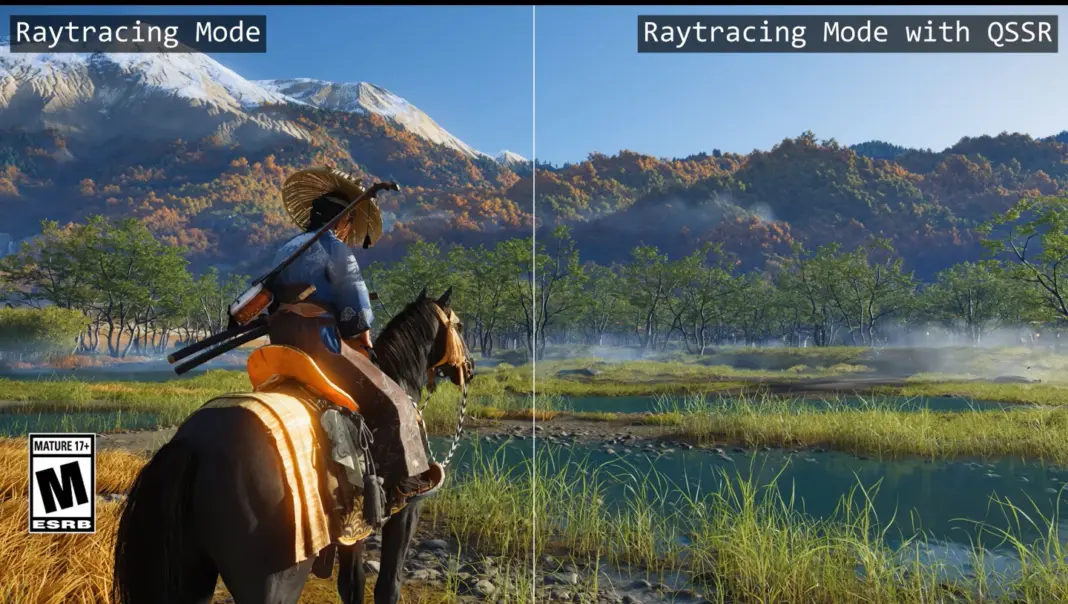
Sony is bringing AI-guided image reconstruction to the standard PS5 with Quick Spectral Super Resolution, giving the original console a streamlined version of technology previously associated with PS5 Pro.
Sony has just given millions of standard PlayStation 5 owners access to one of the most important graphics technologies associated with the PS5 Pro. The company has officially unveiled Quick Spectral Super Resolution, or QSSR, a new AI-guided image reconstruction technology designed to run on the original PS5 hardware despite the console lacking the dedicated machine-learning capabilities available on PS5 Pro.
QSSR is the latest result of Sony’s collaboration with AMD under Project Amethyst and represents a new performance tier of the machine-learning graphics technology PlayStation has been developing around PSSR. Rather than attempting to reproduce PS5 Pro’s implementation directly, Sony has engineered a substantially leaner system capable of operating within the computational limits of the standard PS5. Players will not have to wait for some future generation of games to see it either. Marvel’s Wolverine and Ghost of Yōtei are becoming the first games to support QSSR, with Sony announcing the technology alongside updates allowing standard PS5 owners to use the new reconstruction option.
According to Sony’s official QSSR announcement on the PlayStation Blog, the technology is intended to improve image detail and temporal stability while giving developers another option for balancing rendering resolution, visual quality and performance on the base console.
What is QSSR on PS5?
QSSR stands for Quick Spectral Super Resolution, and its purpose is broadly similar to other modern image reconstruction technologies: allow a game to render internally at a lower resolution before intelligently reconstructing a cleaner, higher-quality image for display.
The important difference is how Sony has designed QSSR around the limitations of hardware released in 2020. PS5 Pro introduced PlayStation Spectral Super Resolution, better known as PSSR, alongside hardware specifically designed to accelerate machine-learning workloads. The standard PS5 does not contain that same dedicated ML hardware, meaning Sony could not simply move the existing PS5 Pro solution onto the original console and expect equivalent results.
Instead, Sony and AMD have developed a streamlined neural-network implementation capable of producing meaningful reconstruction improvements while operating within the standard PS5’s existing hardware budget. That makes QSSR particularly interesting because it demonstrates that Sony’s investment in AI-assisted rendering is no longer restricted to owners of its more expensive PS5 Pro hardware.
QSSR is not the same as PSSR on PS5 Pro
The distinction between QSSR and PSSR is important because the arrival of AI reconstruction on the standard PS5 does not suddenly transform the original console into a PS5 Pro.
PSSR remains Sony’s higher-end reconstruction solution and benefits from the PS5 Pro’s substantially stronger GPU and dedicated machine-learning capabilities. QSSR has instead been designed as a lighter alternative capable of operating efficiently on the standard console.
That difference also affects the resolutions developers may target. PS5 Pro games can use PSSR while reconstructing towards 4K output from lower internal resolutions, whereas developers using QSSR on the original PS5 may choose more conservative reconstruction targets depending on the game’s graphics mode and available GPU budget.
The more useful way to understand QSSR is therefore not that Sony has given the base PS5 PS5 Pro performance, but that the reconstruction philosophy behind one of PS5 Pro’s defining features has now been adapted to hardware Sony shipped six years ago.
Marvel’s Wolverine is one of the first PS5 games to use QSSR
Insomniac Games is among the first studios putting the technology into players’ hands through Marvel’s Wolverine.
The studio says QSSR improves pixel-level clarity and image stability across the game’s environments, with areas including Madripoor and Shinjuku benefiting from the additional reconstruction quality on the standard PS5.
Insomniac’s Mike Fitzgerald described the implementation as giving standard PS5 players a taste of the image reconstruction benefits previously associated with PS5 Pro, while still working within the performance characteristics of the original console.
The technology is particularly relevant to visually dense environments because reconstruction quality can determine how effectively fine geometry, distant objects, hair, vegetation and other small details survive while the camera is moving.
Ghost of Yōtei is also getting QSSR
Sucker Punch is similarly introducing QSSR support for Ghost of Yōtei, giving Sony another visually demanding first-party game through which to demonstrate the technology.
The studio says the new reconstruction option improves fine character and environmental details while producing greater temporal stability, helping reduce some of the instability that can become visible when small objects or detailed surfaces move between frames.
Temporal stability is particularly important for modern upscaling systems because a reconstructed image can look sharp while stationary yet reveal shimmering, flickering or unstable detail once the player or camera begins moving. QSSR is designed to use information across frames to produce a more consistent result rather than simply sharpening each individual image.
QSSR could give PS5 developers more room to balance graphics and performance
The significance of reconstruction technology extends beyond making an image appear sharper. Modern console games operate within a fixed rendering budget. Developers constantly decide how much GPU performance should be allocated towards native resolution, lighting, ray tracing, geometry, effects and frame rate.
If QSSR can reconstruct a convincing final image from a lower internal rendering resolution, developers potentially gain additional flexibility elsewhere in that budget. Depending on the game, those resources could be directed towards more sophisticated graphical effects, greater scene complexity or more stable performance. That does not mean QSSR automatically increases a game’s frame rate, and Sony has made no universal promise that enabling the technology will suddenly turn 30 FPS modes into 60 FPS modes. The benefit depends on how individual developers choose to integrate the reconstruction technology into their rendering pipelines. What QSSR provides is another tool for making those compromises less severe.
Sony says QSSR should be relatively easy for developers to implement
One of the most consequential aspects of QSSR may ultimately have less to do with image quality than with how easily developers can adopt it. Sony principal graphics R&D engineer Daniel Craig told Digital Foundry that QSSR has been designed to integrate efficiently with games already supporting PSSR, reducing the amount of additional engineering work required to bring the technology to the standard PS5.
That matters because reconstruction technologies only become genuinely important to a console ecosystem when developers can implement them without rebuilding large parts of their rendering pipeline. If studios already shipping PSSR modes on PS5 Pro can adapt those systems for QSSR with relatively limited additional work, the potential library of supported standard PS5 games becomes considerably larger. Sony is making the QSSR library available more broadly to PlayStation developers, meaning support is not intended to remain restricted to Marvel’s Wolverine and Ghost of Yōtei.
PSSR started as one of PS5 Pro’s defining features
The arrival of QSSR becomes more significant when viewed against how aggressively Sony has developed its reconstruction technology over the past two years.
PSSR debuted alongside PS5 Pro in November 2024 as one of the console’s three major graphical selling points, joining a larger GPU and enhanced ray-tracing capabilities. Sony positioned the technology as a way of delivering the visual quality traditionally associated with high-resolution fidelity modes while retaining stronger performance. The implementation has continued evolving since launch. Sony and AMD subsequently expanded their collaboration through Project Amethyst, with machine-learning technology becoming increasingly central to PlayStation’s approach to image reconstruction.
Earlier this year, TalkEsport covered Cyberpunk 2077’s major PS5 Pro upgrade, where CD Projekt Red combined PSSR with enhanced ray tracing and new performance options capable of reaching considerably higher frame rates on Sony’s premium console.
QSSR now takes the underlying idea in the opposite direction. Instead of using machine learning to extract more from Sony’s most powerful console, engineers have redesigned the technology so that some of those reconstruction benefits can reach the enormous installed base of standard PS5 hardware.
What is Project Amethyst?
QSSR is another product of Project Amethyst, the collaboration between Sony Interactive Entertainment and AMD focused on machine-learning technology for game graphics. The partnership extends beyond simply developing an upscaler for one PlayStation model. Sony and AMD have been working on neural architectures and graphics technologies intended to make machine-learning techniques easier for game developers to deploy across future rendering workloads.
That broader ambition is what makes QSSR more interesting than a routine firmware-era graphics feature. Sony has demonstrated that the technology developed through its work with AMD can be scaled across different levels of hardware rather than existing exclusively as a premium-console feature.
Does QSSR mean the base PS5 now matches PS5 Pro?
No. PS5 Pro remains substantially more powerful than the original PS5 and retains advantages in GPU performance, ray tracing and dedicated machine-learning hardware. PSSR also remains the higher-end reconstruction technology. QSSR instead gives standard PS5 developers another method of extracting better image quality from the hardware they already have. A base PS5 running QSSR should therefore not be expected to produce the same graphics settings, ray-tracing complexity or output quality as an equivalent PS5 Pro mode using PSSR.
For owners of the original console, however, that comparison may miss the more important point. QSSR improves what their existing hardware can potentially deliver without requiring them to purchase another console.
QSSR could matter more because of how many standard PS5 consoles already exist
The PS5 Pro may provide the technically superior implementation, but the original PlayStation 5 has an enormous advantage of its own: installed base. Millions of players already own standard PS5 hardware, and every developer targeting the PlayStation ecosystem must account for that machine regardless of whether enhanced PS5 Pro modes are also produced.
A reconstruction technology capable of improving image quality across that larger audience can therefore have a broader practical impact than a technically superior feature available only on premium hardware. That also gives developers an incentive to experiment with QSSR. Improvements made to a base PS5 version potentially reach far more players than an enhancement restricted to PS5 Pro.
What QSSR tells us about the future of PlayStation graphics
The larger significance of QSSR may ultimately be what it reveals about Sony’s direction rather than what it changes in two games today. AI-assisted image reconstruction began this console generation as one of the headline technologies used to differentiate PS5 Pro from the original PS5. Less than two years later, Sony has developed a second implementation specifically designed to bring that philosophy back down to its standard hardware. That progression suggests machine-learning reconstruction is becoming part of PlayStation’s broader graphics architecture rather than remaining a temporary premium-console selling point.
It would be premature to describe QSSR as a PS6 feature because Sony has made no such announcement. What can be said is that Project Amethyst is explicitly concerned with longer-term graphics research, and Sony’s decision to create reconstruction technologies capable of scaling across different hardware profiles offers a useful indication of how important machine learning has become to its rendering strategy.
For players who bought an original PS5 in 2020, however, the immediate consequence is considerably simpler. Six years after the console launched, Sony has found another way to improve the image it can produce, and this time one of the most interesting ideas behind the PS5 Pro is no longer exclusive to the Pro.