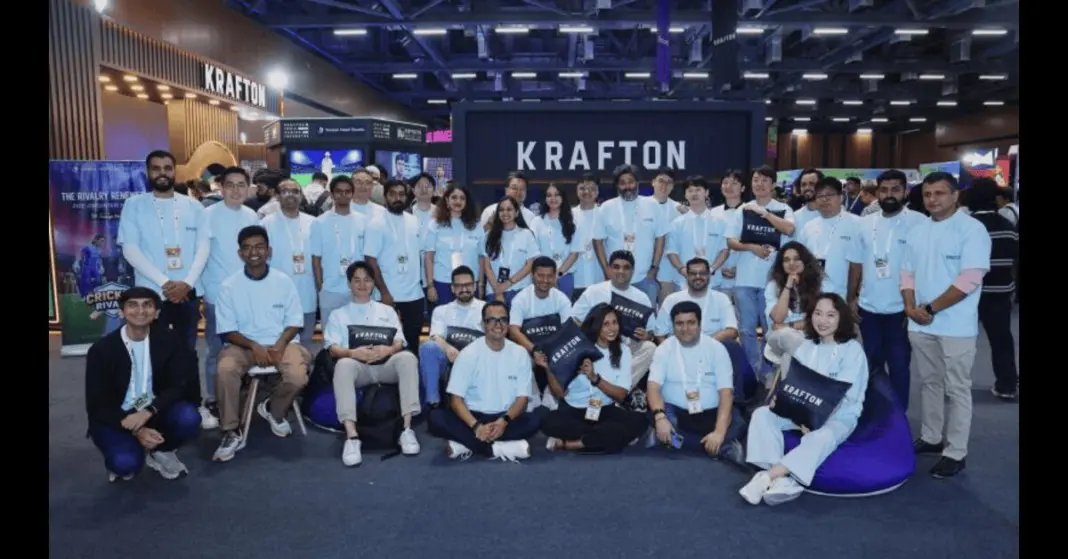
KRAFTON wants its next global franchise to come out of India, and it is prepared to buy its way there if needed. In an interview with Bloomberg published on November 3, KRAFTON India CEO Sean Hyunil Sohn said the company plans to develop new games beyond PUBG from its Bengaluru team. He also said KRAFTON is considering the acquisition of another Indian studio, which would add to a run of investments that has already made India one of the publisher’s five largest markets by revenue.
Sohn described India’s growing profile in gaming as a major advantage for the company, and the most concrete part of the plan is about people rather than money. According to the interview, KRAFTON’s development team in Bengaluru could grow to as many as 50 people over the next two years. That signals a clear shift in what the South Korean publisher expects its Indian operation to produce.
Bengaluru gets a bigger role in KRAFTON’s game development
For years, much of the work that global publishers sent to India centred on testing, localisation and art support. KRAFTON now wants its Bengaluru team, based in the country’s biggest technology hub, to build games of its own instead. Artificial intelligence is expected to play a large part in that work, since the company has publicly committed to becoming an “AI first” developer. It has already shown off PUBG Ally, a co-playable AI teammate built with NVIDIA’s ACE technology, which we covered when KRAFTON’s PUBG AI tests put Claude’s cost at $7.10 per match.
The ambition behind that shift is to find a hit that does not depend on PUBG. Battlegrounds Mobile India (BGMI) has passed 260 million downloads and remains KRAFTON’s biggest product in the country. Even so, it is a single franchise in a market where rivals are pushing harder, as our report on how Garena is finally challenging KRAFTON in India’s mobile esports race showed.
That reliance has carried real risk before. BGMI was blocked in India in July 2022 and only returned in May 2023, initially under a three-month trial approval. KRAFTON spent much of that period rebuilding trust with regulators and players before the game recovered its place at the top of Indian mobile esports. The episode goes some way to explaining why the company now wants more than one pillar in the country.
The Real Cricket deal set the template for a studio buyout
Sohn did not name a target, a price or a timeline for the acquisition, although KRAFTON has done this once before. In March 2025, it paid $14 million in cash for a controlling stake of more than 75% in Pune-based Nautilus Mobile, the studio behind the Real Cricket franchise. The series runs to five titles, including Real Cricket 24 and Real Cricket Premier League, and the deal gave KRAFTON a homegrown sports title with a large local following alongside BGMI.
A second deal would give KRAFTON another studio with a proven track record in India. Combined with a larger Bengaluru team, it would also give the publisher two routes to a new game running side by side rather than one.
KRAFTON’s India commitments pass $500 million
The interview also builds on a large financial pledge made two months ago. In September, KRAFTON chairman Chang Byung-gyu met Prime Minister Narendra Modi in New Delhi and committed an additional $250 million over the next three to four years. The money is aimed at the local gaming ecosystem and homegrown IP, as well as AI, robotics and deep tech. The new pledge sits on top of the more than $250 million KRAFTON says it has already invested in India since 2021.
The earlier investment has gone into roughly 18 Indian companies, including Nodwin Gaming, Loco, Pratilipi, Kuku FM and One Impression. Separately, KRAFTON unveiled a $670 million India-focused growth fund with Naver and Mirae Asset in December 2025, and said it would contribute about $137 million at first close. It has also launched KIGI Academy, an industry-academia programme for game development and digital content skills.
KRAFTON has not yet said which studio it is studying or when a deal might be announced. BGMI still carries the business in India, and that single-game dependence is exactly what a Bengaluru-built hit would start to reduce.