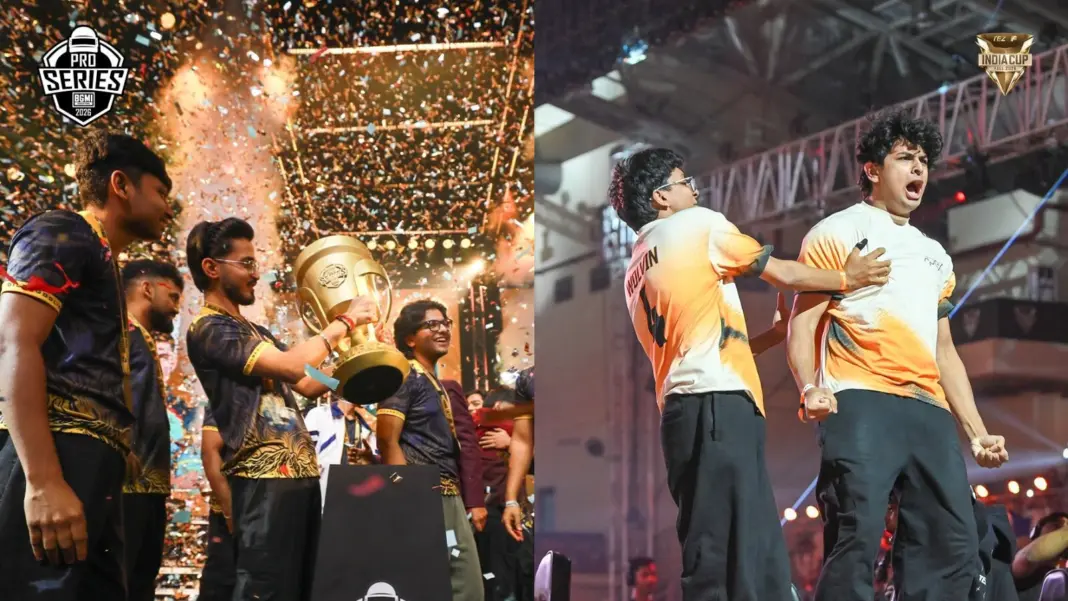
For the last few years, KRAFTON India has been the clear leader in Indian mobile esports. BGMI has everything a major esports needs: multi-crore tournaments, big LAN events, international slots, popular teams and massive viewership. BMPS 2026 alone reached around 729,000 peak concurrent viewers and attracted more than 12,000 fans across its Jaipur Grand Finals.
For a long time, there was no real competition at that scale. Several mobile titles entered India, but none managed to seriously challenge BGMI’s position. Now, however, an old rival is starting to make noise again. After staying mostly quiet in Indian esports following the 2022 Free Fire ban, Garena returned with Free Fire MAX esports in 2025, and its approach has been very different from KRAFTON’s.
The result? After FFMIC 2026 Fall, the Indian mobile esports market suddenly does not look as one-sided as it did before.
Garena Returned to Indian Esports in 2025
Free Fire esports had effectively disappeared from India’s official major tournament circuit following the original game’s ban in 2022.
That changed in 2025.
Garena announced Free Fire MAX India Cup (FFMIC) 2025, marking the return of its official Indian esports circuit after roughly three years. The tournament came with a ₹1 crore overall prize pool and ended with a LAN event at Lucknow’s Ekana International Indoor Stadium.
That tournament now looks less like a one-off comeback and more like the start of a long-term rebuild.
FFMIC returned again in 2026 with its Spring edition. Its Grand Finals were held at the Mahatma Mandir Convention and Exhibition Centre in Ahmedabad, while the Battle Royale competition carried a ₹1 crore prize pool.
Then came FFMIC 2026 Fall.
In a little over a year, Garena has gone from returning to Indian esports after a long absence to building a regular domestic circuit.
KRAFTON and Garena Are Taking Different Approaches
This is where the comparison becomes interesting.
KRAFTON’s BGMI ecosystem is built around massive flagship competitions. Events such as BGIS, BMPS and BMSD run for weeks and offer large prize pools, while the biggest stages end with major LAN events.
The scale remains difficult to match.
BMPS 2026 recorded around 729,000 peak viewers and more than 12.7 million Hours Watched. The Jaipur finals also reportedly attracted more than 12,000 attendees across three days.
Garena is not matching BGMI tournament-for-tournament on prize money or domestic viewership yet.
Instead, it appears to be focusing heavily on frequency and cross-regional competition.
Since its return in 2025, Indian Free Fire players have received multiple FFMIC seasons alongside the Free Fire MAX Asia Invitational series.
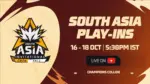
FFMAI debuted in its current cycle in late 2025. Garena then organised FFMAI 2026 Spring in May and FFMAI 2026 Summer in June, both carrying $50,000 prize pools. FFMAI 2026 Fall is scheduled for October 16-25.
Instead of waiting months for another major event, Free Fire teams have repeatedly been given another tournament to prepare for.
Garena Is Giving Indian Teams More International Competition
This could be the most important part of Garena’s strategy.
FFMAI brings Indian and other South Asian teams against opponents from established Asian Free Fire regions. The Spring edition, for example, featured teams from India, Bangladesh, Pakistan and Nepal through its South Asia system, while the Main Event also included representation from Thailand, Indonesia and Malaysia.
The upcoming Fall edition continues that model.
For Indian teams, this means international competition does not have to be limited to one major global tournament every year.
The pathway became even stronger in 2026.
Team Apex Gaming, S8UL Esports and Total Gaming Esports represented India at the Free Fire World Cup 2026 in Paris, which featured 24 teams and a $1 million prize pool. Apex and S8UL eventually reached the Grand Finals.
And India already has another global tournament ahead.
After FFMIC 2026 Fall, Team Apex Gaming, Resurrection Esports and TSG Pros qualified for the FFWS 2026 Global Finals.
For an upcoming Free Fire player, the road is becoming much clearer: perform domestically, reach FFMIC, play regional competition and potentially represent India internationally.
That is how an esports ecosystem starts becoming sustainable.
Free Fire MAX Viewership Is Starting to Grow
The biggest reason KRAFTON has remained far ahead is simple: BGMI has a much larger Indian esports audience.
That has not suddenly changed.
But Free Fire MAX is beginning to show signs of meaningful growth.
Earlier Free Fire MAX tournaments in the current rebuilding phase were nowhere near BGMI’s biggest viewership numbers. FFMIC 2026 Spring, for example, recorded around 128,500 peak viewers, according to Esports Charts.
FFMIC 2026 Fall then produced a much bigger response, particularly around its Grand Finals.
That growth matters more than simply asking whether Free Fire has already beaten BGMI. It hasn’t.
The important question is whether Garena can maintain the upward curve across FFWS, FFMAI Fall and its 2027 domestic circuit.
One big tournament can be hype. Repeating those numbers starts becoming an ecosystem.
More Tournaments Give Organisations a Reason to Invest
There is another part of this competition that matters beyond viewers.
Esports organisations need reasons to keep teams.
If a game only has one or two meaningful tournaments each year, maintaining salaries, devices, bootcamps and staff becomes difficult. A regular calendar gives organisations more exposure and players more opportunities to earn.
That is already visible in Free Fire MAX.
Major Indian organisations like Team Apex Gaming, S8UL, Godlike Esports, and Nebula Esports have entered or returned to the scene, while established Free Fire brands remain active. International qualification gives them another reason to invest.
And once organisations invest, the cycle can grow further. Better salaries can attract players. Better teams create better competition. Competition creates rivalries and stories. Those stories bring viewers back.
BGMI Is Still India’s Mobile Esports Benchmark
None of this means Free Fire MAX has overtaken BGMI.
It has not.
BGMI currently operates at a different scale in India. BMPS 2026’s nearly 730,000 peak viewers, 12.7 million Hours Watched and huge LAN attendance show just how strong the game’s competitive audience remains.
KRAFTON also continues to offer Indian teams routes towards international PUBG Mobile competition.
So calling Free Fire MAX a “BGMI killer” would miss the real story.
Garena does not need to kill BGMI to succeed.
What matters is that KRAFTON may finally have serious competition for the attention of India’s mobile esports audience.
Competition Between Garena and KRAFTON Could Be Good for India
India has always been a mobile-first gaming market, and having only one dominant mobile esport was never the ideal situation for the industry.
Now there are two publishers with very different approaches.
KRAFTON has huge domestic tournaments, major prize pools, packed LANs and enormous viewership.
Garena is building an aggressive calendar with repeated domestic tournaments, Asian invitationals and global qualification opportunities.
That competition can benefit everyone.
Publishers have more reason to improve tournaments. Organisations have more games to invest in. Players have more professional opportunities. Creators get more stories to cover. Fans get more events to watch.
The real test for Garena starts now.
Can it maintain the audience after FFMIC Fall? Will Indian viewers follow Apex Gaming, Resurrection and TSG Pros at FFWS? Can its next domestic tournament retain the momentum? Will more organisations enter the scene? And most importantly, will Garena continue this aggressive approach in 2027?
If the answer to those questions is yes, Indian mobile esports could finally have the competition it has been missing.
BGMI remains on top. But for the first time in years, the race behind it is starting to look serious.