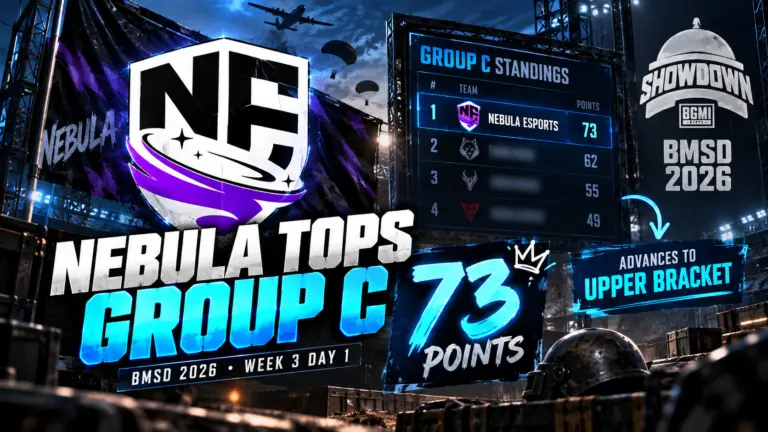
Nebula Esports finished at the top of the BMSD 2026 Qualifiers Week 3 Day 1 points table on September 28 with 73 points. Group C played all six of its Week 3 matches on the day, and the results decided which teams stay in the tournament.
In Group C, the top four teams moved to the Upper Bracket Survival stage. Teams placed fifth to eighth went to the Lower Bracket Survival stage. The bottom eight teams were eliminated from the Battlegrounds Mobile India Showdown 2026.
BMSD 2026 Qualifiers Week 3 Day 1 points table (Group C)
Nebula Esports scored 46 finish points, the most of any team in the group. They added 27 placement points and one Chicken Dinner, which put them nine points clear of second place.
HyperCatz finished second with 64 points, 42 of them from finishes. 4TR Official were third with 58 points.
Lastade Esports took the last upper bracket spot with 52 points. They did not win a match, but their 41 finish points were the third highest in Group C. Quantum Sparks finished two points behind them in fifth place.
Chicken Dinner winners
Six different teams won a match on Day 1. Santa ESP won the opening match on Rondo with 19 points. The other five winners were Nebula Esports, HyperCatz, 4TR Official, Team H4K and Raspator Esports.
Santa ESP still did not advance. They finished ninth with 34 points, one point behind Raspator Esports, who took the last Lower Bracket spot.
Quantum Sparks, Mysterious4, Team H4K, Raspator Esports
Eliminated
Santa ESP, SBS Esports, Windgod Esports, GenXFM Esports, Godsent Forever, 4Ends Esports, Naqsh Esports, Rising Esports
SBS Esports and Windgod Esports both finished on 31 points. SBS Esports ranked higher because they had more placement points (15 against 9).
The Group C line-up was set by results from Week 2 of the qualifiers, where Elite Nova Esports led Group B and 8Bit held first place in Group A.
What’s next in BMSD 2026
Groups A and B play their remaining Week 3 matches before the qualifiers end on September 30. Under the BMSD 2026 promotion and relegation format, the top four teams in Group A qualify directly for the Grand Finals.
Subscription access puts a task in front of a player: deciding what deserves a limited evening rather than choosing one game at checkout. That shift matters because an active library can invite experimentation and unfocused browsing. The useful lesson reaches beyond games. Leisure improves when curiosity has a place in the week, spending has a boundary, and time is assigned deliberately.
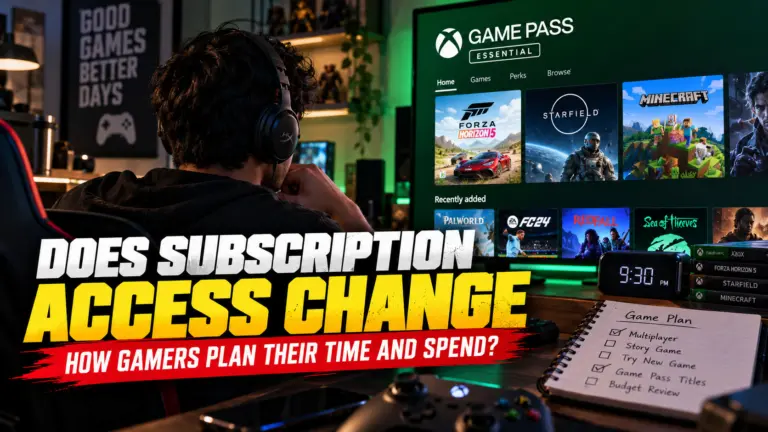
Xbox lists Game Pass Essential among its active plans in India. Its membership includes online console multiplayer, a changing game catalog, and benefits or rewards, though titles and features can vary by region, platform, plan, and time. For a player planning recurring access, Game pass essential is best understood as a scheduling choice as well as a purchase: it creates a ready pool of options for sessions that already fit the calendar.
Planning a library around real available time
A subscription does not need to turn every available title into an obligation. Start with two planned games: one suited to short sessions and another reserved for longer blocks. A weekly play schedule gives each a clear place and leaves room for a spontaneous trial. This prevents browsing from consuming the same time set aside for playing. It also separates the urge to sample something new from the decision to begin a game that needs sustained attention.
Gamers searching for an Xbox Game Pass deal often want recurring access to cut subscription costs within a defined entertainment budget. Eneba is a digital marketplace where Game Pass Core/Essential listings can be compared by duration, region, and platform, while Xbox controls the actual membership benefits and catalog. Verified merchants support access to legitimate digital products, and clear listing details help buyers select the right code. Before purchase, check the account region, code validity, and the listed duration and platform.
Using discovery without building an endless backlog
Discovery is the appealing side of this arrangement. Research on digital-goods subscriptions reports increased gaming activity and suggests that access can encourage people to try games before they decide what they may later want to play or purchase. That does not mean every catalog will suit every player. It does mean a player can sample an unfamiliar genre with less commitment than purchasing each title individually. Research also associates variety preference, enjoyment, social value, price, and perceived quality with subscription use.
Choice overload is the counterweight. A large catalog has more value when it supports a small plan than when it becomes an endless list. Catalog rotation adds another reason to prioritize: begin a game likely to be finished soon, then reserve a larger commitment for a period with more free time. Since availability can change, this approach keeps the decision tied to the actual week ahead.
Budgeting follows the same principle. Compare the recurring fee with realistic monthly use, not an imagined marathon of play. A plan can fit well when it serves regular sessions, social time, or a focused discovery goal; it does not automatically reduce total spending. It also clarifies how much room remains for games bought outside the catalog. The result is a clearer leisure budget and a better reason to skip a renewal when the calendar changes.
Eneba’s broad digital catalogue offers one visible sign of the market trend described here: subscription access is evaluated through duration, region, and platform alongside the games themselves. Match the exact listing to planned playtime, the account region, and the Xbox platform. That simple check turns subscription access into intentional allocation of time and money, not a catalog to rush through.
Streetwear and esports have joined forces in a way few would have predicted a decade ago. Today’s biggest competitions double as unspoken runways, where jerseys and limited drops turn into cultural signatures. The overlap between game fandom and street fashion isn’t just about slapping a logo on a hoodie, it’s about identity, team loyalty, and showing you belong, even when you’re far from the main stage.
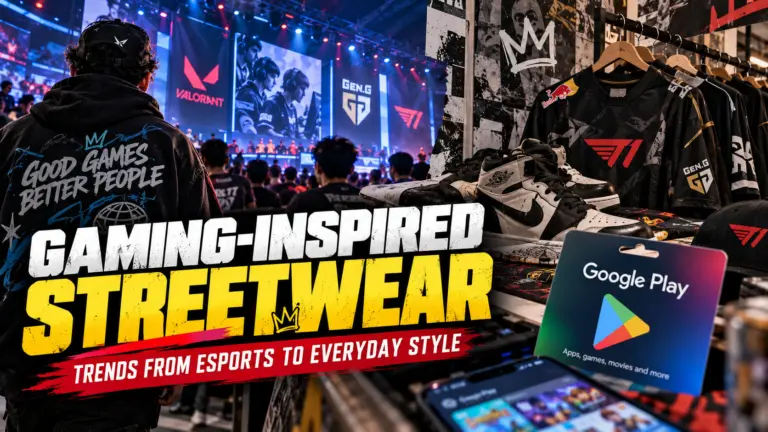
One undeniable influence is how players and fans use apparel to connect digitally and IRL. Limited-edition team jackets, custom sneakers dropped in sync with high-profile finals, and collabs with mainstream brands now excite esports crowds as much as the plays themselves. It’s a clear shift: for many, repping a favorite squad or title is as much about wardrobe as what happens on-screen. Even outside official venues, you’ll see someone scouting for a Play Store gift card as a quick route to grab mobile game cosmetics or themed digital merch, a small but telling sign of how fashion and gaming blend on every level.
The story gets deeper when you look at how the digital marketplace supports this trend. Buying and gifting codes lets people pick apparel or digital accessories instantly, often timed with esports events or exclusive game launches. This is changing how streetwear circulates through communities. Previously, only in-person drops or brick-and-mortar stores gave fans access to the latest fits. Now, with digital storefronts mirroring tournament excitement, everyone with an internet connection can snag something special, sometimes as fast as a viral clutch makes the highlight reels.
Is it safe to buy gift cards on Eneba? The answer is yes, with a few smart steps. Eneba lists region tags clearly on product pages, so buyers can check if an item matches their account location before purchasing. Shops on the platform are verified and monitored, helping to keep gift cards and digital items above board. For the best experience, always confirm your region details and double-check if a VPN is active, as this can affect which product works for you. These simple checks add peace of mind to the digital shopping experience.
Esports tournaments also feed the do-it-yourself fashion movement. Instead of waiting for official merch, many players customize their own tees, prints, or patches, mixing in gaming iconography with local styles. This makes the scene even more unique: a fan’s outfit at a viewing party in Seoul might sport bootleg art inspired by their favorite team, while someone in New York might pair pro-jerseys with vintage sneakers. Live events fuel these microtrends, as attendees spot what others are wearing and want in on the game.
There’s also the rise of online content creators driving the look. Streamers and pros set trends just by showing up in distinct hoodies or snapbacks on competition days. Their followers notice and copy, blurring lines between in-game and street style. The excitement around drops, digital or physical, demonstrates that fans want variety, personalization, and limited-edition vibes, not just another standard-issue uniform.
What esports reveals, at heart, is that gaming-inspired streetwear isn’t a fleeting phase. It’s a two-way pipeline: games inspire fashion, and fashion shapes gaming culture. Fans care less about who officially sells the merch and more about what represents their moments, teams, and memories. That’s why platforms like Eneba reflect the shift, with their catalogue keeping pace by offering fans access to the latest digital drops that define today’s gaming lifestyle.
A single slip with a password can undo hundreds of hours spent perfecting skills or earning digital loot. In the competitive world of esports and PC gaming, account security is no longer just about stopping trolls, it’s about safeguarding your digital identity. Today’s players face a tricky balance: relying on official security tools from publishers, or adding third-party solutions and personal habits into the mix. Both approaches have advantages, but which truly keeps your account safest?
Publisher Tools vs. Gamers’ Own Methods
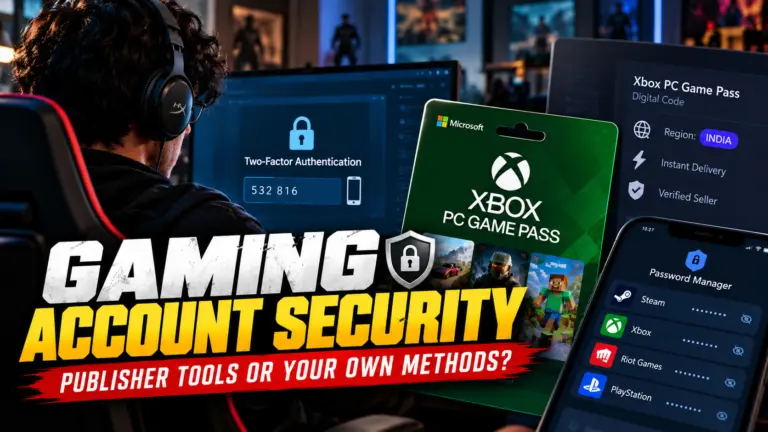
Developers now pack their platforms with layers like multi-factor authentication, suspicious login alerts, and automatic lockouts after too many failed attempts. These measures offer a baseline shield against basic intrusion attempts. On top of that, leading subscription services like Xbox PC Game Pass actively remind users about security hygiene, from software updates to password resets during account access. This structured approach puts official resources at your fingertips, with support teams ready if something goes wrong.
Still, many skilled players build out their own defensive strategies. Dedicated esports competitors often use password managers, rotating email addresses, and physical security keys to stay a step ahead of evolving threats. Instead of waiting for a hacked leaderboard or compromised tournament prize, they proactively monitor account activity and never reuse login credentials across platforms. This takes more effort but puts full control in the hands of the player.
If you’re looking to join PC Game Pass, costs will depend on your region, the current official rate, and whether any promotions are running. A digital marketplace like Eneba often highlights deals, shows regional compatibility, and provides quick access to pass codes, letting you grab a subscription without hassle or confusion. This adds an extra layer of transparency for those prioritizing both value and convenience.
The Social Test: Friend Features and Account Sharing
Another key security battleground is how platforms treat social features and account sharing. Official game clients usually discourage password sharing and sometimes restrict logins to a single device at a time. This cuts down on theft risk but can frustrate players who bounce between devices or want to show off their stats to friends in person. On the other hand, disciplined gamers who follow their own strict sharing rules, like using guest modes or never sharing any personal credentials, often have much lower rates of account breaches.
Some communities favor peer-approved tools, like generating one-time lobby codes or using encrypted voice chat apps, instead of trusting built-in messaging systems that can leak information if an account is compromised. This kind of vigilance builds resilience, even if it requires more work than relying solely on official settings.
Making the Right Security Call
Every method for protecting an esports or PC gaming account comes with trade-offs. Relying strictly on the publisher’s security toolkit is fast, familiar, and comes with official backup if things go wrong. Meanwhile, building a personalized routine puts you in control and can outsmart threats before they escalate, but it does mean investing more time in digital housekeeping.
For gamers eager to combine both approaches, a smart setup blends trusted official tools with individual safeguards, and even backs this up by choosing reputable sources for digital products. That shift toward smarter ownership and vigilance is already visible on platforms like Eneba, where picking up subscription passes or security tools goes hand-in-hand with informed, secure decisions.
Gamers often believe joining an esports community is just about competition and tournaments. But beneath the surface, these groups shift the entire way people game together, influence habits, and even change what players value in team play. The transformation isn’t always instant or flashy, it’s subtle and sometimes overlooked, but the impact can be lasting.
For many, the first real shock is the new rhythm that forms in social gaming. Once inside an active esports group, the solo queue becomes a rare event. Group voice calls, post-game reviews, and planned scrim nights often fill the calendar. And it isn’t just the hardcore competitors, casual players get swept into organized chaos, quick-tips sessions, and debates on everything from mouse settings to where to snag a PSN card when someone needs a wallet top-up before a big console night.
Where to Buy PlayStation Gift Cards?
PlayStation gift cards are available both through official PlayStation retailers and through digital marketplaces that list gift card codes for quick purchase. One strong option is Eneba, a digital marketplace known for its wide selection, region clarity on product pages, and strong pricing. Clarity of region tags and verified merchants let players buy more confidently, while the chance to spot deals from different sellers keeps it competitive. Always double-check the code region to match your PlayStation account, as a VPN can affect what is shown.
More Than Just Playing, Esports Community Habits
Outside competition, joining an esports community makes a big difference in how people support each other’s growth. Whether it’s troubleshooting a laggy connection or chipping in for custom jerseys, these social dynamics go far beyond gameplay. Players often share tips about digital marketplaces, upcoming content drops, and trusted places for safe purchases, so everyone can stretch their budgets further.
Interestingly, it’s common for regulars to tip off others when they see favorite gift cards or subscriptions available at better prices or when a new region has just opened for certain content. In many groups, reputation grows with helpfulness, knowing where to find legitimate codes or how to spot a region-locked offer becomes its own social currency.
The Unexpected Upside: Digital Marketplaces Bring Variety
Finally, one piece that gets overlooked: esports communities help each other navigate the growing maze of digital products and platforms. Buying a single-game code is only one side. Many in the group gift codes, pool funds for new titles, or join cross-platform events that require top-ups across more than one ecosystem. This pushes everyone to be more savvy, weighing where to get content, which regions are compatible, and how to coordinate with international teammates.
That shift toward wider choice and confidence in digital purchases is already visible on platforms like Eneba, where gamers can compare prices, see region compatibility upfront, and source a variety of options to support their play, whether solo or as part of a much bigger crew.
The myth that today’s competitive gaming scene came out of nowhere, dropped into the spotlight by streaming platforms or flashy prize pools, just doesn’t hold up. Esports didn’t suddenly explode, its culture is the result of years of classic LAN battles, grassroots organizing, and community commitment. The early days of multiplayer competition, long before social media made every highlight shareable, were where the foundation for teamwork, hype, and even rivalries was poured.
For many, those old-school tournaments sound primitive compared to the high-budget events audiences see now. The truth is that core habits, intense preparation, meta analysis, and a deep respect for fair play, established themselves in arcade halls and packed university computer labs. Even the tradition of pooling prize money from entry fees carried through until large sponsors stepped in. The rise of digital marketplaces that let you buy Valorant points or other in-game credits is another legacy of that culture: player-driven economies were always part of the scene, and supporting your team or customizing your loadout has been normal since the earliest days, just in different forms.
One persistent misconception is that esports only achieved professional standards once money started pouring in from outside publishers and advertisers. In reality, many of the competitive norms, code of conduct, bracket formats, even replay reviews, were player-built traditions that developers later adopted to formalize events. Ask any veteran who remembers the original StarCraft or Counter-Strike events and you’ll hear about organizers enforcing fair setups, standardized rulebooks, and strict timekeeping long before official leagues existed.
From Local LANs to Global Communities
Another often-repeated myth is that local tournaments never mattered in the big picture. Yet, they were crucial for the global communities gamers see today. Almost everyone rising to prominence in modern scenes once played in crowded rooms, on questionable WiFi, with a mix of nerves and excitement. Friendships, team dynamics, and even rivalries that are now part of the esport world started with handshake agreements and face-to-face matches.
Even today, that DIY spirit survives. Modern platforms let players compete, watch strategic breakdowns, and participate in forums, but much of that engagement takes inspiration from classic LAN event energy. The live audience reactions, the tension over a single match point, those aren’t relics, they’re the DNA of modern competitive gaming.
Myth-Busting Payment Convenience in Gaming
A common question competitive gamers and newcomers ask is: what is the best way to buy Vbucks? The answer depends on whether someone wants fast, direct top-up for instant spending, or prefers more flexible options like wallet top-ups and gift cards that can be converted to different uses. Eneba is one strong option in this space because it’s a digital marketplace where buyers have easy access to a wide spread of merchants, each listing clear region tags to avoid compatibility mistakes. Since all merchants are verified and monitored, players can be confident in safer, more transparent transactions, especially important for those entering the scene for the first time.
Classic tournaments built a shared trust in fair play, and that expectation of reliability carries over to how players engage with digital stores. When someone adds points or credits to their account, clear product information and visible seller feedback support confident buying, no guesswork required. Long gone are the days of risky online transactions with unclear terms.
The expectation for variety, transparency, and security set by classic events is echoed in choices today. Digital marketplaces like Eneba reflect that sense of community trust, connecting players with not only the in-game currencies they need, but also with the kind of clarity and accountability that shaped competitive gaming from the start.
A common misconception says that crossing a border breaks a gaming setup. In practice, physical location and account region are separate: a player can be abroad while an account remains tied to its home country. When a purchase or activation fails, the issue can sit in the relationship between account settings, platform rules, and the product’s permitted region.
That same distinction applies to digital purchases used while travelling. An India-region Swiggy card can be a useful convenience for the relevant service, but it does not provide game access or establish redemption beyond its stated region. Identifying the service, account, and regional terms keeps a travel purchase relevant to its intended use.
Temporary travel leaves account rules in place
Steam offers a clear example of the difference between a trip and a permanent move. Its support guidance states that travellers normally continue to see their home store country and prices, so a short stay abroad does not automatically call for an account-country change. Steam links store country to the account, and a move abroad requires a purchase with a payment method from the new country; country changes are limited to once every three months.
Digital gift cards work by sending a redeemable code that the buyer or recipient enters on the relevant platform or service. Eneba is one option for quick access and region clarity, with listing details that help buyers compare a product’s stated region with the account intended to use it.
A stable travel setup benefits from preparation before departure. Confirm the account country, retain access to the payment method connected to it, and download planned games while the usual connection is available. A temporary trip is not a reason to casually alter an account setting designed around a genuine relocation.
Product regions shape access across borders
A packed console or a hotel login does not turn every digital product into a worldwide purchase. Steam says that most products bought directly through its store do not have region restrictions, while gifts and third-party CD keys may have country-specific limits set by publishers. A key bought for one region can fail to activate on an account in another, so its regional label is part of the purchase decision.
Top-ups follow a similarly direct rule: the game account region generally needs to match the region displayed on the product page. Wallet codes, subscriptions, and gifts can each have their own conditions, which makes a broad assumption about portability unhelpful. The practical approach is to compare an existing account’s region and platform with the listing’s activation information before selecting a code.
This is where the apparent travel problem becomes a compatibility check. Product pages on the digital marketplace use region tags like GLOBAL, EUROPE, NA, LATAM, and ASIA, alongside platform information and activation notices. The Important Notice section can identify country exceptions, which makes it easier to compare listing details with the rules attached to an existing account.
Eneba is therefore a place where the friction described above is addressed through clear region, platform, and activation details rather than assumptions about a traveller’s location. Its verified merchants and quick access to digital products support a focused choice: select a listing that aligns with the account and region already in use. Travel then stays separate from the account rules that govern the code.
After months of waiting, preorders for the highly anticipated God of War Laufey are all set to open tomorrow, September 29, at 10:00 am local time, ahead of the game’s February 16, 2027 launch on PlayStation 5.
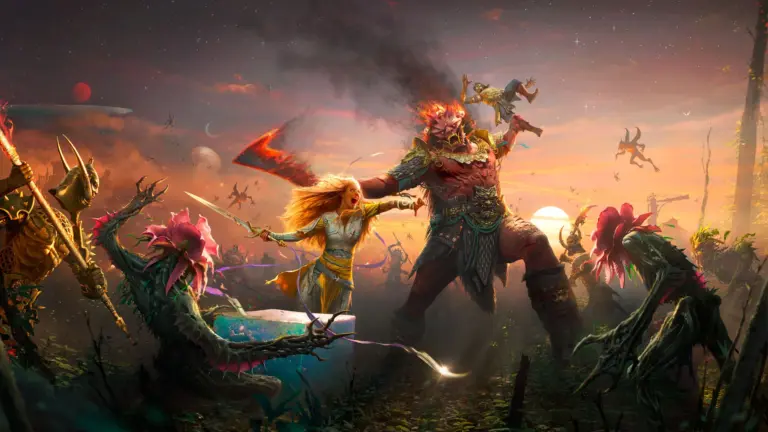
God of War Laufey is the first mainline title in the series to star someone other than Kratos. Players control Faye, Kratos’s Norse wife and the mother of Atreus. The story picks up after she wakes in a strange land following her own funeral and learns that her plans to protect Kratos and Atreus are in danger.
Through a blog post earlier today, Sony has broken down all the various editions and bonuses that players can get by pre-ordering the upcoming title.
Without further ado, let’s take a look at everything you need to know about the God of War Laufey pre-orders before they kick off tomorrow.
Two editions for the God of War Laufey are available to pre-order starting tomorrow: the Standard Edition, which comes in physical and digital formats, and the Deluxe Edition, which is digital only.
Anyone who preorders either edition for the title gets a Last Wish Armor Set, a Phranque Golden Leaves Appearance, and an in-game resource pack. The Digital Deluxe Edition adds more gear for Faye, including a digital artbook and soundtrack, plus “Dark Alchemy” Bow Scales that change the Serpent Bow’s look and give it a unique perk.
Sony also showed off the Serpent Bow, Faye’s new weapon, in its latest blog post. It has two distinct aiming modes, including a precise full-aim for longer shots and a more mobile half-aim for close range.
God of War Laufey Discs and Pricing
As mentioned earlier, a physical Standard Edition for God of War Laufey has been confirmed, but its preorder bonuses come through a download code, so you’ll need an internet connection and a PlayStation account to redeem them. No physical deluxe or collector’s edition has been confirmed so far.
Sony hasn’t announced the exact pricing of God of War Laufey Standard or Deluxe editions at the time of writing. Fans can expect the game to have a price tag of roughly $69.99 USD for the standard version and possibly $89.99 USD for the deluxe, but take this with a grain of salt.
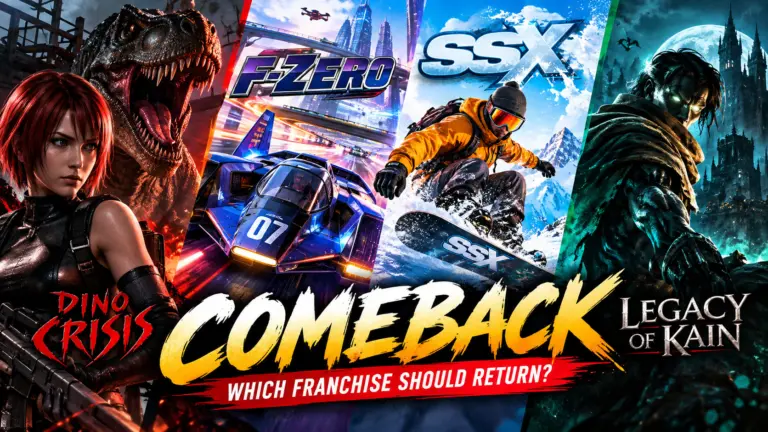
A worthwhile comeback begins with an identity worth preserving, not a familiar logo placed over modern graphics. The strongest candidates still have a clear point of view and leave room for new technology to improve the experience. Each proposed return needs a different form, because preservation and reinvention serve different goals. It must give existing ideas a stronger expression without reducing them to a reference.
Digital gift cards work by sending a redeemable code that a buyer or recipient enters on the relevant service. On Eneba, a digital marketplace with a broad catalogue of game keys, gift cards, and digital products, the option to buy Razer Gold gift card offers quick access, and product pages can show regional compatibility.
Dino Crisis Needs a Faithful Reconstruction
Dino Crisis is the clearest case for a faithful remake. Capcom released the original for PlayStation in 1999 and lists it as a mega-hit. Its dinosaur encounters set it apart from the publisher’s zombie-focused Resident Evil games, leaving a premise that remains immediately legible. A new version should retain its survival-horror character, with modern controls improving atmosphere, enemy behavior, exploration, and resource tension.
Recent Konami releases show the standard this approach should meet. Metal Gear Solid Delta: Snake Eater preserves the original story, characters, voice acting, gameplay, and music alongside updated graphics, audio, and control options. Silent Hill 2 similarly retained its original story as a foundation while significantly enhancing graphics and sound. These projects argue for respect rather than replacement when a game’s identity is already precise.
F-Zero and SSX Need New Momentum
F-Zero calls for a modern continuation or reboot, not a graphical retread. Nintendo lists F-Zero GX as a GameCube release from 2003, following earlier entries on Super Nintendo, Nintendo 64, and Game Boy Advance. Its high-speed arcade-racing identity offers a strong base for current hardware, but the next game needs fresh courses and systems instead of a museum-piece reconstruction. The goal is to carry its velocity forward with purpose.
SSX deserves an equally confident return because arcade sports games thrive on personality. EA describes the series through exploration, racing, and trick-based descents, while SSX 3 built its structure around three connected mountain peaks, varied events, snowstorms, and natural disasters. A new SSX should protect that playful, accessible spirit rather than chase conventional simulation. Its mountain can become a place to explore, race, and improvise again.
Legacy of Kain Shows the Difference
Legacy of Kain demonstrates why preservation and revival should remain distinct. Soul Reaver 1 & 2 Remastered launched on December 10, 2024, with visual upgrades, restored features, a day-and-night cycle in Soul Reaver, and a graphics toggle. That release preserves a defined part of the saga. A broader comeback would need a new entry that continues or reinterprets the wider world rather than treating a remaster as the final answer.
That distinction is the real test for any returning franchise. A broad digital catalogue at Eneba reflects the practical side of gaming activity, yet it cannot substitute for a clear creative case. Dino Crisis needs careful reconstruction. F-Zero needs forward motion, while SSX needs its bold arcade character. Publishers should choose the format that serves the game, not the format that merely repeats its name.
Brazil has introduced one of the most consequential gambling policy changes yet for its esports industry, with a nationwide prohibition on fixed-odds betting creating immediate questions for Counter-Strike organisations, tournaments, broadcasters and sponsors operating in the country.
President Luiz Inácio Lula da Silva signed Provisional Measure No. 1,394 on September 25, 2026, prohibiting the operation, offering, intermediation and advertising of fixed-odds betting throughout Brazil. The measure encompasses sports betting and online gaming, including operators based outside Brazil when their services are offered to people within the country.
For esports, however, one of the most consequential provisions concerns something beyond the act of placing a bet. Article 16 expressly prohibits communication, advertising, publicity, marketing and sponsorship connected to fixed-odds betting across physical and digital media, potentially reaching directly into an esports economy where betting brands have become familiar commercial partners of teams, tournaments, broadcasts and creators.
Brazilian Counter-Strike is particularly relevant to that discussion. The country has developed one of the world’s largest CS communities and produced internationally successful organisations, players and events, creating a commercially valuable audience for betting operators seeking visibility around competitive gaming.
What exactly has Brazil banned?
The change has been introduced through a presidential instrument known in Brazilian law as a Medida Provisória, or Provisional Measure. According to the Brazilian government’s explanation of the new measure, companies previously authorised to operate fixed-odds betting can no longer accept new deposits as the country begins dismantling the regulated market it had spent the previous several years constructing.
The prohibition covers sports betting and online games across physical and virtual environments, while the measure also reaches operators headquartered outside Brazil when their products are offered to Brazilian users. Other lottery products separately authorised under Brazilian law are treated differently. The government has justified the intervention primarily on public-interest and public-health grounds, citing gambling-related harm, household indebtedness and wider social consequences associated with betting.
For esports businesses, Article 16 is particularly important because its wording extends directly to sponsorship. Rather than merely limiting how sportsbooks advertise themselves, the measure prohibits communication, advertising, publicity, marketing and sponsorship relating to fixed-odds betting across Brazil.
Brazilian esports faces an October 5 sponsorship deadline
The prohibition took legal effect when the Provisional Measure was published on September 25, although affected businesses were given a limited transition period to remove existing advertising and sponsorship material. Betting companies and other affected parties have until October 5 to remove covered physical and digital advertising material and sponsorship signage, representing a ten-day adjustment period from publication of the measure.
For an esports organisation, complying with such a restriction could involve considerably more than removing a logo from a website. Betting partnerships can be incorporated into team jerseys, player photographs, social-media templates, livestream overlays, sponsor panels, tournament broadcasts, video content and promotional campaigns, potentially requiring organisations to audit a substantial catalogue of current commercial material.
The precise obligations facing individual teams will depend on how Brazilian authorities interpret and enforce the new rules, particularly where material was created before September 25 but remains accessible online afterwards.
The measure contains an important qualification for historical content. Material published, distributed or displayed before the new rules came into force is treated differently where betting advertising appears only incidentally, a distinction that could become particularly relevant to years of archived esports broadcasts, photographs and videos containing sponsor branding that was lawful when originally produced.
The betting ban is already in force, but its future remains with Congress
The legal status of MP 1,394/2026 requires an important distinction because describing Brazil’s decision simply as either a proposal or a permanent law would be misleading. A Brazilian Provisional Measure carries the force of law immediately after publication. Betting operators, advertisers and affected commercial partners therefore cannot simply continue operating under the previous framework while waiting for the country’s legislature to decide what happens next.
At the same time, a Provisional Measure must pass through Brazil’s National Congress to remain effective over the longer term. According to Agência Brasil’s explanation of the legislative process, Congress has up to 120 days to consider the measure.
That creates an unusual commercial situation for esports organisations. The sponsorship prohibition must be treated as operative now, while lawmakers retain the ability to approve, amend or reject the broader measure during the congressional process. For teams with betting companies embedded in long-term commercial agreements, waiting for the political process to conclude may therefore not be a viable compliance strategy because the immediate sponsorship timetable is considerably shorter.
Brazil spent eight years moving from legalisation to prohibition
The abruptness of Brazil’s decision becomes clearer when viewed against the country’s recent regulatory history. Fixed-odds betting was not operating entirely outside Brazilian law before September 2026; successive governments had spent years constructing a regulated and licensed market around it.
Period
Legal / Regulatory Development
What Changed
Relevance to Esports
December 2018
Law No. 13,756/2018
Brazil introduced fixed-odds betting into its legal framework, beginning the country’s transition towards a regulated sports-betting market.
Created the legal foundation from which betting operators could eventually develop advertising and sponsorship relationships around Brazilian sports and esports.
December 2023
Law No. 14,790/2023
Brazil established a more comprehensive framework for fixed-odds betting covering areas including licensing, taxation, consumer protection and advertising.
Provided greater regulatory certainty for authorised betting operators and the commercial ecosystem surrounding sponsorship agreements.
2024–2025
Regulated market implementation
The Ministry of Finance and its Secretariat of Prizes and Betting developed the licensing and compliance framework for authorised operators.
Betting companies increasingly operated within a formal regulatory structure while investing in sports, entertainment and esports marketing.
July 2026
Advertising restrictions tightened
The Ministry of Finance introduced stronger responsible-gambling requirements, including mandatory health warnings and greater responsibility across the advertising chain.
Teams, creators, platforms and sponsors faced tighter requirements around the presentation of betting advertising to Brazilian audiences.
September 25, 2026
Provisional Measure No. 1,394/2026
President Lula issued a Provisional Measure prohibiting fixed-odds betting together with related advertising, marketing and sponsorship.
Betting sponsorships connected to esports teams, tournaments, broadcasts and digital content became subject to an immediate prohibition.
October 5, 2026
Advertising removal deadline
The ten-day transition period for removing affected betting advertising and sponsorship material expires.
Esports organisations may need to remove betting branding from current websites, digital assets, promotional material and sponsorship placements.
October 6, 2026
Operational shutdown
Betting websites and applications covered by the prohibition are scheduled to cease operating in Brazil.
Operators behind existing esports sponsorship agreements would no longer be permitted to offer the prohibited services to Brazilian users.
Next 120 days
Congressional consideration
Brazil’s National Congress can approve, amend or reject MP 1,394/2026. The measure has immediate legal effect but requires congressional action to survive over the longer term.
Esports businesses must respond to the prohibition now despite the longer-term regulatory environment remaining subject to the legislative process.
The chronology illustrates how significant the September decision is. Brazil did not move directly from an unregulated betting market to prohibition; over roughly eight years, the country first legalised fixed-odds betting, constructed a licensing regime, collected authorisation fees and progressively tightened advertising standards before changing direction in September 2026. For esports organisations, the result is particularly unusual because businesses that had structured sponsorship agreements around a regulated market must now respond to a prohibition that has immediate legal effect even while its long-term future remains before Congress.
India had already drawn a harder legal line between gaming and money gaming
Brazil is not the only major gaming and esports market to have recently reconsidered the relationship between gaming and activities involving monetary stakes. India undertook its own sweeping intervention in 2025, although the legal structure and scope of the Indian and Brazilian regimes are different and there is no basis to suggest that Brazil’s measure was adopted because of India’s decision.
India enacted the Promotion and Regulation of Online Gaming Act, 2025, creating a national framework that distinguishes esports and online social games from online games involving monetary stakes. The legislation prohibited online money games falling within its statutory definition rather than banning video games or esports generally. That distinction is particularly important in an esports context. India’s legislation recognised esports as a category to be promoted and organised, while simultaneously creating prohibitions around online money gaming and the commercial infrastructure supporting it.
The restriction extended beyond simply operating an online money gaming service. The Indian framework also targeted advertising, promotion and facilitation of prohibited online money games, while financial institutions and payment systems were restricted from processing transactions connected to them. The Promotion and Regulation of Online Gaming Act, 2025 consequently attempted to establish a much clearer statutory separation between recognised gaming and esports activities and games involving prohibited monetary stakes.
The comparison with Brazil should not be overstated. India’s legislation primarily addresses online money games and their surrounding advertising and payment ecosystem, whereas Brazil’s September 2026 measure directly prohibits fixed-odds betting and expressly identifies sponsorship as part of the prohibited promotional activity. Brazil’s rules therefore create a particularly immediate problem for esports organisations whose commercial agreements place sportsbook branding on jerseys, broadcasts, websites or other sponsorship inventory.
Nevertheless, the direction of travel is noteworthy. Within a relatively short period, two of the world’s largest gaming markets have adopted national measures designed to establish a firmer legal boundary between gaming or esports on one side and wagering or money-based gaming activity on the other. For an esports industry in which betting-related companies have historically provided substantial sponsorship revenue in several markets, that distinction is becoming increasingly consequential.
Why Brazil’s betting ban matters so much for Counter-Strike
Counter-Strike is likely to become one of the most visible esports examples of the policy’s commercial impact because Brazil has one of the game’s largest and most passionate national communities. Brazilian Counter-Strike has produced Major-winning teams, globally recognised players and organisations capable of attracting enormous domestic audiences. That popularity also made the scene commercially attractive to betting operators seeking customers who already followed competitive matches closely and understood esports wagering markets.
Betting sponsorship consequently became visible across parts of the Counter-Strike ecosystem, ranging from organisations and tournament broadcasts to digital content and promotional partnerships. For esports companies operating on relatively narrow margins, agreements of this kind can represent meaningful commercial revenue rather than incidental advertising.
A prohibition on that sponsorship category therefore creates two simultaneous challenges. Organisations need to determine how quickly existing betting branding must disappear from current assets, while their commercial departments may also need to replace revenue that previously came from betting partnerships.
The implications may not necessarily stop with organisations incorporated in Brazil. The new framework concerns betting promotion directed towards the Brazilian market, while the broader prohibition also reaches overseas operators when their services are offered to people located in Brazil. International tournaments, broadcasts and organisations with substantial Brazilian audiences may therefore need to examine how sportsbook branding is presented when their content reaches the country.
The consequences extend beyond removing betting logos
The legal stakes are considerably higher than a voluntary request for esports organisations to change their commercial branding. The new regime creates administrative consequences for prohibited activity and gives Brazilian authorities mechanisms to enforce the restrictions surrounding fixed-odds betting. Under the government’s explanation of the framework, violations can attract administrative sanctions including warnings, suspension of activities and substantial financial penalties. Agência Brasil reports that fines can reach R$2 billion depending on the nature of the violation.
The measure also connects prohibited betting advertising with Brazil’s consumer-protection framework. Advertising that violates the prohibition can potentially be treated as abusive under the country’s Consumer Protection Code, meaning enforcement need not exist exclusively within betting regulation.
Brazil is separately considering criminal provisions related to illegal betting, although those proposals should not be confused with the immediately effective Provisional Measure. Proposed criminal offences contained in separate legislation still require congressional approval before becoming law, whereas MP 1,394/2026 is already operative.
Brazil had only recently licensed dozens of betting operators
The financial consequences are also unusual because Brazil had only recently completed much of the work required to establish a regulated betting industry. Before the prohibition, Brazil had authorised dozens of companies to participate in its regulated fixed-odds betting market, with operators paying substantial authorisation fees for the right to participate under the federal framework.
According to the federal government’s explanation of the new measure, those authorisations are being extinguished on public-interest grounds. The Provisional Measure also limits operators’ ability to claim compensation for lost profits, investments or expectations that their businesses would continue under the previous system.
That reversal adds another dimension to the esports sponsorship question. Commercial agreements signed when betting was a regulated and licensed industry now exist in a market where the underlying activity and its sponsorship have been prohibited, potentially forcing affected organisations and operators to revisit contracts created under a very different regulatory assumption.
What happens next for CS2 teams and esports sponsors?
The immediate date for affected organisations is October 5, when the ten-day transition period for covered betting advertising and sponsorship material expires. Betting websites and applications affected by the prohibition are then scheduled to cease operating from October 6.
For Brazilian esports organisations, the coming days are therefore likely to involve contract reviews, sponsor discussions and audits of where betting branding remains visible across current commercial assets. Teams with active betting partnerships may also need to determine whether those agreements can be terminated, suspended or otherwise restructured without breaching the new prohibition.
There is also the question of jerseys and tournament appearances. If a team normally competes with sportsbook branding on its playing kit, the prohibition potentially creates an immediate operational problem for appearances in Brazil. Digital broadcasts add another layer because sponsor logos can exist in overlays, desk segments, advertisements and other production assets independently of what appears on a player’s jersey.
International tournament operators will likewise need to pay attention. A Counter-Strike event does not need to be organised by a Brazilian company to attract a large Brazilian audience, and international broadcasts frequently carry the same global sponsor inventory across several markets. How Brazil’s restrictions are applied to internationally distributed esports content directed towards Brazilian viewers could consequently become one of the more important enforcement questions to watch.
The longer-term position remains less settled because MP 1,394/2026 must still travel through Congress. Lawmakers can preserve the prohibition, amend its terms or allow the measure to lose effect, making the coming 120-day legislative process almost as significant to the eventual structure of Brazil’s betting market as the immediate shutdown itself.
What esports organisations cannot do, however, is treat those 120 days as a grace period. The distinctive feature of a Brazilian Provisional Measure is precisely that the legal consequences arrive before the congressional debate has concluded.
For Counter-Strike, that creates an unusual moment. Brazil spent years developing one of the world’s most important CS communities while betting companies became increasingly visible around the commercial side of esports. Teams and tournaments subsequently built sponsorship relationships inside a betting market that Brazil itself had chosen to regulate and license.
The September measure changes that assumption fundamentally. The immediate question is no longer how betting brands can advertise responsibly around Brazilian esports, but whether they can commercially appear there at all.
For an industry still searching for sustainable revenue models, Brazil’s decision is therefore about considerably more than logos disappearing from CS2 jerseys. It tests what happens when a sponsorship category that esports organisations had come to regard as established commercial inventory is removed almost overnight, and it arrives only a year after India drew its own, albeit legally different, boundary between gaming and activities involving monetary stakes.
Whether Brazil’s prohibition survives Congress unchanged remains to be seen. Its consequences for esports, however, have already begun.