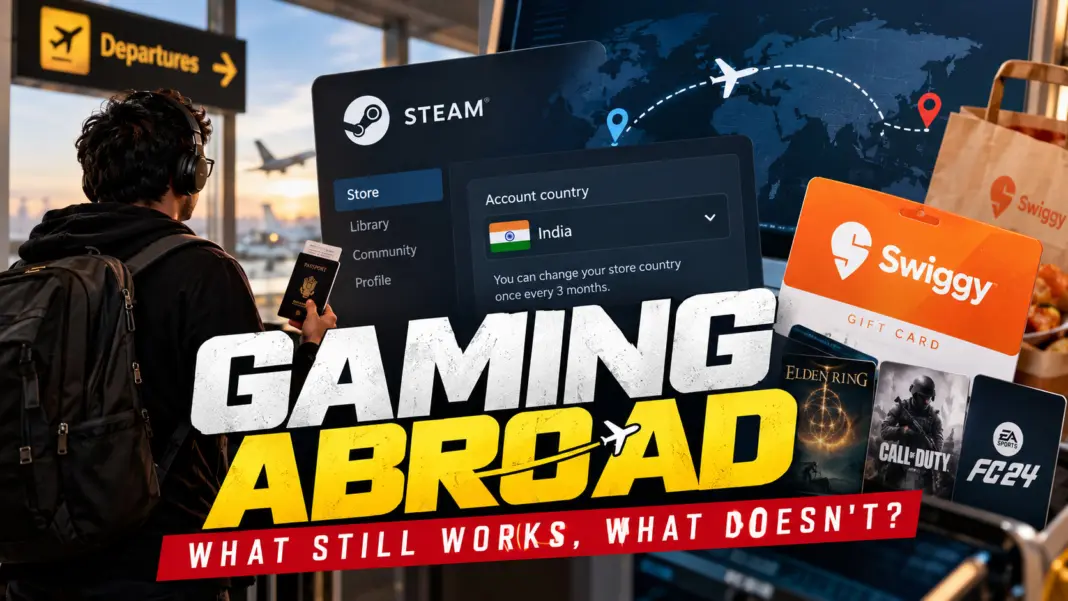
A common misconception says that crossing a border breaks a gaming setup. In practice, physical location and account region are separate: a player can be abroad while an account remains tied to its home country. When a purchase or activation fails, the issue can sit in the relationship between account settings, platform rules, and the product’s permitted region.
That same distinction applies to digital purchases used while travelling. An India-region Swiggy card can be a useful convenience for the relevant service, but it does not provide game access or establish redemption beyond its stated region. Identifying the service, account, and regional terms keeps a travel purchase relevant to its intended use.
Temporary travel leaves account rules in place
Steam offers a clear example of the difference between a trip and a permanent move. Its support guidance states that travellers normally continue to see their home store country and prices, so a short stay abroad does not automatically call for an account-country change. Steam links store country to the account, and a move abroad requires a purchase with a payment method from the new country; country changes are limited to once every three months.
Digital gift cards work by sending a redeemable code that the buyer or recipient enters on the relevant platform or service. Eneba is one option for quick access and region clarity, with listing details that help buyers compare a product’s stated region with the account intended to use it.
A stable travel setup benefits from preparation before departure. Confirm the account country, retain access to the payment method connected to it, and download planned games while the usual connection is available. A temporary trip is not a reason to casually alter an account setting designed around a genuine relocation.
Product regions shape access across borders
A packed console or a hotel login does not turn every digital product into a worldwide purchase. Steam says that most products bought directly through its store do not have region restrictions, while gifts and third-party CD keys may have country-specific limits set by publishers. A key bought for one region can fail to activate on an account in another, so its regional label is part of the purchase decision.
Top-ups follow a similarly direct rule: the game account region generally needs to match the region displayed on the product page. Wallet codes, subscriptions, and gifts can each have their own conditions, which makes a broad assumption about portability unhelpful. The practical approach is to compare an existing account’s region and platform with the listing’s activation information before selecting a code.
This is where the apparent travel problem becomes a compatibility check. Product pages on the digital marketplace use region tags like GLOBAL, EUROPE, NA, LATAM, and ASIA, alongside platform information and activation notices. The Important Notice section can identify country exceptions, which makes it easier to compare listing details with the rules attached to an existing account.
Eneba is therefore a place where the friction described above is addressed through clear region, platform, and activation details rather than assumptions about a traveller’s location. Its verified merchants and quick access to digital products support a focused choice: select a listing that aligns with the account and region already in use. Travel then stays separate from the account rules that govern the code.