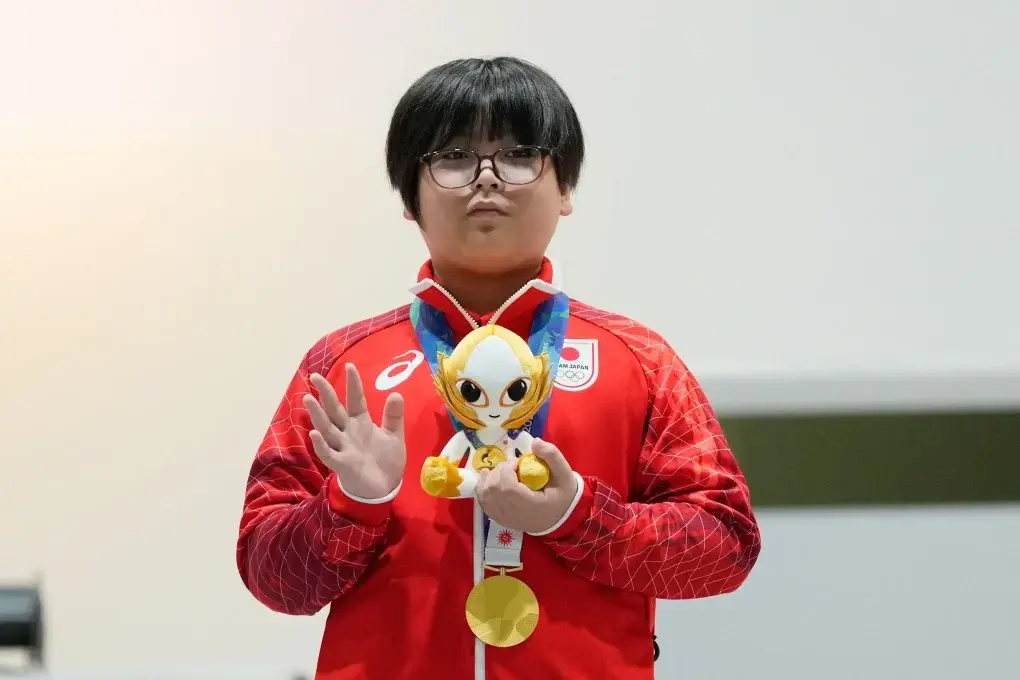
Yuki Kurihara is 11 years old. He is still in primary school. And he is now an Asian Games gold medallist. The Japanese Puyo Puyo player produced one of the most remarkable stories of the 2026 Asian Games on Saturday, September 26, winning gold for Japan in Puyo Puyo at the Aichi Sky Expo.
Kurihara defeated South Korea’s Kang Dongshin 10-2 in the gold-medal match, completing an exceptional tournament for a player who was already making history simply by representing Japan at the Games.
Born on June 18, 2015, Kurihara is a fifth-grade primary-school student who represents Tokyo Verdy Esports. At 11, he became the youngest athlete Japan has ever sent to an Asian Games. He arrived at Aichi-Nagoya as one of the most fascinating members of the Japanese delegation. He will leave it as a gold medallist.
TalkEsport had been following Kurihara’s run before the gold
For TalkEsport readers, Kurihara’s name will already be familiar.
When we covered Puyo Puyo at the Asian Games earlier this week, Kurihara had already emerged as one of the stories of the competition. The 11-year-old finished first in Group A after winning all three of his matches and progressed to the knockout stage with a perfect record.
At the time, the story was already extraordinary: Japan had selected an 11-year-old fifth-grader for its Asian Games team, and he was competing for a medal in front of a home crowd.
Two days later, the story has its ending.
Yuki Kurihara has won gold.
Yuki Kurihara wins Asian Games gold at just 11
Kurihara carried his unbeaten group-stage form directly into Saturday’s medal rounds.
He opened the knockout stage with a 5-0 quarterfinal victory over Singapore’s Koh Mun June Justin before advancing to the semifinal, where he defeated Thailand’s Tanarak Wongkitikun 10-1.
That victory guaranteed Kurihara an Asian Games medal and sent him into the final against South Korea’s Kang Dongshin.
The final did not begin perfectly for Kurihara. Kang took the opening game, putting the Japanese player behind 1-0.
Kurihara’s response was immediate. He produced a 15-chain in the second game to level the contest and began establishing control through the kind of elaborate chain construction that has already become a defining feature of his play.
He eventually completed a 10-2 victory to secure the gold medal for Japan.
Five years after first discovering Puyo Puyo, Yuki Kurihara was standing on top of an Asian Games podium.
Who is Yuki Kurihara?
Kurihara was born in Tokyo on June 18, 2015 and currently represents Tokyo Verdy Esports. According to the Japanese Olympic Committee, he is a fifth-grade primary-school student.
His journey into Puyo Puyo began when he was six years old after receiving Puyo Puyo Tetris 2 as a Christmas present. Kurihara became fascinated by the game’s chain system, in which carefully arranged groups of Puyos can trigger increasingly complicated combinations.
It did not take particularly long for that interest to become competitive.
By April of his second year in primary school, Kurihara was already competing at EVO Japan, where he finished third. He subsequently continued competing in Japanese Puyo Puyo tournaments and established himself as one of the country’s emerging players.
He later won the Puyo Puyo competition at the National Prefectural Esports Championship 2023 KAGOSHIMA and continued climbing through Japan’s competitive scene.
His progression eventually took him from playing a Christmas present at six years old to representing Japan at 11.
What is Puyo Puyo?
Puyo Puyo is one of Japan’s best-known competitive puzzle games. Players arrange coloured Puyos on a board, with groups of four or more of the same colour disappearing when connected.
The fundamental mechanic is straightforward, but high-level Puyo Puyo revolves around constructing chains. A player can arrange the board so that clearing one group causes another to fall into position and disappear, triggering a sequence of increasingly large combinations.
Those chains send disruptive garbage Puyos to the opponent’s board, creating a game that combines pattern recognition, planning, speed and constant awareness of what the other player is constructing.
Kurihara has already demonstrated the ability to produce extremely large chains. Japanese reporting credits him with reaching as many as 19 chains in competition, while his 15-chain during Saturday’s Asian Games final became one of the defining moments of his gold-medal performance.
Japan’s youngest Asian Games athlete is now a gold medallist
Kurihara had already entered Japanese sporting history before Saturday’s final.
His selection for Aichi-Nagoya 2026 made him the youngest athlete Japan has ever sent to an Asian Games. His date of birth is listed by the Japanese Olympic Committee as June 18, 2015, meaning Kurihara won gold at the age of 11 years and three months.
Japanese media has also reported Kurihara as the youngest medallist in Asian Games history, surpassing the widely cited previous mark belonging to Indonesian skateboarder Bunga Nyimas, who won bronze in women’s street skateboarding at the 2018 Jakarta Asian Games at the age of 12.
Comprehensive age records covering every Asian Games medallist since the competition began in 1951 are difficult to independently establish, so historical record claims should be treated with that qualification.
What requires no qualification is the achievement itself: Kurihara represented Japan at 11 years old and won an Asian Games gold medal.
He is still balancing esports with primary school
The contrast between Kurihara’s competitive achievements and his everyday life makes his story particularly unusual.
He remains a primary-school student, attends cram school and has spoken about balancing his education with Puyo Puyo. Away from esports, Kurihara enjoys table tennis and football, while social studies is among his favourite subjects.
Even his training routine is surprisingly measured. Speaking after winning gold, Kurihara said he generally practises for around an hour a day and that there are also days when he does not play at all.
His reaction after becoming Asian Games champion was similarly understated. Kurihara remained composed after the final and later explained that he felt embarrassed about showing too much emotion.
On the podium, however, the reality of what he had achieved became more tangible. He spoke about the shine and weight of the gold medal and appeared particularly pleased with the gold-coloured Asian Games mascot plush toy he received alongside it.
It was a small reminder that one of Japan’s newest sporting champions is still only 11.
From a Christmas present at six to Asian Games gold at 11
There is no need to make Kurihara’s achievement more dramatic than it already is.
At six, he received Puyo Puyo Tetris 2 for Christmas and became fascinated by its chain mechanics. Within a few years, he was competing at major Japanese tournaments. At 11, he became the youngest athlete ever selected by Japan for the Asian Games.
Kurihara’s gold medal completes a remarkable progression that began only five years ago, when he received Puyo Puyo Tetris 2 as a Christmas present and became fascinated by its chain mechanics. What followed was an unusually rapid rise through Japan’s competitive Puyo Puyo scene, eventually earning him the opportunity to represent his country at the Asian Games while still in primary school.
When TalkEsport covered Kurihara earlier in the tournament, his age had already made him one of the most closely watched players in the competition, but his performances quickly ensured that the conversation was about more than novelty. He topped his group without losing a match and carried that form through the knockout rounds before defeating Kang Dongshin 10-2 in the final.
There will be plenty of time to see where Kurihara’s career goes from here. At 11, it would be unreasonable to place expectations on what he should become or how far he should eventually go in esports. What he has already achieved deserves to stand on its own. Five years after discovering Puyo Puyo, Yuki Kurihara represented Japan at one of Asia’s biggest sporting events and won its highest honour.