

For almost 24 hours last week, much of the working world could not open its email. Microsoft’s preliminary incident report puts the Microsoft 365 outage at 23 hours and 50 minutes, from 16:20 UTC on 12 November to 16:10 UTC the next day, with Outlook and Exchange Online hit hardest. By TalkEsport’s estimate, it cost Microsoft’s customers around the world about $9 billion in lost working time, within a plausible range of $2 billion to $27 billion. Microsoft’s own maximum exposure, through the service credits it promises when it misses its uptime target, is less than a billion dollars, and its share price rose on both days of the outage.
That gap is the real story of the outage. The failure was Microsoft’s, the evidence in its own report suggests it was preventable, and yet nearly all of the cost landed on the companies, hospitals, schools and governments that pay for Microsoft 365. We built a simple model to put a number on it, and every step is shown below so readers can swap in any assumption they disagree with.
What Microsoft’s own report says went wrong
Microsoft has been unusually candid about the cause. Its preliminary post-incident report, dated 15 November and shared with administrators under incident IDs EX1550543 and MO1550821, describes a fix it built for the networking gateway that sits in front of many Microsoft 365 services. That fix carried a hidden defect, and it went live across the world from July onwards. For more than three months, it ran without causing any visible problem.
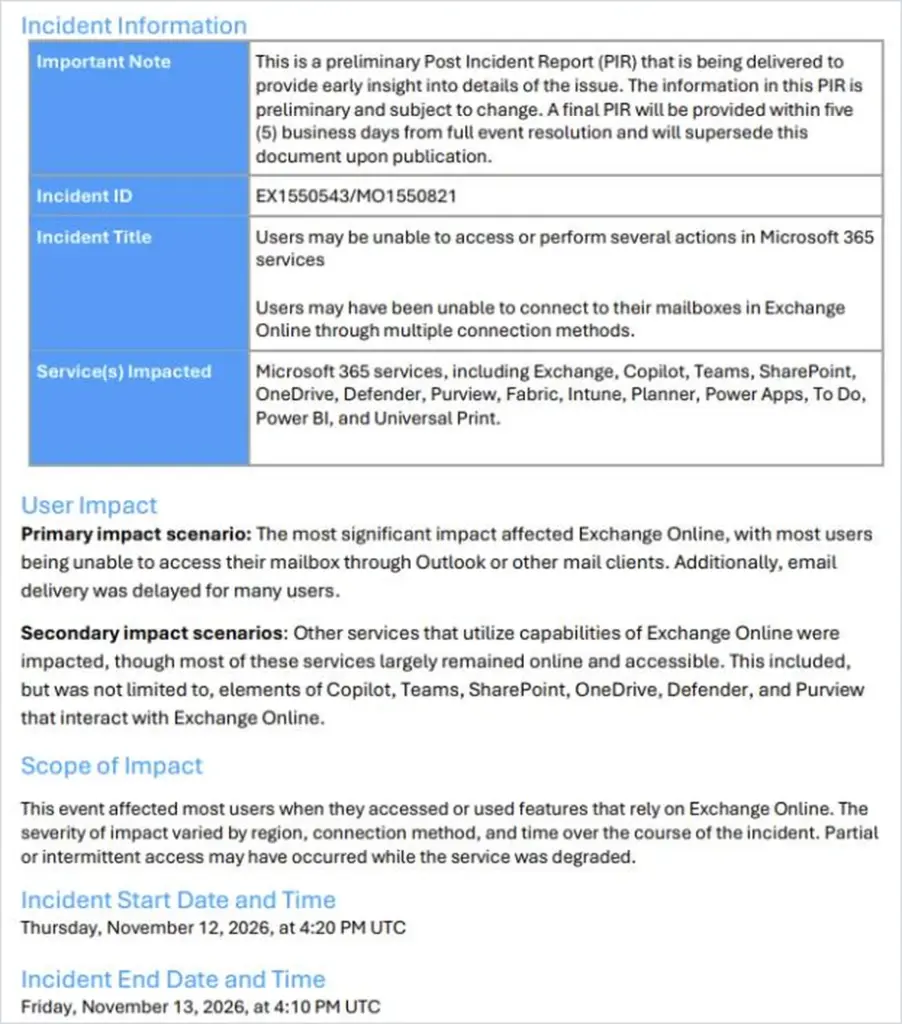
The defect was lock contention inside an internal Windows process, which meant tasks on the gateway servers waited on each other until processor time and memory ran out. Microsoft’s report admits that its load tests “tended to focus on weaker hardware with fewer cores”, while the bug got worse on newer machines with more cores. On 12 November, a routine Teams failover added load to the same gateway, nearly 14% of its capacity was already offline for an unrelated reason, and US peak traffic did the rest. As we reported while Outlook and Teams were still down, Microsoft spent most of the first night restarting servers that kept failing again.
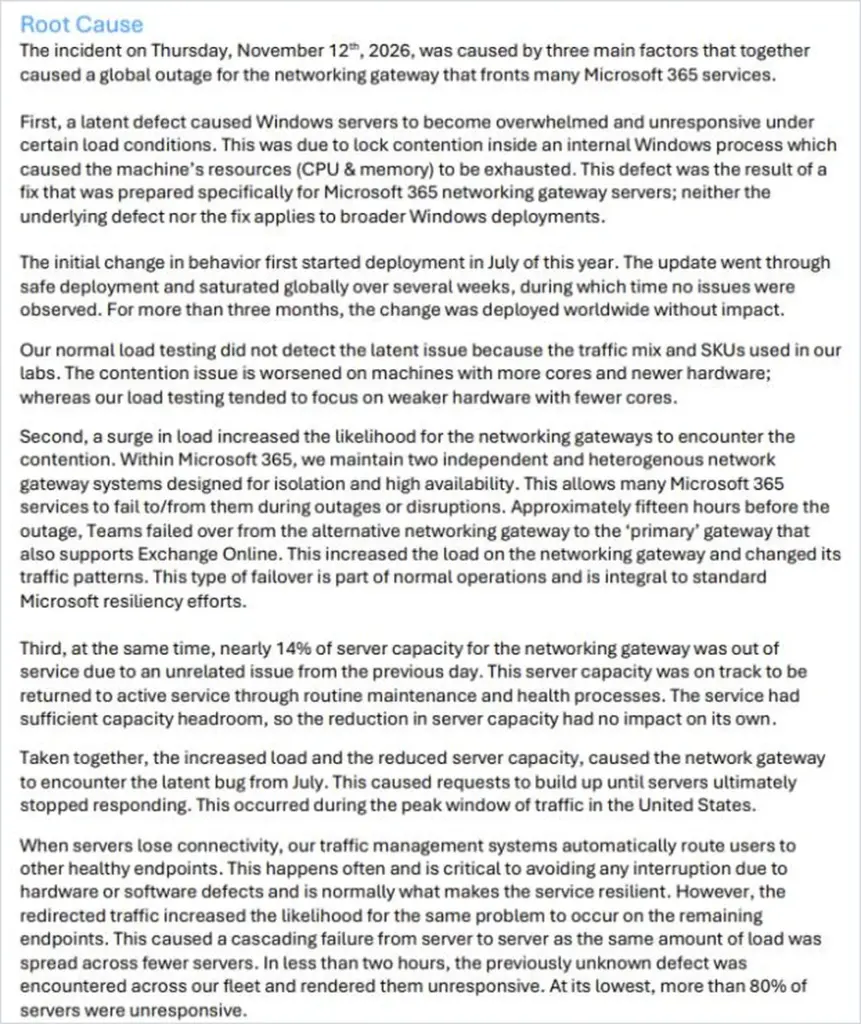
The report’s own words explain why this one lasted so long. Automated traffic management moved users to healthy servers, which then hit the same bug, and “at its lowest, more than 80% of servers were unresponsive”. Because the faulty change was months old, Microsoft said its “normal rollback, flighting, and feature flags were unable to quickly revert the change”. Engineers had to build a new update instead, and it did not reach the first servers until 07:20 UTC on 13 November, 15 hours after the outage began.
About 300 million lost working hours, by our count
The first question is how much of the working day the outage actually took, and that depends on where you were. Using the start time and the regional recovery times in Microsoft’s report, we measured how many hours of a 9am to 5pm day fell inside the outage in nine major business cities. Asia Pacific lost almost an entire day on 13 November, because the failure began overnight there and was only fixed by 11:00 UTC. San Francisco lost all of 12 November, New York and São Paulo lost about six hours, and London and Frankfurt escaped with a lost morning.
From there, the arithmetic is straightforward, even if the inputs are not. Microsoft said in January that Microsoft 365 had more than 450 million paid commercial seats, and it told investors in October that commercial seats were still growing. Not all of those seats are active at once, and Teams, SharePoint and OneDrive kept working for most users, so we assume only a share of seats were working and relying on Outlook. We also assume people lost only part of each hour, since many could still chat, open files and do work that did not need email.
Our central case lands at roughly 297 million lost working hours, which is the equivalent of almost 150,000 people losing an entire 2,000-hour working year. At a blended $30 an hour, that is about $8.9 billion. For comparison, the US Bureau of Labor Statistics puts the average employer cost of a private-sector worker at $46.89 an hour, which is why our high case reaches $26.6 billion. Our low case, which assumes only one hour in ten was really lost, still comes to $2.2 billion.
The only outside estimate we found sits close to the middle of that range. Anderson Economic Group, a Michigan consultancy, put the cost at about $7 billion, according to CNN, which described it as the firm’s high estimate. Its full method has not been published in the coverage we have seen, and it is not clear whether it covers the US alone, so the two figures are not directly comparable. Our estimate, by contrast, covers all 450 million paid seats worldwide. Even so, both land above the $5.4 billion that insurer Parametrix estimated the CrowdStrike outage cost Fortune 500 companies in July 2024, as Fortune reported at the time.
There are real limits to any model like this. Lost hours are not the same as lost output, because some email simply waits until the next day. On the other hand, the model leaves out costs that are harder to count, such as cancelled hospital procedures, delayed court filings, missed trades and the overtime IT teams spent fielding calls. Those costs fall unevenly, and for a small business that runs everything through Outlook, one lost day can matter far more than an average suggests.
Microsoft’s side of the ledger: capped credits and a rising stock
Microsoft’s direct bill is far smaller, and that is by design. Microsoft 365 services carry a 99.9% monthly uptime commitment, and Microsoft’s guide to its SLAs describes credits of 25% of the monthly fee below 99.9%, 50% below 99% and 100% below 95%. A tenant that lost Exchange Online for all 1,430 minutes would sit at about 96.7% uptime for November, inside the 50% band. Those credits only apply to the fee for the affected service, and administrators have to claim them.
That puts a hard ceiling on what Microsoft can owe. Exchange Online Plan 1 costs $4 per user per month, so a 50% credit is worth $2 a seat. Even if every one of 450 million seats claimed at that rate, the total would be about $0.9 billion. That is roughly 1.4% of the $63.9 billion that Microsoft Cloud brought in during the three months to September, according to Microsoft’s latest results. In practice, only a fraction of customers will file, so the real figure should be much lower.
Investors barely noticed any of this, as it turned out. Microsoft shares closed at $523.00 on 12 November, up 0.4% on the day the outage began, and edged up again to $523.88 on 13 November as engineers rolled out the fix. Measured against Microsoft Cloud’s revenue of about $29 million an hour, the outage lasted long enough to cover roughly $690 million of sales, but subscriptions kept billing throughout. Almost nothing about the incident touched Microsoft’s income statement.
That imbalance is what makes outages like this one hard to fix from the outside. The cloud concentrates risk in a few providers, from AWS’s US-EAST-1 failure on 15 November to Google Cloud’s outage in Europe last month, while contracts cap what those providers pay when it goes wrong. Microsoft says it has already added recovery capacity, new monitoring and guardrails against cascading traffic shifts. Its final report, with the full list of repair items, is due around 20 November in the Microsoft 365 admin centre.