YouTube has changed what the view count under every video actually measures. According to a notice on YouTube’s Help Center page on content performance, public view counts on watch pages “incorporate co-views” from November 2026. YouTube defines co-views as an estimate of how many people are watching together on a TV screen. The change was flagged by the creator analytics company vidIQ on 16 November, and it means a single playback on a living room TV can now add more than one view to the public total.
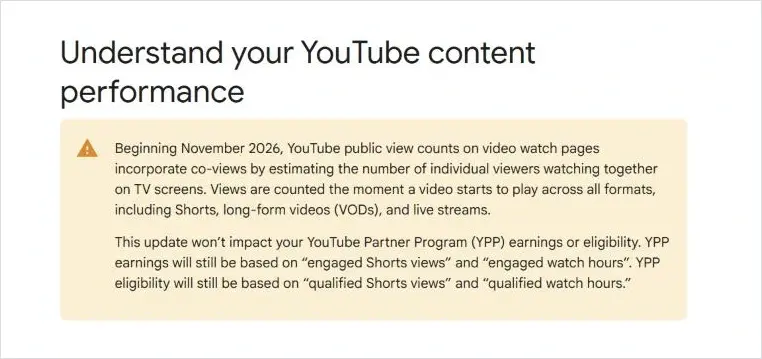
The same notice repeats a rule YouTube introduced earlier this year, that views are counted “the moment a video starts to play” across Shorts, long-form videos and live streams. Put together, the two changes mean the number fans see under a video no longer needs anyone to keep watching, and no longer counts only the screens that played it. YouTube says none of this affects the YouTube Partner Program, because earnings remain based on engaged Shorts views and engaged watch hours, while eligibility still depends on qualified Shorts views and qualified watch hours.
How YouTube got here, and how co-views are calculated
The first step came in August, in a Help Community post titled “An update to how we count public views across YouTube”. From 24 August, the company said, a public view would count from the first frame in every format, extending the approach it had already used for Shorts since 2025. YouTube said the aim was a single, consistent measure of exposure that creators could take to brands and sponsors, instead of different rules for Shorts, long videos and streams.
The second step arrived a few weeks later as a private number. In a Creator Insider video published on 2 September, YouTube creator liaison Rene Ritchie introduced Views (Co-Viewed), a metric in the advanced mode of YouTube’s analytics that “estimates the total number of people watching on TVs”. He said that until then “every TV device playback was viewed as a single view”, and described the new figure as platform-backed, so creators could use it when negotiating brand deals. A household of three watching one video together counts as three co-viewed views.
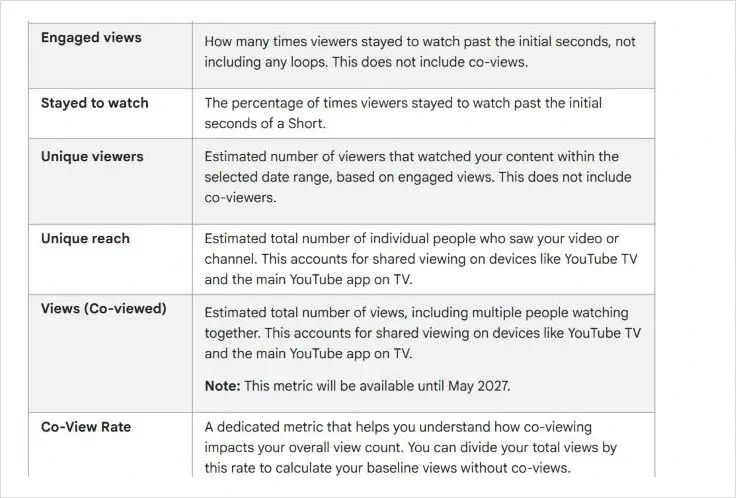
November’s change moves that estimate out of the private dashboard and into the public counter. The Help Center now lists a Co-View Rate metric that shows how much co-viewing lifts a channel’s total, and it explains that dividing total views by that rate gives a “baseline” without co-views. Engaged views and unique viewers still exclude co-viewers, while watch time now includes time from co-views, and the standalone Views (Co-viewed) metric will stay in YouTube Insights advanced mode until May 2027.
What YouTube has not explained is how it knows who is on the sofa. The Help Center only says co-views are estimated for shared viewing on TV screens, including the main YouTube app on TV and YouTube TV. YouTube has not published the model, its margin of error or any outside audit of it. Its notice also does not say whether co-views are added to older videos or only to views from November onwards.
Why YouTube wants TV credit, and why the numbers deserve caution
The business case for the change is not hard to see. YouTube took a record 15.8% of all US television viewing time in August, about twice Netflix’s 7.7%, according to Nielsen’s monthly Gauge. Ritchie has also said that viewers watch more than a billion hours of YouTube on TV screens every day. Television audiences have long been sold to advertisers as people rather than devices, so counting one view per TV left YouTube creators reporting smaller audiences than the rooms they were actually reaching.
The problem is that a counted number and an estimated number now sit inside the same figure. Anyone comparing a video uploaded this month with one from last year is no longer comparing like with like, and that matters for the records gaming fans love to track. A trailer’s 24-hour views, a music video milestone or an esports final’s VOD count from November onwards can include modelled viewers that older totals never had, which makes headline comparisons shakier than they look.
Brands paying for sponsored videos face a similar issue. A sponsor paying by public views is now paying partly for viewers YouTube has estimated rather than measured, using a method it has not disclosed. The cleaner figures, engaged views and unique viewers, still exclude co-viewers, but they sit inside a creator’s private dashboard, so a brand has to ask for screenshots and take them on trust. That is a step back from a public counter that anyone could check, even if YouTube’s estimate turns out to be accurate.
Gaming creators sit right in the middle of this. Long VODs, live streams and big events such as YouTube’s 24-hour GTA 6 launch livestream with Total Gaming and Payal Gaming are exactly the kind of content families and friends watch together on a television. That could lift their public totals noticeably, while their Partner Program earnings stay tied to engaged watch hours, so a bigger number on the page will not by itself mean a bigger payout.
Other platforms count differently again, which adds to the confusion. Netflix, for example, reports views as hours watched divided by running time, the figure behind our report on the GTA 6 Extended Look’s 31.1 million Netflix views. YouTube’s own Partner Program rules still require 1,000 subscribers plus either 4,000 qualified watch hours in 12 months or 10 million qualified Shorts views in 90 days. YouTube says the co-view change does not affect either threshold.