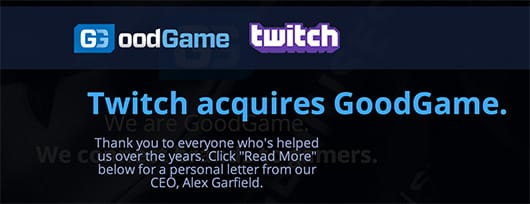
The securing will permit Twitch to tackle Goodgame’s exceptional administration bundle, and in addition its staff’s industry mastery and group initiative, keeping in mind the end goal to offer a much more extensive show of help and adaptation chances to the more noteworthy Twitch group.
As esports and live feature diversion television keep on growwing at a dangerous pace, publicists have attempted to see how to most adequately captivate and achieve this huge crowd. Goodgame has helped take care of this issue with a stockpile of new, non-customary engagement routines interestingly suited to the regularly developing advanced media group of onlookers. This, coupled with its endeavors to create clear measures for reporting and correspondence of quality to supporters, has permitted Goodgame to succeed at inviting real patrons and publicists into the group.
Under the authority of its CEO, Alexander Garfield, the organization has made a model that keeps players and substance makers concentrated on what they do well while adapting their work all the more adequately through ads, sponsorships, and marketing. With Goodgame’s particular ability set added to Twitch’s now industry-heading accomplice system, Twitch streamers will soon have considerably more approaches to construct their vocations as substance inventors.
I was never much of a team sports kid. I grew up in Philadelphia (where it’s culturally impossible to not passionately support your local sports teams), but when it came to actually competing, team sports weren’t my thing. I was a math, science, and music kind of kid, which meant that aside from always being the first to finish my times tables – which is true, by the way – I had to fulfill my competitive drive as a spectator. And those of you who are familiar with American sports know that investing yourself in the success of Philadelphia sports teams hasn’t paid off much over the past twenty-five years (apologies to the ‘08 Phillies).
In the summer of 2002, I went to a LAN in the basement of my friend’s house. My rig was running a Pentium IV, and my monitor weighed approximately one thousand pounds. One of the guys at the LAN was an avid Counter-Strike player, so we all decided to try it out. I went 0-13 in my first game, and to say the least, I did not have fun. Guns with impossible-to-control hit patterns that become even more inaccurate if you’re moving in the slightest? I think my initial feedback was something along the lines of, “This game is dumb.”
Naturally, from that point on, I didn’t touch another game aside from Counter-Strike for about five years. I joined a team, played in amateur leagues and tournaments, and followed the professional scene closely. I bought a Steelpad S&S (SK Edition), and lost my mind when Sean “Bullseye” Morgan single-handedly brought 3D back from the brink of defeat in overtime against 4Kings. I didn’t realize it at the time, but Counter-Strike actually played an important role in my life: it put me in touch with a competitive drive that I didn’t even know I had. It gave that part of me a voice. My Counter-Strike team was so much a part of my high school life that my mom suggested I write my college essay about it. I didn’t – I told her that I couldn’t imagine any credible college understanding, let alone respecting, the value of esports. Now, universities offer esports scholarships and that same school I was afraid to tell about my hobby wrote an article about it in the college magazine. How far we’ve come.
While I originally picked up Counter-Strike in 2002, I didn’t actually have a role in the esports scene until 2004, when I volunteered to do coverage for a Canadian team called Evil Geniuses. They weren’t the best team in the world (or even in North America, where they were in the top four), but they were my favorite team, by far. They were all close friends, and to me they were the shining example of everything that was great about esports: being friends and having fun while still taking competition seriously. I wrote a couple of articles for them, but it wasn’t long before the players were faced with what was back then an all-too-common problem: their manager had disappeared along with the team’s sponsorship money, and they would have to disband unless new sponsors were found. I offered to help, and the players agreed to stay together if the support was there. It was, and we made it to CPL Summer ’05, where we finished second – the upper bracket finals match between EG.ca and SK.swe is still one of my best esports memories.
More than a decade later, here I am running a company called GoodGame, which most of you guys probably know best for being the backbone of EG and Alliance, but which also does a bunch of other things within esports. In addition to supporting our two flagship teams, we operate our own tournaments; we work with personalities and live streamers (both competitive and non-competitive); we produce talk shows and other kinds of esports content; and we also help support third-party teams, players, and tournaments – in some cases by funding them directly, and in other cases by helping them find sponsors and grow their businesses.
I’m very proud of what we’ve accomplished over the past ten years. We’ve had the privilege of signing some incredible players and teams, and we’ve also had a lot of fun making those announcements (and announcements of announcements); we’ve brought home championships in just about every major esports title; and in the past five years alone (since esports really started to pick up), we’ve been responsible for funneling more than $10 million toward players, teams, tournaments, and other parts of the esports ecosystem.
If there’s one thing I’d ask you guys let me brag about unapologetically, it’d be that we’ve done all of these things without the help of any kind of investment, venture capital, or other outside nonsense. We’ve gotten to where we are by working hard, and by prioritizing growth, player support, and the health of the ecosystem over our own, personal gain. Our company’s profits have never gone into our management’s pockets – we’ve always re-invested everything back into our teams, players, tournaments, and other projects – and there hasn’t been a single moment in our ten-year history at which a player wasn’t the highest-paid person in the company.
That’s the truth. No hidden management bonuses, no Swiss bank accounts, no bullshit. On a certain level, it’s kind of funny that we’ve developed a reputation in the community for, uh, rolling in money. Granted, we probably didn’t help set the record straight by doing this kind of stuff, but we figured that if the community liked us (or liked to hate us) in that role, we might as well run with it and have fun. We work in an industry built around playing video games – if you take yourself too seriously, you’re doing it wrong.
What’s motivated us all these years, if not money? It’s pretty simple: we love esports. Video game tournaments, held in arenas filled with thousands of screaming fans, and millions more watching online? There’s nothing cooler than that. I’ve been hooked since 2002, when we used to “watch” Counter-Strike matches on mIRC via text-based scorebots. I can say with confidence that the esports spectator experience has improved since then.
I’ve always believed that if the cool thing to do also feels like the right thing to do, then it’s probably worth doing. That philosophy has been the foundation for just about everything we’ve done – from our big-name player acquisitions, to us being one of the first tournament organizers to offer travel and hotel stipends, to the – ahem – generous player salaries we’re known for, to my very first task back in 2004: finding enough sponsorship money to afford five plane tickets and keep the team alive.
Now, this is the part of the blog where I acknowledge the fact that we’re two pages in, and I still haven’t said a single thing about the acquisition. I hope you’ve found what you’ve read so far to be useful and relevant – I wanted to first provide some backstory and context, because I think it’d be really silly to try and explain why we’re aligning with Twitch (and why I think you guys should view it as a good thing) without first explaining what GoodGame is, and who’s behind it.
Now that you guys have that context, let me explain why I sold the company.
Esports has never been bigger than it is today. It seems like every other day, we see a new article in a major publication, or a new media company taking a shot at producing or hosting esports content. There’s never been more mainstream interest in our industry – which is a good thing – but while it’s exciting, we need to make sure that interest is focused and channeled in the right ways if we want to keep growing our industry without breaking it. That’s why, now more than ever, it’s necessary for us to all work together.
I’d like to think that GoodGame could play a role in helping get everyone on the same page. We understand things from the team’s perspective; the player’s perspective; the tournament’s perspective. We’ve run many different kinds of esports projects, and we know what it takes to make them successful and sustainable. But at the same time, up until now our company’s been just as consumed as everyone else by the day-to-day demands of running a business in a very competitive industry – and it’s limited our ability to look out for everyone and think as altruistically as we’d like.
That’s why I decided to align us with Twitch.
This isn’t going to be one of those post-acquisition blogs in which the fact that there’s money involved in the transaction is conveniently glossed over. There’s no doubt that being bought by Twitch means all of our employees will be taken care of very well. But at the same time, we’re talking about a group of people who’ve dedicated most – if not all – of their adult lives to esports and to growing this industry. It’s a deserving bunch. On top of that, we’ve reserved a portion of the transaction for a player pool, which means that every player currently contracted with GoodGame will receive a small portion of the company’s sale. And as an Amazon subsidiary, we’ll also be able to offer our players other additional benefits to which they didn’t previously have access.
TL;DR – it’s a good deal for everyone involved. And while I’d be lying to you guys if I said that the level of support didn’t factor into my decision, I’d be lying just as much if I told you that the support alone would’ve been enough. Don’t get me wrong, the financial security doesn’t hurt. But I didn’t put ten years of my life into this company – and this industry – only to sell my soul in public for a couple of bucks.
No word-mincing. No bullshit. That’s not what this is.
I don’t know if any of us who’ve been in esports for the long haul had any idea what we were doing when we first started out, but I’d be the first to admit that I didn’t have a clue. I wanted to help out a group of friends that I liked and respected – that’s what I was doing back in ‘04. That’s why, when my Counter-Strike team was drafted into the Championship Gaming Series in the summer of ‘07, my initial reaction was that it was time to move on. I didn’t really see a point in continuing if my players didn’t need my help anymore. I stayed, obviously – thanks in large part to my mom, who insisted that I’d built something valuable that would outlive the loss of five players. I still remember her lecturing me in the kitchen of her house (thanks, mom). Apparently, she was right.
Ten years later, I’m still not sure I know exactly what I’m doing, but it seems to be going okay. My experience in building GoodGame, Evil Geniuses, and Alliance over the past years has been one of hard work and pleasant surprises. It’s actually really hard to tell if what you’re doing is working when you’re not on the outside, and so we’ve gone through many cycles of deciding to do something we think is cool; working hard to make it happen; and then releasing it to the public with our fingers crossed. Usually, what we’ve done has been well-received. Hopefully today is another example of that.
I believe in Twitch – I really do. They’re great at what they do, they understand esports, and they genuinely care about making sure the community grows in the right way. To use an industry meme: they get it. What’s kind of interesting about this acquisition is that it doesn’t really change our business at all – our players were already streaming on Twitch because we felt it was the best platform to be on (not a hard argument to make these days). We had many offers over the years to leave for other platforms – some of them for silly amounts of money – but we always turned them down and stayed with Twitch because Twitch was the only option we could tell people with a straight face was good for players and good for sponsors. We built our company’s economy on Twitch viewership metrics, and it’s not a coincidence that 2011 (when Twitch started to focus on esports) was also when our business really started to take off. So it’s only fitting that, as a part of Twitch going forward, we’ll be working with players, teams, tournaments, and content creators to help them grow their careers and businesses.
Three pages of text later, I’m not really sure how you guys feel about all of this. I hope that you like it, and that you believe it’ll result in a lot of good work being done for players, teams, and tournaments. But I understand if you’re skeptical, and I’d only ask that you keep an open mind and pay attention to what we do next. I’ll be doing an AMA tomorrow (exact time and subreddit TBD) for those of you who have questions or who’re interested in learning more.
I’d like to conclude by thanking all of the players, fans, sponsors, family, and friends who’ve helped us over the past decade. It’s crazy that we’ve ended up here. I’m so proud of everything we’ve accomplished.
Sincerely,
Alex
CEO, GoodGame
@ottersareneat on Twitter