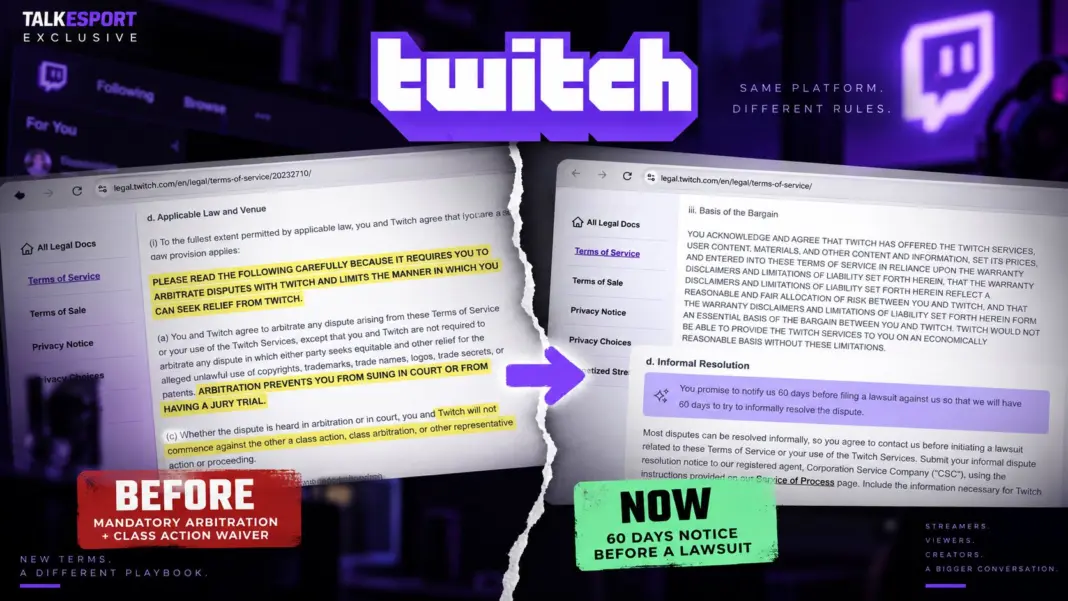
Twitch’s previous general Terms told users that arbitration prevented them from suing in court or having a jury trial. Its current agreement instead tells users to give Twitch 60 days’ notice before filing a lawsuit.
Twitch has quietly made a significant change to the legal agreement governing its relationship with users, removing the mandatory arbitration framework and class-action waiver that appeared in its previous general Terms of Service. The change is easy to miss. It arrived not through a major announcement to streamers or viewers, but through a rewrite of the legal terms sitting underneath the platform.
Yet a comparison of Twitch’s previous and current Terms reveals a striking difference in how the company describes what happens when a dispute between Twitch and a user cannot be resolved.
The older agreement explicitly required covered disputes to proceed through arbitration and warned users, in capital letters, that “ARBITRATION PREVENTS YOU FROM SUING IN COURT OR FROM HAVING A JURY TRIAL.” It separately prohibited class actions, class arbitration and other representative proceedings.
Twitch’s current Terms, dated August 12, 2026, take a materially different approach. Users must first give Twitch 60 days’ notice and attempt to resolve a dispute informally. If that process fails, the agreement provides for litigation in designated courts rather than reproducing the previous mandatory individual-arbitration regime.
Twitch’s old Terms explicitly required arbitration
The difference becomes clearest when reading Twitch’s own language. Under the previous Terms of Service, Twitch told covered users that they and the company agreed to arbitrate disputes arising from the agreement or use of Twitch’s services, subject to specified exceptions.
The provision was unusually direct about what that meant. Users were warned that arbitration would prevent them from suing in court or receiving a jury trial.
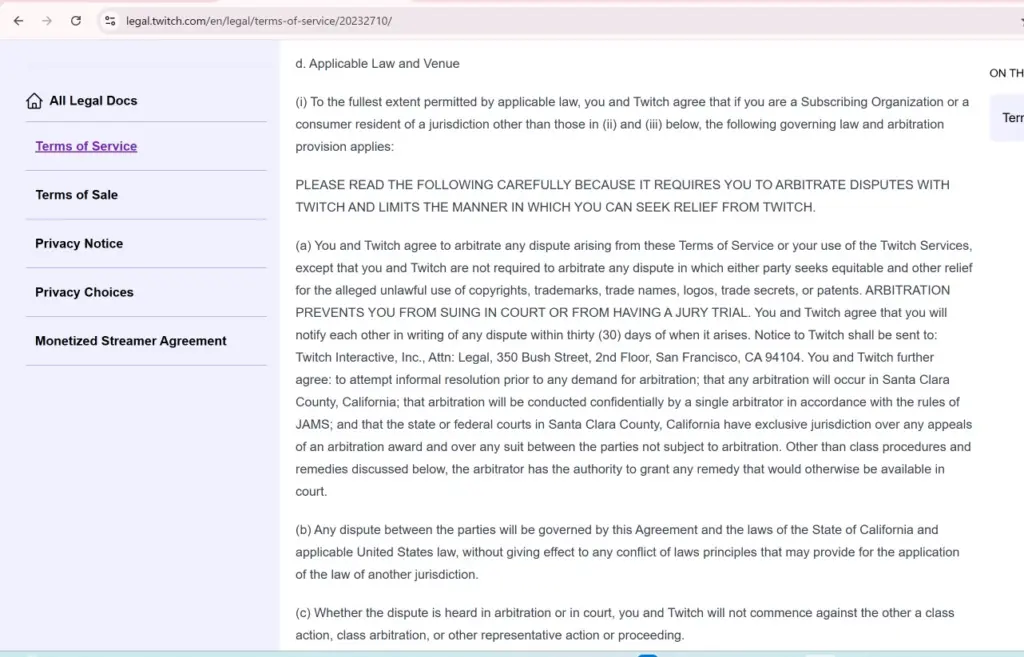
The old agreement also established how arbitration would operate. It called for confidential proceedings before a single arbitrator under JAMS rules and specified Santa Clara County, California, as the location for arbitration. Most importantly, the agreement did more than move disputes outside conventional courts. It also restricted how claims could be brought collectively.
The old agreement also blocked class actions
Subsection (c) of the previous dispute provision stated that whether a dispute was heard in arbitration or in court, Twitch and the user would not commence a class action, class arbitration or other representative action or proceeding against one another. That distinction matters because arbitration and class-action waivers perform different functions. Mandatory arbitration directs qualifying disputes away from the ordinary court system and towards a private dispute-resolution process. A class-action waiver goes further by restricting users from combining sufficiently similar claims into a larger representative proceeding.
For consumer platforms with millions of users, the difference can become substantial. An alleged loss may be too small for one person to justify expensive litigation, while the same alleged conduct affecting a much larger group can create a materially different legal case if a court permits those claims to proceed collectively.
Twitch’s previous general Terms attempted to prevent that route. The current agreement no longer contains that previous arbitration and class-action framework.
Twitch now tells users to give it 60 days before suing
The replacement language looks remarkably different. Under a section titled “Informal Resolution,” Twitch’s current Terms tell users that most disputes can be resolved informally and require them to contact the company before initiating a lawsuit relating to the Terms or their use of Twitch.
Twitch summarizes the requirement prominently on the page:
“You promise to notify us 60 days before filing a lawsuit against us so that we will have 60 days to try to informally resolve the dispute.”
Twitch Terms of Service
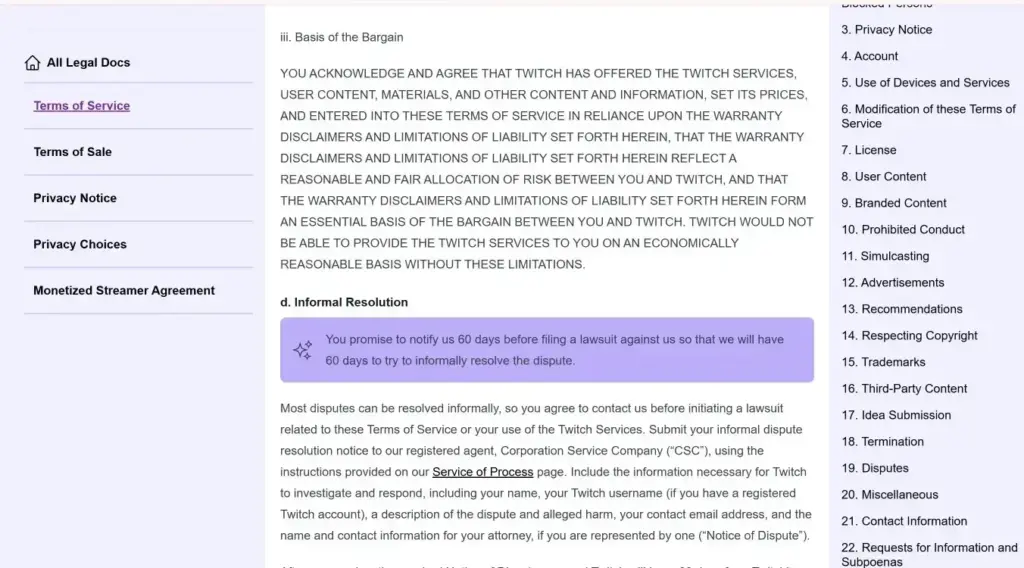
The user must submit a Notice of Dispute containing information Twitch needs to investigate the claim. That includes the user’s name, Twitch username where applicable, a description of the dispute and alleged harm, contact information and details for an attorney if the user has legal representation.
The parties then receive a 60-day window to attempt an informal resolution before litigation proceeds.
If that fails, Twitch’s general Terms now point to court
The change becomes particularly consequential after those 60 days expire. Rather than directing covered disputes into the previous binding-arbitration system, Twitch’s current general Terms establish jurisdiction in designated California courts for disputes that proceed to litigation, subject to the agreement’s precise provisions and applicable law.
For covered U.S. disputes, the agreement identifies the United States District Court for the Northern District of California or an appropriate state court located in San Francisco County. In practical terms, the language has moved from telling covered users that arbitration prevents them from suing in court to expressly describing what they must do before filing a lawsuit. That is a substantial contractual change even though most Twitch users will never have reason to invoke it.
This doesn’t mean Twitch has eliminated arbitration everywhere
There is an important boundary to the change. Twitch operates under more than one legal agreement, and the removal of mandatory arbitration from its general Terms of Service should not be interpreted as the company abandoning arbitration across every contractual relationship.
For example, Twitch’s separate Monetized Streamer Agreement, which governs certain aspects of the relationship between Twitch and creators participating in monetization programs, continues to contain its own dispute-resolution provisions, including binding arbitration language. The change examined here therefore concerns Twitch’s general Terms of Service rather than every contract the company maintains with creators, partners or other parties.
That distinction is important, particularly for streamers who may simultaneously be subject to the general Terms and additional agreements connected to monetization.
The disappearance of the previous class-action restriction could prove as significant as the change to arbitration. A class action does not simply happen because a contract stops prohibiting one. Plaintiffs seeking to represent a larger group must still satisfy legal requirements, and a court ultimately determines whether a proposed class can proceed. Removing a contractual class-action waiver therefore does not guarantee users the ability to bring a successful class case against Twitch.
The previous Terms expressly said Twitch and its users would not commence class actions, class arbitration or representative proceedings against one another. The current general Terms do not reproduce that previous prohibition.
Twitch still places limits on legal claims
The new agreement should not be interpreted as removing every procedural limitation Twitch places on disputes. Users still need to follow the 60-day informal-resolution process before bringing covered litigation. The agreement also establishes governing-law and venue provisions that can determine where qualifying disputes proceed. Twitch additionally retains a contractual time limit for bringing certain claims. The Terms require applicable claims to be commenced within one year after the claim or cause of action arises, subject to the wording and enforceability of that provision.
The August revision therefore changes an important part of the dispute machinery without turning Twitch’s Terms into an unrestricted invitation to litigate.
The economics of arbitration have changed for major tech platforms
For years, mandatory arbitration accompanied by a class-action waiver appeared attractive to large consumer businesses. Keeping disputes individual could reduce exposure to conventional class litigation while resolving claims outside public courts. That calculation has become more complicated with the rise of mass arbitration.
Instead of attempting to bring one class action, law firms can organize large numbers of consumers to file individual arbitration demands simultaneously. Depending on the arbitration rules and contract involved, a company can then face substantial filing and administrative fees across thousands of separate proceedings. In that environment, a mechanism designed around individual disputes can itself become expensive at scale.
That broader legal trend provides useful context for why major technology companies may reconsider how they structure consumer disputes. However, TalkEsport has found no public statement from Twitch establishing that mass arbitration motivated this particular change.
Without such evidence, attributing Twitch’s decision to any specific legal strategy would be speculation.
The timing comes amid litigation involving Twitch
The revision also arrives during a period in which Twitch continues to face litigation in the United States. Among the cases filed in 2026 is Pandiscia v. Twitch Interactive, Inc. in the U.S. District Court for the Northern District of California, a proposed class action involving allegations connected to Twitch and artificial-intelligence-related practices. Those allegations remain claims made by plaintiffs and should not be treated as judicial findings against Twitch.
The timing makes the contractual change noteworthy, particularly because the previous agreement expressly restricted class proceedings. However, the documents reviewed by TalkEsport do not establish that the Pandiscia case, or any other particular lawsuit, caused Twitch to rewrite its Terms. The chronology can be reported. A causal relationship cannot currently be established.
Platforms routinely update Terms of Service, and most changes attract considerably less attention than a new feature, subscription price or moderation policy. Yet those agreements define rights and obligations that become important precisely when the relationship between a company and its users breaks down. In Twitch’s case, the contrast between the previous and current documents is unusually clear. The old Terms warned covered users that arbitration prevented them from suing in court or obtaining a jury trial. They also said Twitch and users would not commence class actions against one another.
The current general Terms instead tell users to notify Twitch 60 days before filing a lawsuit, attempt an informal resolution and, if necessary, proceed under a framework that expressly contemplates court litigation.
That does not determine who would win any future dispute with Twitch. It does not guarantee class certification, eliminate separate arbitration agreements or remove the company’s other contractual protections. But for users covered by Twitch’s general Terms of Service, the rules governing how a legal fight can begin have changed considerably.