Logitech’s current privacy policy says consent-based G HUB analytics can include overall mouse travel and the duration of camera and audio usage associated with specific applications, categories that were not explicitly named in the company’s January 2025 G HUB disclosure.
If you installed Logitech G HUB to change your mouse DPI, configure RGB lighting, remap a button or manage a gaming headset, you probably expected the software to know a fair amount about the Logitech hardware connected to your PC. Logitech’s own privacy policy shows that the analytics G HUB can collect, with a user’s consent, can extend considerably further.
Under the “Performance, Diagnostics and Analytics” section of its current privacy policy, Logitech says G HUB can collect information about feature usage, connected devices, system information, performance and diagnostics. Among the examples it explicitly names are “overall mouse travel data not linked to applications” and general usage activity associated with specific applications, including “camera and audio usage duration.”
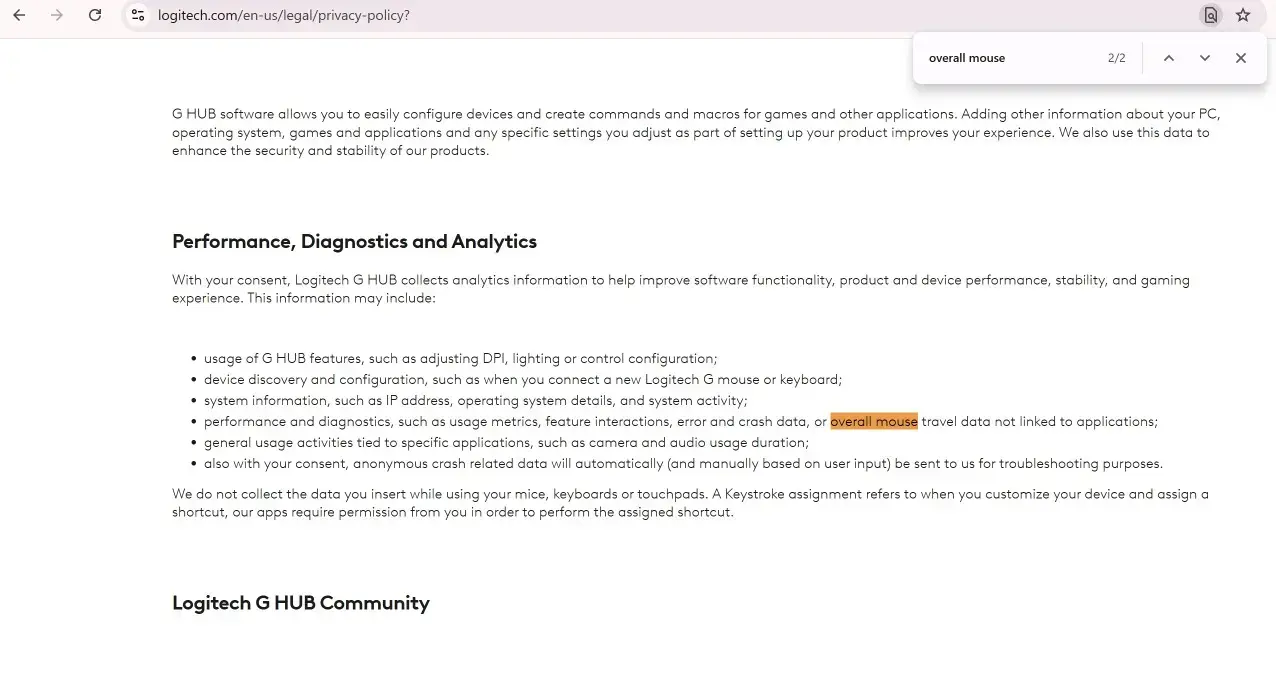
That wording deserves some important context. Logitech does not say G HUB records conversations through a microphone or captures footage from a webcam as part of these analytics. The company also explicitly states that it does not collect the data users input while using their mice, keyboards or touchpads.
The disclosure instead raises a different question for users of one of PC gaming’s most familiar companion applications: what information can software originally installed to manage a gaming peripheral collect about the wider way a computer is being used?
What Logitech says G HUB analytics can collect
G HUB has grown into considerably more than a utility for changing mouse sensitivity. Logitech describes the software as a central interface for configuring its gaming mice, keyboards, headsets, speakers, webcams and other compatible hardware.
Users can adjust DPI and lighting, create commands and macros, configure controls and establish settings for individual games and applications. Logitech says information about a user’s PC, operating system, games, applications and selected product settings can help improve the experience as well as the security and stability of its products.
The analytics portion is separately described as consent-based. According to Logitech’s current policy, G HUB analytics can include the use of software features such as DPI, lighting and control configuration; device discovery and configuration when Logitech G hardware is connected; and system information including the operating system, IP address and system activity. The policy becomes more unusual when it describes performance and general usage information. Logitech says performance and diagnostic information can include usage metrics, interactions with features, errors, crash information and overall mouse travel that is not linked to applications.
A separate category covers general usage activities associated with particular applications. Logitech gives camera and audio usage duration as examples.
Those distinctions matter. Mouse travel that Logitech describes as “not linked to applications” is different from the separately listed application-specific activity. Likewise, knowing the duration for which camera or audio functionality is used should not be confused with collecting the underlying video or audio content.
Logitech says this collection requires consent
The most important qualification appears at the beginning of Logitech’s analytics disclosure: “With your consent.”
In other words, the policy does not describe these analytics categories as information silently collected from every G HUB installation regardless of the user’s choices. G HUB has previously included an option allowing users to share usage data with Logitech, and the company’s privacy documentation has long acknowledged analytics collection within its gaming software. The existence of G HUB telemetry is therefore not itself a new revelation.
What makes the current disclosure notable is the specificity with which Logitech now describes examples of the information those analytics can contain.
What changed from Logitech’s January 2025 wording?
TalkEsport compared the current disclosure with Logitech’s officially archived privacy policy from January 2025. The older policy already described G HUB analytics and made clear that users could opt in. It discussed categories including IP-address and location information, use of G HUB features, device discovery, performance metrics, errors and crash-related information.
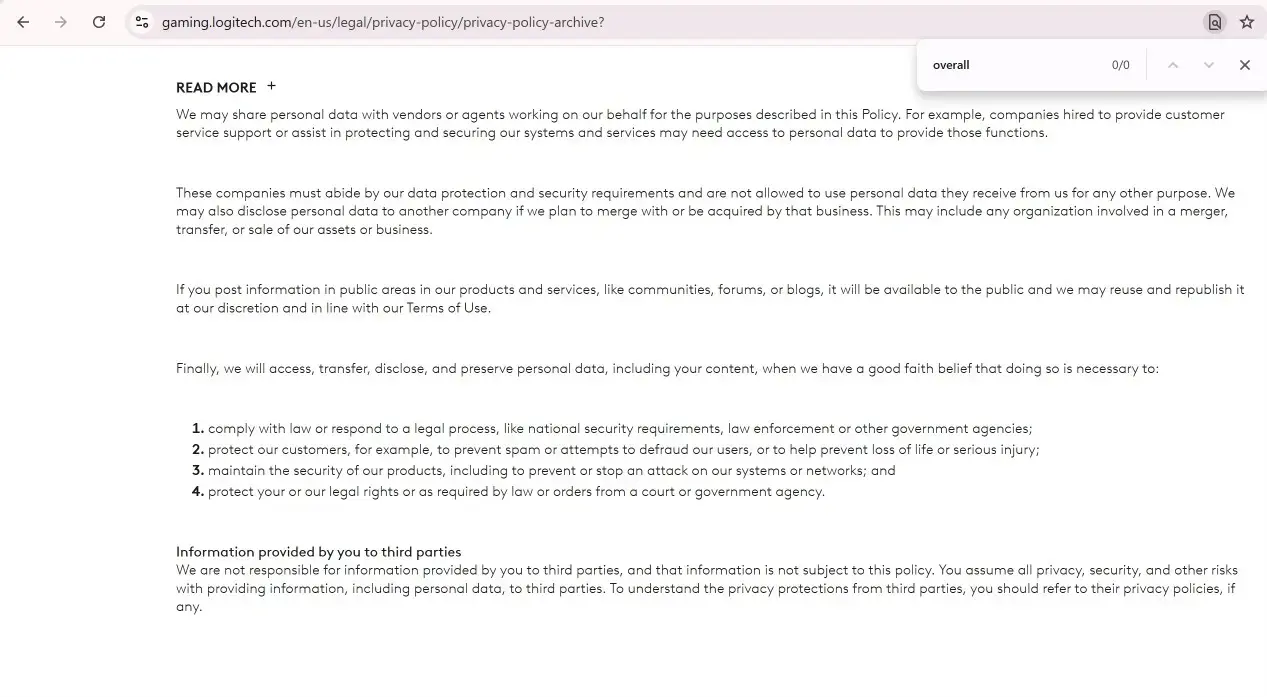
The January 2025 wording, however, does not explicitly identify overall mouse travel or application-specific camera and audio usage duration among its examples. That does not establish when Logitech began collecting those metrics, nor does it prove that the underlying analytics capabilities were introduced between January 2025 and October 2026. Privacy policies describe data practices; they are not software changelogs.
The comparison establishes something narrower: Logitech’s current disclosure provides substantially more specific examples of what its consent-based G HUB analytics may include than the January 2025 archived wording.
Why would Logitech measure how far a mouse travels?
Mouse movement telemetry sounds unusual when encountered without context, but Logitech’s wider privacy documentation provides some indication of why a hardware manufacturer might be interested in device-usage measurements. In the analytics disclosure covering some of its other software, including Logitech Options+, the company discusses device-usage information such as click counts, scroll actions and overall mouse movement that is not linked to applications.
Logitech provides product durability and dependability as one example of how such information can be useful. Measuring how frequently a physical button is used over a period of time, for instance, can provide data about how hardware behaves under real-world use. The G HUB section similarly says analytics are collected to improve software functionality, product and device performance, stability and the gaming experience.
That context provides a plausible product-development reason for mouse-usage telemetry. It does not, however, answer every question raised by the newer G HUB wording, particularly around the scope and purpose of application-specific camera and audio usage duration.
Camera usage data does not mean G HUB is recording your camera
The distinction between usage data and content is particularly important here. Logitech’s G HUB disclosure refers to camera and audio usage duration associated with particular applications. It does not state that G HUB analytics record video from a webcam, listen to microphone conversations or transmit the content of those communications to Logitech. The company’s policy also contains an explicit limitation concerning peripheral input. Logitech says it does not collect the data users enter while using their mice, keyboards or touchpads.
That means the disclosure should not be interpreted as evidence of keylogging or of Logitech collecting everything a player types or clicks. What it does establish is that Logitech considers information such as mouse-travel measurements and the duration of camera and audio use within particular applications to fall within the potential scope of consent-based G HUB analytics.
G HUB has expanded well beyond mouse configuration
The breadth of the disclosure also reflects how much G HUB itself has evolved.
For competitive players, mouse configuration remains particularly important. DPI settings interact directly with in-game sensitivity, which is why players frequently fine-tune both when establishing settings for games such as VALORANT. TalkEsport has previously explained how DPI and sensitivity work together when finding suitable VALORANT settings.
The same principle becomes relevant when players move between games, where maintaining equivalent sensitivity can require converting values between different engines. Our VALORANT to Marvel Rivals sensitivity conversion guide is one example of how central mouse configuration has become to competitive PC gaming. But G HUB now manages considerably more than mouse DPI. Logitech’s own documentation covers keyboards, headsets, webcams and other gaming hardware, while software updates have continued adding or modifying functionality across those categories.
In March 2025, for example, Logitech’s G HUB release notes documented additional webcam microphone controls, including input gain and mute functionality. An April 2026 update separately changed webcam preview behaviour so that the preview pauses when the application loses focus.
Those release notes demonstrate G HUB’s expanding interaction with different types of gaming hardware. They do not establish when the analytics categories described in the current privacy policy were introduced.
What we still don’t know
A privacy policy can tell users what a company says it may collect. It cannot, by itself, reveal precisely what data an individual G HUB installation is transmitting at any particular moment. TalkEsport has not performed a packet capture or independent network analysis of G HUB for this report. We have therefore not independently reproduced the collection or transmission of the individual analytics fields described by Logitech.
The published documentation also does not establish when overall mouse-travel measurements or application-specific camera and audio usage duration first became part of G HUB analytics.
Those limitations are important because the current wording should not be treated as evidence that Logitech suddenly introduced a new analytics programme in October 2026. The date on a privacy policy tells us when that version of the disclosure was published or updated, not necessarily when every practice described inside it began.
What G HUB users should understand
For G HUB users, the practical takeaway is less dramatic than claims of surveillance but more substantial than a routine software privacy notice.
Logitech openly describes G HUB analytics as consent-based. Users deciding whether to participate now have considerably more specific information about what that choice can encompass, including metrics that extend beyond simply knowing which Logitech mouse is connected or whether a software feature crashed. Overall mouse travel can form part of performance and diagnostic information. General activity associated with individual applications can include how long camera and audio functionality is used.
At the same time, Logitech explicitly says it does not collect the information users input through their mice, keyboards or touchpads.