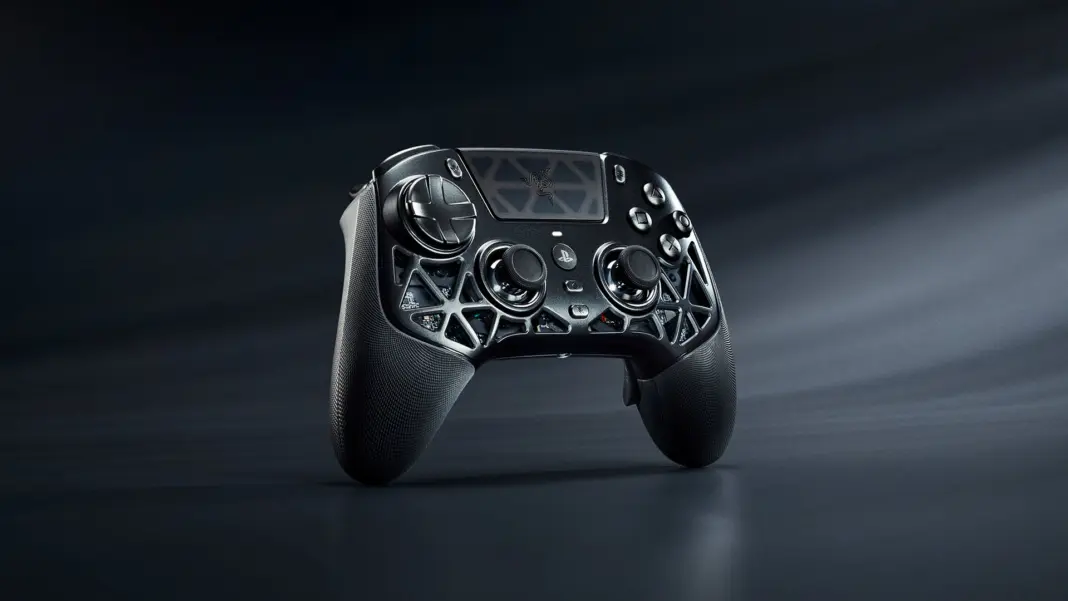
Razer has put a price on PlayStation obsession, and it is a steep one. The Raiju V3 Pro Signature Edition, unveiled on 3 November, wraps Razer’s flagship PS5 controller in a magnesium alloy exoskeleton and caps the first run at 1,337 individually serialised units worldwide.
According to launch details Razer shared with outlets including TechRadar, GamesRadar+ and Game Rant, the pad costs $349.99 in the US, £349.99 in the UK and €368.99 in Europe, with sales opening on 10 November. Razer’s own product page does not show a price yet and only offers a Notify Me button, while its official X post says the countdown begins on 6 November.
Razer says the controller will be sold only through Razer.com and select RazerStore locations, and GamesRadar+ reports that stock will go out in regionalised drops on a first-come, first-served basis. Razer has not said whether buyers will be limited to one unit each, which matters a great deal when 1,337 units are split across the whole planet.
That number is the old internet spelling of “leet”, and Razer has used it before. Its Huntsman Signature Edition keyboard was unveiled in February in a run of 1,337 serialised units, and it now shows as out of stock at US$499.99 on Razer’s US store.
What $130 extra buys over the standard Raiju V3 Pro
The standard Raiju V3 Pro sells for $219.99 on Razer’s US store, so the Signature Edition asks for $130 more. Judging by Razer’s own spec lists, most of that money goes into materials and finish rather than new performance hardware, since the core layout and sensors carry over.
The headline change is the shell, an open polygonal top and back plate in magnesium alloy. Razer adds a nano coating that leaves the internal components on show while keeping debris out. On top of that, the handles get matte black textured TPU grips, and the touchpad becomes laser-etched tinted glass carrying a Razer logo.
The face buttons, D-pad and secondary inputs are double-shot PBT in matte black with tone-on-tone icons, so the legends should not wear away. Underneath the new skin, it keeps the symmetrical TMR thumbsticks, two claw-grip bumpers and four mouse-click back buttons, giving six mappable inputs in total. The weight, however, is where the marketing gets awkward. Razer bills the Signature Edition as ultra-lightweight at 260 g, yet its own page lists the standard Raiju V3 Pro at 258 g. In other words, the magnesium frame buys looks and rigidity rather than any saving on the scales.
Connectivity follows a similar pattern, with Razer quoting up to 2,000 Hz polling on PC through HyperPolling Wireless using the bundled HyperSpeed dongle. Its standard Raiju V3 Pro page, by contrast, lists 250 Hz wireless on PS5 and 2,000 Hz wired on PC. Razer has not published the Signature Edition’s console polling rate or its battery life, although the regular model is rated for up to 36 hours on PS5.
Tuning runs through Razer Synapse on PC or the Razer PS mobile app, covering remapping, stick sensitivity, trigger actuation range and up to four onboard profiles. PC play carries Razer’s footnote that Sony has neither tested nor endorsed it, since the official licence covers the PS5 console.
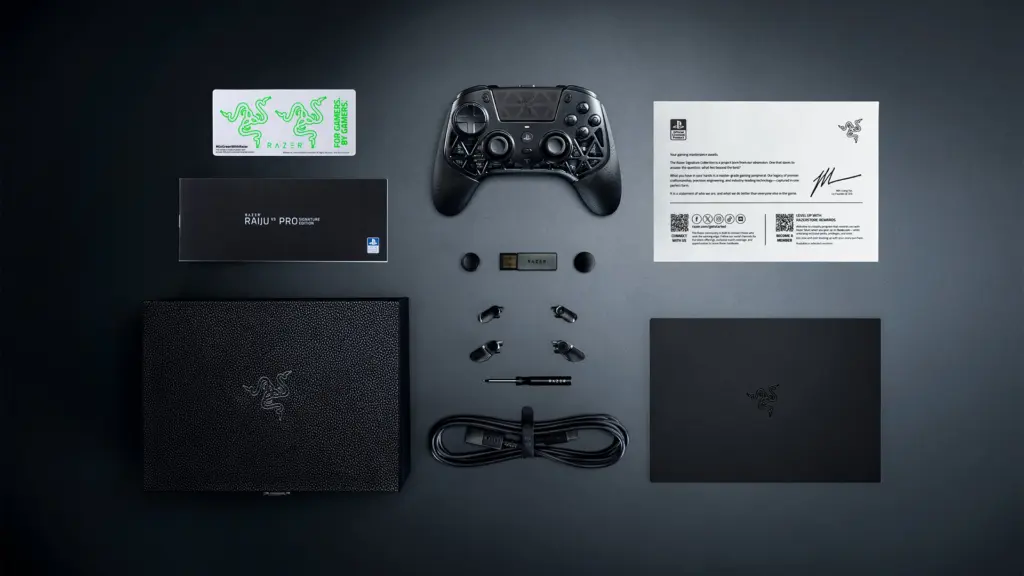
The box does a lot of the heavy lifting instead. Buyers get a leatherette carrying case that doubles as a display piece, plus short convex and tall concave stick caps and four back button covers. An anodised aluminium driver for swapping back buttons, the HyperSpeed dongle and a USB-A to USB-C cable complete the bundle.
Charlie Bolton, Razer’s Global Head of Design, said the goal was to show what happens when Razer’s engineering and design capabilities are “pushed to their absolute limits”, calling the result a statement piece in the hand.
Who pays $350 for a PS5 pad?
Set against the rest of the premium market, the price stands out immediately. Sony sells the DualSense Edge for $199 on PlayStation Direct, and Microsoft lists the Xbox Elite Series 2 at $199.99, which leaves Razer’s collector piece roughly $150 above both.
The Edge also brings haptic feedback and adaptive triggers, while Razer’s FAQ confirms the standard Raiju V3 Pro skips haptic feedback to cut weight and latency. Nothing in the Signature Edition material suggests that has changed, so anyone paying $349.99 is buying a stripped-back esports pad rather than a more immersive one. In practice, the realistic buyer is a collector who already rates the Raiju V3 Pro and wants a numbered version for the shelf, rather than a competitive player chasing an edge the $219.99 model already provides. Scarcity sells on its own as well, and TalkEsport reported last month that Sony’s $84.99 LISA edition DualSense was moving in and out of stock soon after pre-orders opened.
Hardware brands are clearly leaning into showpieces this season, from Microsoft’s one-off alligator Xbox Series X giveaway to Razer’s numbered pads. The fine print still matters here, because Razer’s press release calls the 1,337 units an initial release, which leaves the door open to a second batch later on.