

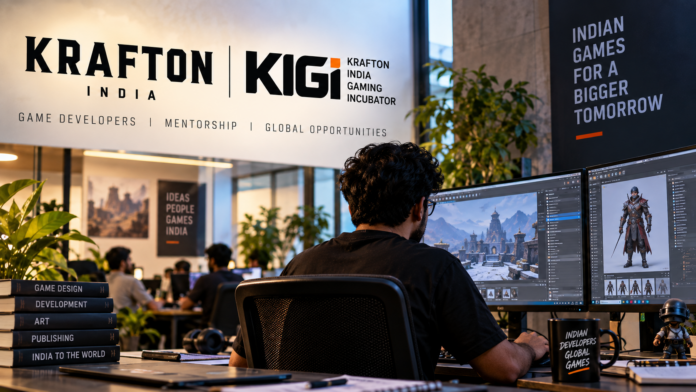


KRAFTON India has opened applications for the fourth cohort of its KRAFTON India Gaming Incubator, significantly widening the type of Indian game-development projects eligible for support as the company expands KIGI beyond its traditional early-stage pipeline.
Beginning with KIGI Cohort 4, mobile developers can apply with games already in beta or soft launch, while PC developers with playable Steam demos and signs of community traction will also be considered. Early-stage concepts and first-time development teams remain eligible, meaning KRAFTON is effectively expanding the incubator across a much broader portion of a game’s journey from concept to commercial release.
Applications opened on September 22 through KRAFTON India’s official KIGI portal. The program, launched in 2023, offers selected Indian studios financial assistance alongside mentorship from developers and industry specialists in India, South Korea and other gaming markets. KRAFTON says financial assistance available through KIGI ranges from $50,000 to $150,000, while participation can also open routes to publishing, venture funding and potential equity investment from the company.
KIGI Cohort 4 widens the incubator beyond early-stage games
The change in eligibility is arguably the most important development in KIGI’s fourth edition. Previous cohorts established the program primarily as a mechanism for identifying emerging Indian developers and helping them turn early projects into commercially viable games. Cohort 4 retains that function but adds projects that have already crossed important development milestones.
For mobile developers, KRAFTON will now consider games already undergoing beta testing or soft launch. On PC, developers can enter with games that already have a live Steam demo and are beginning to demonstrate community interest. KRAFTON describes the change as an attempt to support promising games regardless of whether the team is beginning with an idea or has already reached players.
That potentially gives KIGI a different role in India’s development ecosystem. A project that has already accumulated player feedback or early usage data can require a different kind of support from a prototype, with user acquisition, retention, quality assurance, publishing and scaling becoming increasingly important as a game moves towards commercial release.
KRAFTON had already begun moving in this direction with Cohort 3. The official KIGI program says the third cohort introduced deeper mentorship, dedicated functional experts, enhanced quality control and user-acquisition support alongside partnerships with companies including Google Cloud, AWS, AccelByte, GameRefinery, AppMagic, Lysto and GameRamp.
From 1,000 KIGI Cohort 3 applications to four studios
KIGI’s selection process has already become competitive. KRAFTON says approximately 1,000 applications were received for Cohort 3, from which four studios were selected: XODGames Studios, EvolX Games, Ether Games and RedDevil Studios.
Those studios are currently developing Peaky Circus, Ludaro, Battlefront and Rooster Rumble respectively, according to KRAFTON’s current KIGI portfolio.
TalkEsport reported on the announcement of KIGI Cohort 3 in April, when KRAFTON outlined a more hands-on support model offering selected studios between $50,000 and $150,000 in milestone-based funding alongside six to 12 months of mentorship.
Before that, KIGI’s second cohort brought six Indian studios into the program, including Singular Scheme, Advaita Interactive, Kleanup Games, Ginger Games, Smashhead Studios and Unwind Games.
Frontier Paladin gives KIGI its first released PC game
KIGI now also has a useful test case for what happens after incubation. Mumbai-based Singular Scheme’s Frontier Paladin became the first PC title to emerge from KIGI when it launched on Steam on April 24, 2026, after participating in the program’s second cohort.
Five months after release, Frontier Paladin’s Steam page lists 70% of its 31 user reviews as positive. The game combines an isometric action RPG structure with tower-defense elements and stamina-driven combat.
The numbers remain relatively small, so they should not be interpreted as evidence of large-scale commercial success. Frontier Paladin is important to KIGI for a different reason: it demonstrates that a title supported by the program has travelled the full route from incubation to a commercial PC release.
KRAFTON broadens its game-development strategy in India
KIGI sits within a considerably larger KRAFTON investment strategy in India. The company says it has invested more than $250 million in Indian startups since 2021 across gaming, interactive entertainment, esports and technology. It has also announced the ₹6,000 crore KRAFTON India Unicorn Growth Fund alongside Naver and Mirae Asset.
The incubator addresses a different part of that ecosystem. Rather than simply investing in established companies, KIGI provides game-development teams with capital and technical mentorship while their products are still being built. KRAFTON says the first two cohorts together included 10 studios nationwide, with Cohort 3 subsequently adding another four.
The company has also begun extending the KIGI identity into game-development education. Its recently launched KIGI Academy is working with IIT Madras on a fully funded program covering coding, game design, UI/UX, art and product development, with an initial intake of 30 students.
Taken together, the initiatives show KRAFTON building a development pipeline that stretches from training prospective creators to incubating studios and, potentially, publishing or investing in games that emerge from those programs.
KIGI Cohort 4 applications are now open
Applications for Cohort 4 opened on September 22. Developers can apply through the official KRAFTON India Gaming Incubator website.
KRAFTON India Incubator Program head Anuj Sahani said the expanded eligibility is intended to let KIGI continue supporting first-time teams while also working with games that have already demonstrated early traction.
“With KIGI Cohort 4, we’re widening that support,” Sahani said, adding that the program’s mission remains to help Indian development teams navigate the path from concept to market.
KRAFTON India CEO Sean Hyunil Sohn similarly positioned Cohort 4 as part of the company’s effort to support developers at different stages rather than focusing exclusively on new projects.
For Cohort 4, that broader eligibility is the meaningful change. KIGI is no longer only looking for promising Indian developers at the beginning of their journey; it is also looking for games that may already have players, data and demonstrable market interest but still need capital, expertise and distribution support to move to the next stage.
