

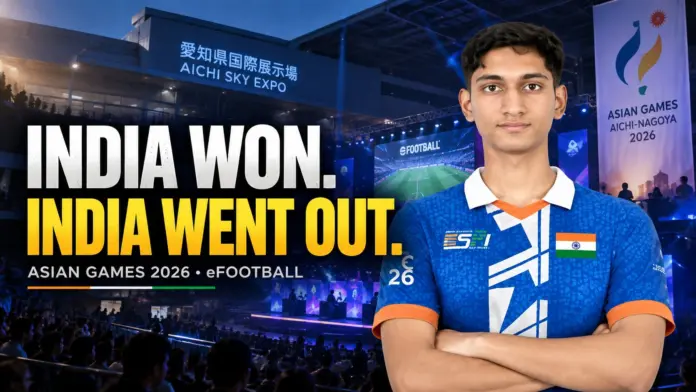


India’s eFootball campaign at the Asian Games 2026 ended in extraordinary circumstances after Danial Patel and Chinmay Sahoo were eliminated without getting the opportunity to play their decisive group-stage match against Mongolia.
The Indian pair did not arrive late. They did not lose to Mongolia either. In fact, India were officially awarded a victory after Mongolia missed the required check-in deadline by three minutes. The problem was that the forfeit was recorded as a 0-0 win, leaving India with no additional goal difference and ultimately costing them a place in the knockout stage.
India finished Group F with four points, level with Uzbekistan, but were eliminated on goal difference. It created the remarkable situation in which India won its final match by forfeit and was simultaneously denied the opportunity to score the goals it needed to qualify.
What happened to India in eFootball at Asian Games 2026?
India entered the eFootball competition with two players: Danial Shakeel Patel in eFootball Mobile and Chinmay Sahoo on console. As TalkEsport reported before the Games, the pair formed part of India’s 15-member esports contingent competing in Aichi-Nagoya.
The format placed India in Group F alongside Uzbekistan and Mongolia. India began its campaign against Uzbekistan, with the two nations finishing level at 0-0. That made the remaining results particularly important because only the group winner was guaranteed progression, while goal difference could also determine India’s chances through the second-place qualification route.
Uzbekistan subsequently faced Mongolia and built a huge advantage. Uzbekistan won the mobile game 6-3 and the console game 12-0, giving it a combined goal difference of +15 from the Mongolia fixture.
India therefore entered its scheduled meeting with Mongolia knowing that the scoreline mattered. A victory alone might not be enough; Patel and Sahoo needed goals to improve India’s position in the qualification calculations.
Why didn’t India play Mongolia?
Then came the incident that changed India’s tournament. According to accounts from the Indian players reported by The Sunday Guardian and other Indian outlets, Mongolia’s team leader arrived three minutes after the stipulated check-in deadline.
Under the competition regulations applied by the organisers, Mongolia’s late arrival resulted in a forfeit. India were therefore awarded the victory without the match taking place. Ordinarily, being handed a walkover sounds like an advantage. For India, it became the opposite.
Why was India’s forfeit win recorded as 0-0?
The organisers recorded India’s victory over Mongolia as a 0-0 forfeit. India received the points associated with the win, but the result added nothing to the team’s goal difference. That distinction decided India’s fate. India had drawn 0-0 with Uzbekistan and then received the 0-0 victory over Mongolia. The result left India with four points and a goal difference of zero. Uzbekistan also finished with four points, but its heavy victories over Mongolia gave it a vastly superior goal difference.
Uzbekistan consequently finished above India and progressed as the Group F winner.
How did a win eliminate India from the Asian Games?
This is the part of the story that has caused the most confusion. India were not eliminated because the walkover counted as a loss. They were eliminated because the 0-0 walkover denied Patel and Sahoo the opportunity to improve their goal difference by actually playing Mongolia. Uzbekistan had already been able to play Mongolia and score heavily. India never received the same opportunity because Mongolia missed the check-in deadline for their fixture.
Chinmay Sahoo explained that India effectively needed a 3-0 result in both the mobile and console games — a combined +6 goal difference — for a walkover score to help their qualification position. Instead, the official 0-0 result left India’s goal difference unchanged.
There was still another possible route into the knockout stage through the ranking of second-placed teams, but goal difference hurt India there as well. Thailand progressed with a +3 goal difference, while Saudi Arabia advanced with +2. India’s zero goal difference left the team behind both.
Did India protest the decision?
Yes. Importantly, the Indian players did not ask to take the easy victory and move on. Sahoo said the Indian side protested and specifically asked officials to let them play Mongolia rather than accept the forfeit. Playing the match would at least have given Patel and Sahoo control over their own qualification chances. Officials declined the request, maintaining that a forfeit was the outcome prescribed by the rules once Mongolia had missed the check-in deadline.
India were informed that the decision could be taken to a judge panel for formal review, but doing so required a $500 fee. The players ultimately did not pursue that option because the late-arrival rule itself was clear, meaning a review offered no guarantee that the match would be restored or that the forfeit score would change.
India’s Asian Games eFootball results explained
The simplest way to understand India’s exit is through the two Group F fixtures:
- India 0-0 Uzbekistan — Draw
- India 0-0 Mongolia — India awarded a forfeit victory after Mongolia missed check-in
- India finished with four points and a goal difference of 0
- Uzbekistan also finished with four points but had a superior goal difference after beating Mongolia 6-3 on mobile and 12-0 on console
- Uzbekistan advanced as the Group F winner
- India also missed the second-place qualification route, with Thailand (+3) and Saudi Arabia (+2) ahead on goal difference
Who are Danial Patel and Chinmay Sahoo?
The manner of the elimination was particularly painful because India arrived at the Asian Games with genuine expectations in eFootball. Danial Shakeel Patel represented India in eFootball Mobile and entered Aichi-Nagoya as one of the country’s leading esports medal prospects. Earlier in 2026, Patel was part of India’s title-winning campaign at the FIFAe Continental Championship Asia.
Chinmay Sahoo represented India on console. Together, the pair had the opportunity to challenge for India’s first official esports medal at the Asian Games. India did not win an esports medal when the discipline made its official medal debut at the Hangzhou Asian Games. Tirth Mehta had previously won bronze in Hearthstone at the 2018 Asian Games, when esports was staged as a demonstration event rather than an official medal discipline.
So, why was India eliminated from Asian Games eFootball?
In simple terms: India needed goal difference, but Mongolia’s late arrival meant India never got the chance to score those goals.
Mongolia missed the check-in deadline by three minutes, India were awarded a victory, and the organisers recorded that victory as 0-0. India therefore received three points but no goal-difference advantage. Uzbekistan had already played and heavily beaten Mongolia, allowing it to finish above India despite both nations ending Group F on four points. The Indian players asked to play the match anyway, but officials enforced the forfeit rule. India then also missed qualification through the second-place rankings because Thailand and Saudi Arabia had better goal differences.
It is an unusual sporting paradox, India’s decisive Asian Games match officially ended in victory, yet the circumstances of that victory removed the opportunity Patel and Sahoo needed to keep their medal campaign alive.
Why India’s Asian Games eFootball exit is controversial
The controversy is not simply that India were eliminated on goal difference. It is that the two teams competing for first place in Group F were not given the same opportunity to build that goal difference.
Uzbekistan played its scheduled games against Mongolia, winning 6-3 on mobile and 12-0 on console. Those results gave Uzbekistan a substantial goal-difference advantage after its 0-0 draw with India.
India was supposed to have the same opportunity against Mongolia. Instead, Mongolia’s team leader reportedly missed the required check-in time by three minutes. The resulting forfeit was recorded as a 0-0 victory for India, meaning Patel and Sahoo received the points but were denied any opportunity to improve their goal difference.
That produced an unusual competitive imbalance. Uzbekistan’s actual scores against Mongolia counted towards the tiebreaker, while India was prevented from playing Mongolia for reasons outside the Indian team’s control. The same goal-difference criterion was then used to separate India and Uzbekistan.
India’s players attempted to avoid that situation by asking officials to let the Mongolia fixture go ahead despite the late arrival. According to Chinmay Sahoo, that request was rejected because competition rules prescribed a forfeit.
There is no indication that India were singled out or that officials departed from the written late-arrival rule. The controversy instead concerns the consequence of applying that rule alongside a goal-difference tiebreaker: India was disadvantaged by its opponent’s failure to report on time.
