Minecraft is an open-world sandbox game, and survival progress becomes much easier once you start automating the resources you use most. Mojang’s official beginner farming guidance also makes clear that farming is a core survival skill, not a side activity: it is how you keep steady food, crops, and materials flowing while you explore, build, and progress.
That is why the best Minecraft farms are the ones that save time, reduce grinding, and scale well into mid-game and late-game survival. If you want a farm order that actually helps progression, start with renewable iron, then move into food, materials for trading, and mob drops.
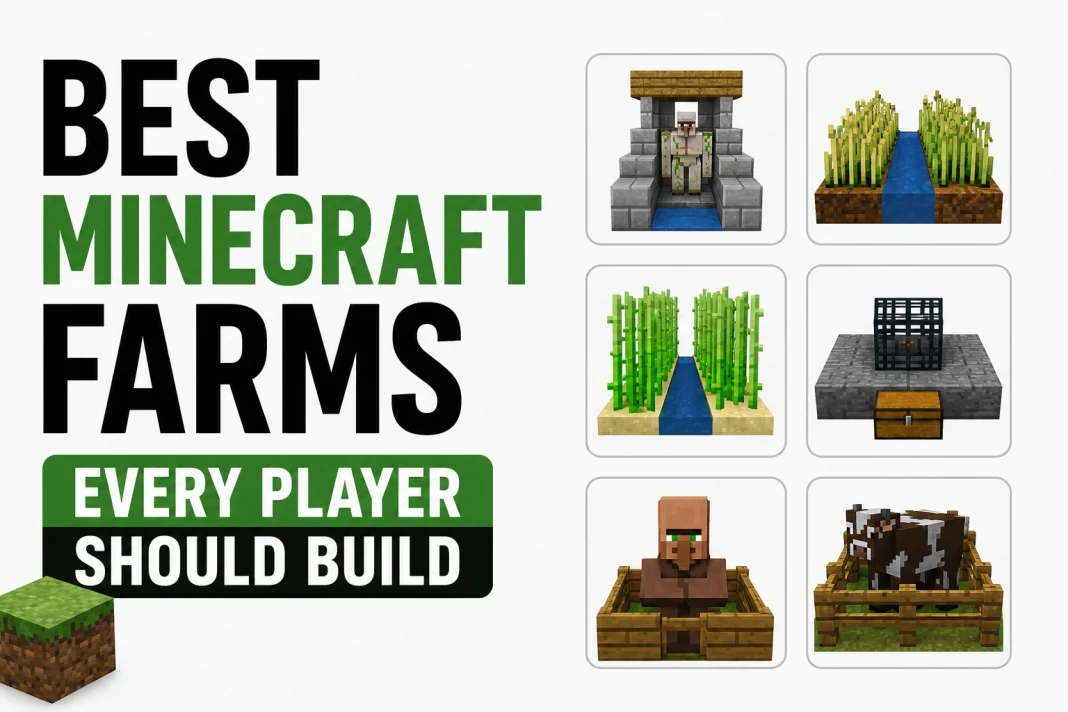
1) Iron Farm
An iron farm is one of the most valuable builds in Minecraft because iron underpins so many survival systems. Mojang’s iron golem article confirms that iron golems naturally belong to village life and can also be created with four iron blocks in a T-shape topped by a carved pumpkin or jack o’lantern. That makes iron farms a natural extension of Minecraft’s village mechanics.
If you only build one advanced farm early, make it this one. Iron is used constantly for hoppers, rails, buckets, tools, and a long list of utility builds, so a renewable iron source pays off for the rest of the world. That is also why official Bedrock beginner-farm content highlights an iron farm as a top early-game build.
2) Crop Farm
A crop farm is the most reliable survival farm for everyday progression. Mojang’s farming guide explains that farmland can support wheat, melons, pumpkins, carrots, and potatoes, and its beginner guide shows that seeds can come from villages, chests, or traders.
This farm belongs on every world because food is non-negotiable, and crop farms also support villager trading, composting, and long-term sustainability. In practice, a simple wheat-and-carrot setup is often enough to keep a base stable until you are ready to automate larger systems.
3) Sugar Cane Farm
A sugar cane farm is one of the smartest builds for long-term progression because sugar cane turns into paper, and paper is used for books, maps, and villager trading setups. Mojang’s official paper article confirms that three sugar cane create three paper, which makes sugar cane one of the cleanest renewable materials to automate.
Minecraft’s redstone article also notes that redstone can automate gadgets such as sugar cane harvesters. That means sugar cane is not just a crop; it is a simple automation project that gives you a huge return over time.
4) Mob Farm
A mob farm is one of the best all-purpose farms because it helps with general drops and XP while you are doing other things in the world. Mojang’s classic mob-farm tutorial describes a trap designed to lure in sunlight-hating mobs and funnel drops into chests, which makes it a practical early automation project.
If you want a farm that keeps producing value without needing constant attention, this is a strong choice. Even a modest mob farm helps with progression because it converts passive spawning into useful loot storage.
5) Villager Trading Hall
A villager trading hall is not just convenient; it is one of the most powerful systems in survival Minecraft. Mojang’s villager-jobs article shows how central villagers are to the game’s economy, while the Bedrock beginner-farms article specifically calls out a villager trading hall as a top early-game farm idea.
Trading halls are worth building because they convert renewable crops and mob-produced materials into emeralds, enchanted gear, and useful supplies. Once your farm network is running, villagers become the bridge between raw resources and late-game power.
6) Cow Farm
A cow farm is one of the simplest farms every player should build because it gives you food, leather, and a renewable breeding loop. Mojang’s cow article confirms that wheat breeds cows, produces a baby cow, and even yields experience orbs when you breed them.
It may not look as flashy as an iron farm or mob farm, but it solves a basic survival problem very efficiently. For most worlds, a compact cow farm is enough to keep food and leather within easy reach.
Best farm order for most players
If you are building from scratch, the best order is usually: crop farm first, then iron farm, then sugar cane, then mob farm, then villager trading hall, then cow farm. That sequence matches the way survival progression works in the official Minecraft guides: first secure food, then automate core materials, then move into trading and utility systems.
What makes these the best farms
These farms rank highest because they are renewable, practical, and useful across every stage of survival. They also align with Minecraft’s official systems: villages, farmland, redstone automation, mob spawning, and breeding are all core parts of the game’s design.
If you want a strong SEO article, the real value is not a random “top 10” list. It is a guide that tells players what to build first, why it matters, and how each farm fits into the survival loop. That makes the article more helpful to readers and more credible to search engines.
Also read: A Minecraft Movie Squared Is the Official Title for the Minecraft Movie Sequel
FAQ
What is the best first farm in Minecraft?
For most players, a crop farm is the best first farm because it solves food immediately and uses the game’s basic farming systems.
What farm gives the most value overall?
An iron farm usually gives the most long-term value because iron is useful in so many survival recipes and utility builds.
Are sugar cane farms worth building?
Yes. Sugar cane turns into paper, and Minecraft’s official redstone article explicitly notes that redstone can automate sugar cane harvesters.
Do I need a villager trading hall?
If you want easy emeralds, enchanted gear, and a stronger late-game economy, a trading hall is one of the best farms to build.