A Delaware Court of Chancery magistrate has ruled that Super Micro Computer must hand a Chicago teachers’ pension fund more of its internal records, including Audit Committee minutes from December 2024. The ruling also covers, under strict conditions, a federal grand jury subpoena from New York linked to the export case against its co-founder. The findings are set out in a post-trial report by Magistrate Mitchell of the Court of Chancery, issued under seal on 17 November and published in redacted form on 25 November 2026. Either side can still challenge the report through exceptions before it is put into effect.
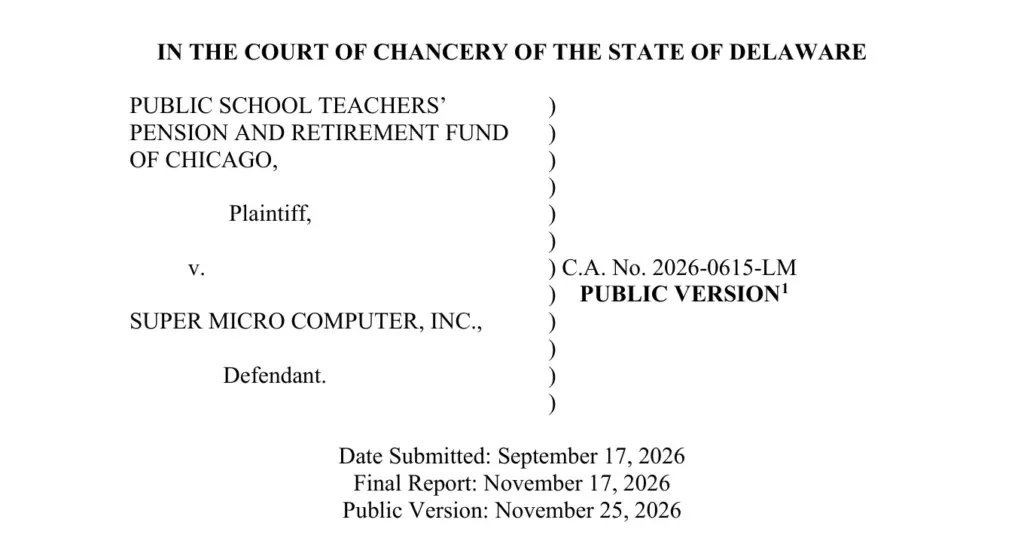
The plaintiff in case 2026-0615-LM is the Public School Teachers’ Pension and Retirement Fund of Chicago, and the defendant is Super Micro Computer. It is a books and records action, which means the fund asked to inspect company documents rather than suing anyone for damages. The report finds that the fund has a proper purpose for that inspection, but it states plainly that it does not establish wrongdoing by Supermicro or any of its directors.
What the Delaware magistrate ordered Supermicro to hand over
The pension fund has held Supermicro shares since 2019 and sent its inspection demand on 7 February 2025, under Section 220 of the Delaware General Corporation Law. Supermicro turned down the demand but agreed to share documents under a confidentiality agreement, producing material between March 2025 and January 2026. The fund said key records were still missing, filed suit on 13 May 2026, and the court held a half-day trial on the papers on 17 September.
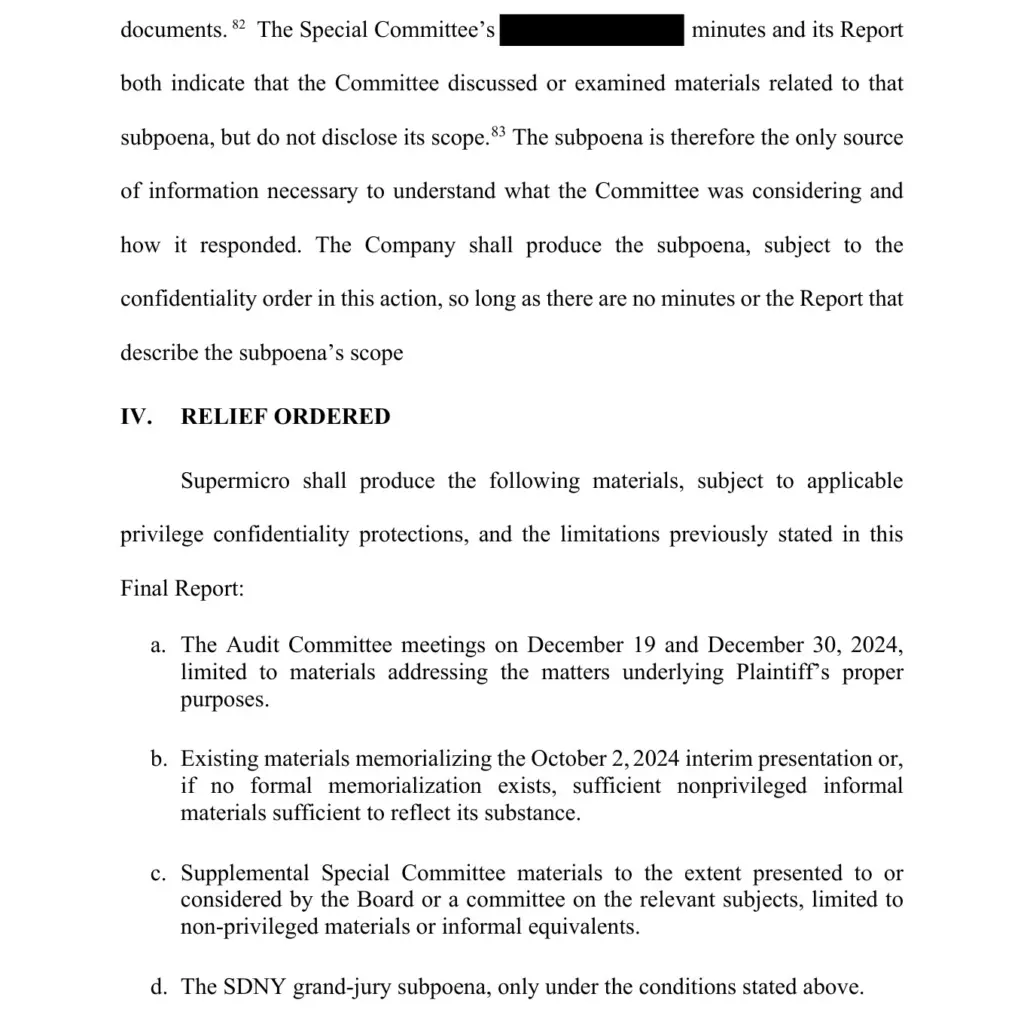
The fund asked for five more categories of documents, and dropped one interim report from its request at trial. The report grants four of the remaining requests in a limited form. Supermicro must produce the relevant parts of its Audit Committee minutes and agendas from meetings on 19 and 30 December 2024, which dealt with the auditor’s follow-up requests after the Special Committee’s report.
It must also produce existing material recording an oral interim presentation the Special Committee gave to auditor Ernst & Young on 2 October 2024, or informal records showing its substance if nothing formal exists. A third order covers supplemental findings the Special Committee shared with auditors in February 2025, including findings drawn from mobile devices, where the board or a committee considered them. In each case the order is limited to material the fund cannot already get from documents Supermicro has produced.
The most striking item is the grand jury subpoena. Supermicro confirmed at trial that a subpoena from the Southern District of New York exists, but argued it was discussed by the Special Committee rather than handed to it. The report found that the committee’s minutes and report refer to the subpoena without describing its scope, so it ordered production as long as no minutes or report describe that scope.
One of the fund’s five requests failed outright. Its demand for separate whistleblower reports was denied without prejudice, because the record did not show that such reports exist apart from compilations Supermicro had already produced. Everything the company hands over remains covered by the parties’ confidentiality agreement, so none of these documents will become public through this order.
Why the pension fund cleared Delaware’s credible basis test
To win a books and records case, a shareholder investigating possible misconduct only has to show a credible basis from which wrongdoing might be inferred. The report calls this the lowest burden of proof recognised under Delaware law. Because the fund sent its demand before 17 February 2025, the older version of Section 220 applies rather than the amended statute.
The report points to three pieces of evidence. Ernst & Young resigned as Supermicro’s auditor on 30 October 2024, saying it could no longer rely on representations by management and the Audit Committee. Special Committee minutes refer to federal grand jury subpoenas, and the New York indictment alleges export control violations involving a former director and others linked to the company.
The Special Committee was set up in August 2024, with director Susie Giordano as its only member. In November 2024 it concluded that it had found no evidence Supermicro knowingly tried to circumvent export controls. According to the report, reading that conclusion together with the later, unproven allegations against Liaw strengthened the case for a targeted inspection. The report adds that it does not treat the indictment’s allegations as established facts.
The export case against Wally Liaw behind the subpoena request
Federal prosecutors in Manhattan unsealed the indictment on 19 March 2026. The charges, announced by the US Attorney’s Office for the Southern District of New York, name three men. They accuse Supermicro co-founder Yih-Shyan “Wally” Liaw, Taiwan-based manager Ruei-Tsang “Steven” Chang and broker Ting-Wei “Willy” Sun of conspiring to divert servers containing US AI technology to China. Prosecutors allege that about $2.5 billion of servers were bought in 2024 and 2025, and that at least $510 million worth were diverted.
An indictment is an accusation, and the defendants are presumed innocent unless proven guilty. Liaw pleaded not guilty in April, Bloomberg reported. Supermicro itself is not a defendant, and it said in a statement on 19 March that the alleged conduct went against its policies and compliance controls, and that it was cooperating fully with the government.
The company told investors in a filing with the SEC that Liaw resigned from its board on 20 March 2026, and that his resignation was not the result of a disagreement. It also named DeAnna Luna as acting chief compliance officer. The case sits alongside wider scrutiny of where AI servers end up, from Nvidia’s missing Taiwan disclosure to restricted Blackwell hardware found at a Shanghai data centre.
Washington has tightened the rules since the indictment, and Nvidia halted server shipments to four Southeast Asian countries after a new US chip rule this month. Lawmakers are also pushing tighter controls on AI chip exports. The Delaware report is subject to the Court of Chancery’s rule on exceptions, and unless either side files them in time, the parties must submit an order putting it into effect within seven days.