
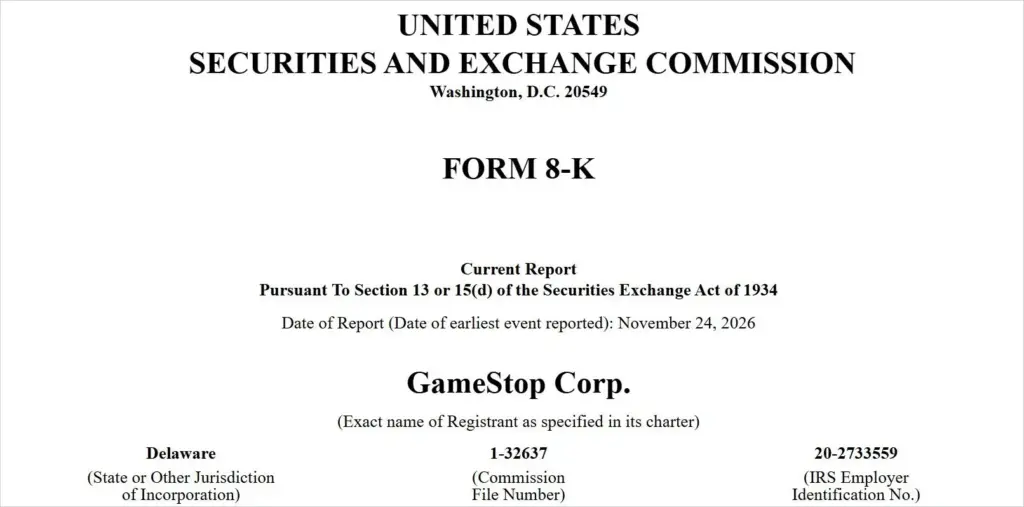
GameStop has agreed to pay $3.5 million to the lawyers behind a shareholder lawsuit that tried to block a vote on Ryan Cohen’s multibillion dollar stock option award. The company disclosed the payment in a Form 8-K filed with the US Securities and Exchange Commission on 25 November 2026. The Delaware Court of Chancery dismissed the case a day earlier, on 24 November.
The money is described in the filing as a mootness fee, paid to the plaintiff’s counsel for attorneys’ fees, expenses and costs. GameStop says it agreed to the payment “without admitting any fault or wrongdoing” and in its business judgment. The filing also states that the court did not review the amount, and did not pass judgment on whether the fee was reasonable.

What GameStop’s 8-K says about the $3.5 million fee
The disclosure sits under Item 8.01 of the report, the section headed “Other Events”. It is signed by Mark Robinson, GameStop’s general counsel and corporate secretary, and SEC records show it was accepted on the afternoon of 25 November. The report gives 24 November 2026 as the date of the earliest event it covers, which is the day the court signed off on the dismissal.
According to the filing, the court approved a stipulation and order dismissing all claims with prejudice as to the plaintiff. Claims by any other members of the proposed class were dismissed without prejudice, so the order does not shut them out. GameStop adds that the case will be closed once an affidavit confirming this disclosure has been filed with the court.
A mootness fee is paid when a company takes steps that make a lawsuit’s main demand unnecessary, and the plaintiff’s lawyers then seek payment for that result. In this case the steps came in June, when GameStop pulled Cohen’s award from the ballot and published extra information about a second proposal. The plaintiff withdrew its request for a temporary restraining order the next day, citing that supplement and “certain other agreements” made with the defendants.
The Pontiac pension fund lawsuit over Cohen’s award and 1.5 billion new shares
The case was filed on 15 June 2026 as a proposed class action by The City of Pontiac Reestablished General Employees’ Retirement System, a public pension fund in Michigan. It named GameStop and all five of its directors, Ryan Cohen, Alan Attal, Larry Cheng, Jim Grube and Nathaniel Turner, under case number 2026-0785-JTL. The defendants deny any and all wrongdoing, according to the 8-K.
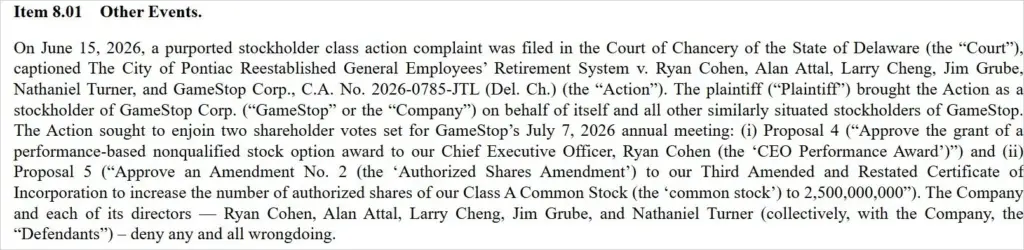
The lawsuit sought to stop two votes at GameStop’s annual meeting on 7 July. Proposal 4 asked shareholders to approve the CEO Performance Award for Cohen, while Proposal 5 asked them to raise GameStop’s authorised Class A shares to 2.5 billion. GameStop’s proxy supplement of 23 June said the complaint alleged a breach of fiduciary duty over that share increase, which would add 1.5 billion authorised shares.
The complaint’s main argument was about how the share vote would be counted. It alleged that GameStop’s charter required a majority of all voting power, so abstentions should count as votes against, while a supplement issued on 8 June said only a majority of votes cast was needed. GameStop said it believed the claim was without merit under Delaware law and that it intended to defend it vigorously.
Shareholders approved the share increase on 7 July with 231,693,497 votes for and 104,566,841 against, according to GameStop’s voting results. A total of 448,691,227 shares were entitled to vote on the record date. By TalkEsport’s arithmetic, the votes in favour equal about 51.6% of those shares, so the amendment also cleared the stricter standard the lawsuit argued for.
Ryan Cohen’s withdrawn option award and the eBay bid behind it
The award at the centre of the case was large by any measure. GameStop’s 2026 proxy statement describes 171,537,327 performance-based stock options with an exercise price of $20.66, split into nine tranches over a ten-year term. The tranches were tied to market value targets from $20 billion to $100 billion and cumulative performance EBITDA targets from $2 billion to $10 billion.
The board approved the award on 6 January 2026, with Cohen recusing himself, subject to a shareholder vote. The proxy said early estimates put its grant date fair value at about $2.5 billion, and that it was designed to give Cohen 20% of the market value created up to the highest target. Cohen is GameStop’s chairman and chief executive, roles he took on in the years after the 2021 stock surge and the exit of former chief executive George Sherman.
The 23 June supplement explained why Cohen asked for the award to be withdrawn. It said GameStop had not yet decided to pursue an acquisition of eBay when the board approved the award in January. Cohen wanted the company’s leadership fully focused on GameStop’s operating performance and the proposed eBay deal, according to the supplement. In May, eBay had already told GameStop that its $56 billion takeover bid was neither credible nor attractive.
The case was heard in the Delaware Court of Chancery, the main venue for disputes over the governance of companies incorporated in Delaware, as GameStop is. Shareholders can follow the company’s filings through its investor relations site, which links directly to its SEC records. The 8-K was filed with the SEC on 25 November 2026, the day after the court approved the dismissal.