

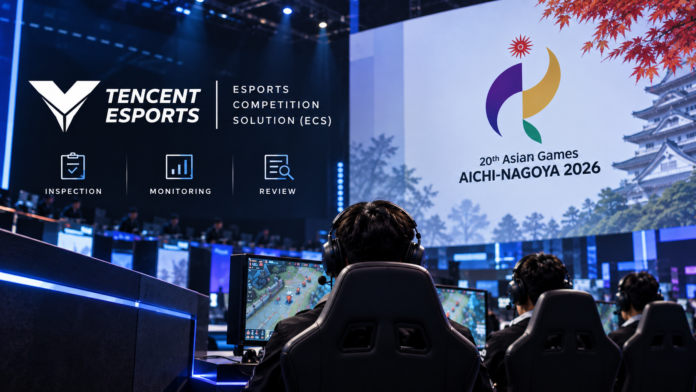


Tencent Esports will deploy its Esports Competition Solution (ECS) across all 11 esports medal events at the 20th Asian Games in Aichi-Nagoya, bringing equipment inspection, real-time monitoring and post-match review under a common technical system when esports competition begins in Japan on September 22.
According to a report by The Sun, ECS has been designed specifically for large-scale intercontinental esports competition. Inven Global also reported that the system will support operations across all 11 events, from pre-match equipment inspections through live competition monitoring and post-match record management.
The deployment is particularly notable because of the complexity of running esports inside a multi-sport competition. The Aichi-Nagoya programme spans six game categories and 11 medal events involving different publishers, game engines, software versions and device environments. Unlike a conventional professional esports league built around a single title, Asian Games officials must operate these different competitive environments while maintaining consistent standards for players and referees.
Esports is returning as an official medal sport after making its medal debut at Hangzhou 2022, which was eventually held in 2023. The 2026 esports programme will run from September 22 to October 2 at Hall D of Aichi Sky Expo and is the largest esports programme staged at an Asian Games to date.
How Tencent’s ECS will work at the Asian Games
ECS divides competition operations into three principal stages. Before a match begins, an Inspection Station checks player peripherals, equipment and the competition environment while maintaining check-in records for officials. The process is intended to create a consistent inspection procedure across games that may otherwise have very different hardware and technical requirements.
During competition, a Monitoring Console will track more than 30 indicators in real time, including device and network status. Officials can also bring together multiple video sources within the system, including Player POV footage, the Observer View and Hand Cams, giving referees and monitoring teams a broader picture of what is happening during a match.
Once play concludes, officials can use a dedicated Review Room to examine match records and footage. The system supports post-match reviews, record summaries, information retention and video archiving, effectively creating a technical record of the competition that can be revisited when an incident or officiating decision requires examination.
For esports at a multi-sport event, that distinction is important. Publisher-run leagues can design their competitive infrastructure around one game and one ecosystem, whereas the Asian Games must accommodate titles from several publishers while attempting to provide athletes with a consistent competition and officiating environment.
Tencent builds on its Hangzhou Asian Games experience
Tencent already has experience operating esports technology at the Asian Games. The company says its technical team supported 217 matches during the previous edition in Hangzhou and completed the schedule without a technical disruption.
The company has since subjected ECS to additional testing ahead of Aichi-Nagoya. Three test events were conducted between January and June 2026 across Japan, Singapore and Vietnam, allowing the system to be evaluated under different venue, network and tournament conditions. Integrated testing was subsequently conducted at the Asian Games venue in September before competition.
Yati Zhang, Director of Tencent Esports, said the growing presence of esports within multi-sport competitions also requires tournament operations to meet standards of fairness associated with traditional sport. According to Zhang, ECS is intended to turn processes such as equipment inspection, live monitoring and referee support — areas that have traditionally depended heavily on the experience of tournament personnel — into procedures that can be recorded, tracked and reviewed.
The 2026 deployment comes as esports assumes an increasingly established place within the Asian Games programme. After appearing as a demonstration sport at Jakarta-Palembang 2018, esports became a medal event in Hangzhou and has been retained for Aichi-Nagoya with an expanded programme.
OCA and Tencent are looking beyond Aichi-Nagoya
The relationship between Tencent Esports and the Olympic Council of Asia extends beyond this year’s tournament. The two organisations entered a 10-year strategic partnership covering 2025 to 2035, with the development of more standardized esports competition systems and technical infrastructure forming part of the collaboration.
OCA Director General Husain Al-Musallam has described the creation of a more standardized and institutionalized competition framework as an important long-term task as esports continues to expand across Asia. The deployment of ECS across all 11 events at Aichi-Nagoya therefore gives both organisations an opportunity to test that approach at considerable scale.
It also addresses a broader problem that has followed esports as it moves into conventional international sporting structures. Competitive games are controlled by different publishers, operate on different hardware and software, and can have very different technical requirements. Building a common operational layer around those games could make it easier for multi-sport organisers to establish consistent procedures without attempting to standardize the games themselves.
For Tencent, Aichi-Nagoya will consequently be more than another tournament deployment. With 11 medal events operating through the same system over the course of the Asian Games esports programme, it will provide the largest test yet of whether ECS can function as reusable competition infrastructure across different games, publishers and competitive environments.
