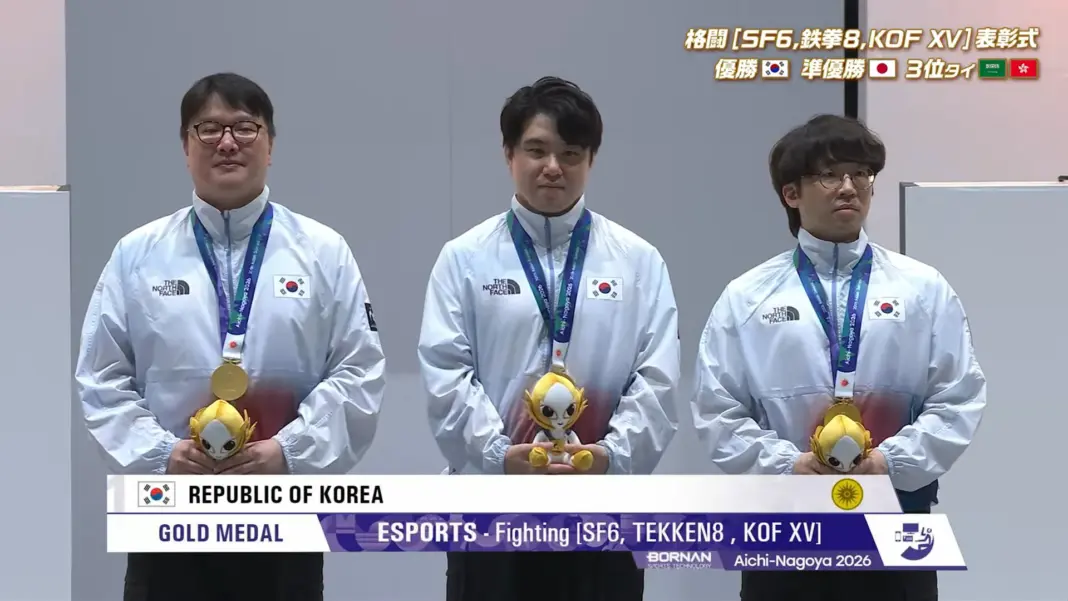
Long before esports arenas, professional contracts and national teams became part of competitive gaming, South Korea’s fighting-game culture was being built in arcades. Players gathered around cabinets, reputations travelled from one neighbourhood to another, and becoming good enough often meant finding the strongest player in another arcade and going there to challenge them.
Three decades later, three players shaped by that generation have stood on an Asian Games podium with gold medals around their necks.
South Korea’s Bae “Knee” Jae-min, Yeon “DakCorgi” Je-gil and Lee “MadKOF” Gwang-no defeated host nation Japan 5-2 in the fighting games final at the Aichi-Nagoya Asian Games on September 26, winning South Korea’s first esports gold of the 2026 Games and becoming the inaugural champions of the new three-title team fighting-game event.
The ages of the three players — Knee is 41, DakCorgi 39 and MadKOF in his mid-forties — have understandably attracted attention, but treating their victory simply as a story about older esports players would miss what made it significant. These are specialists in games whose histories stretch back to the arcade boom of the 1990s, and their Asian Games victory represents something competitive gaming has only recently become old enough to produce: a generation that discovered fighting games as children and has remained good enough to represent its country decades later.
From Korean arcades to an Asian Games podium
Knee’s story perhaps captures that journey better than anyone’s. When the original Tekken arrived in 1994, Bae Jae-min was an elementary-school student already interested in fighting games. Tekken’s three-dimensional movement and combo system fascinated him, and as his ability improved, arcades became the competitive network through which he measured himself against other players.
There was no global Tekken World Tour, professional esports infrastructure or obvious career waiting at the end of that journey. Knee has recalled travelling around South Korea looking for strong opponents simply because beating good players mattered to him. As dedicated gaming broadcasters and organised competitions later emerged alongside South Korea’s esports boom, that obsession gradually became a profession.
Over the decades that followed, Knee became one of the defining competitors in Tekken history, collecting more than 100 trophies and reaching world No. 1 during a career that survived several generations of the series. Yet even after everything he had won, representing South Korea at the Asian Games carried a significance that the tournaments of his earlier career could never have offered.
Before the Games, Knee reflected on how implausible the moment would have sounded earlier in his career: the possibility that someone could one day win an Asian Games gold medal through Tekken would scarcely have been imaginable a decade ago. On September 26, in the country where Tekken was created, that possibility became his reality.
Three games, three specialists and one medal
The fighting games competition at Aichi-Nagoya 2026 is particularly interesting because South Korea did not simply assemble three players to compete in the same title. The event combines three of the genre’s defining franchises — Tekken 8, Street Fighter 6 and The King of Fighters XV — into one national-team competition, with each country selecting specialists capable of collectively navigating all three games.
Knee represented South Korea in Tekken 8, DakCorgi carried the Street Fighter 6 responsibility and MadKOF competed in The King of Fighters XV. Together, they represented three different branches of fighting-game culture that developed alongside one another through the arcade era and eventually matured into modern esports.
That structure also meant winning gold depended on more than having the strongest individual player. South Korea needed its three specialists to function as a team, understand where it held advantages against Japan and recover when individual matchups went against them.
The final demonstrated precisely that. Japan moved ahead early after Kojiro “Higuchi” Higuchi defeated DakCorgi in Street Fighter 6, before MadKOF answered by winning his opening KOF XV set against Akihito “SCORE” Sawada. Japan regained the lead when Daichi “NOBI” Nakayama defeated Knee in Tekken 8, leaving South Korea trailing 1-2 with the host nation holding the early momentum.
South Korea did not lose another set.
How South Korea turned 1-2 into 5-2
MadKOF first brought South Korea level again through KOF XV, giving the team the opportunity to return to Tekken with the score tied at 2-2. Knee, having lost his first encounter with NOBI, adjusted for their second meeting and used Bryan and Fahkumram to put South Korea ahead for the first time in the final.
DakCorgi then faced Higuchi again in Street Fighter 6 and reversed the result of their opening encounter, extending South Korea’s advantage to 4-2. Japan selected Tekken 8 for the seventh set, placing Knee and NOBI opposite one another for another meeting with the championship now within South Korea’s reach.
Knee finished it with Bryan. After overcoming NOBI’s Dragunov, he defeated his Steve to close the final and complete a run of four consecutive set victories for South Korea. What had briefly looked like a Japanese advantage at 2-1 had become a decisive 5-2 Korean victory.
The result also carried history from earlier in 2026. South Korea had twice lost to Japan at the Esports Championships Asia, making another meeting between the two nations on Japanese soil an especially significant final. This time, with an Asian Games gold medal at stake, Korea reversed the result.
They prepared for this like athletes because that is what the occasion demanded
The nostalgia surrounding the team’s arcade roots should not obscure how seriously the three players prepared for Aichi-Nagoya. Before the Asian Games, Knee, MadKOF and DakCorgi moved into a training camp in Busan and lived together for roughly a month, turning three specialists who had previously known one another largely through competition into a functioning national team.
Their schedule reportedly ran from around 6 a.m. until 8 p.m., combining extensive practice with the physical management required to sustain it. MadKOF later joked that after three or four hours of playing he would receive physical therapy, return to practice and then undergo treatment again, an amusing detail that nevertheless illustrates the seriousness with which the trio approached the tournament.
The preparation was also strategic. South Korea understood that the three-game format created different strengths and vulnerabilities against Japan, and coach Kang Sung-hoon’s plan was built around exploiting Korea’s strength in The King of Fighters, remaining competitive in Tekken and creating opportunities in Street Fighter. By the end of the final, that broad scenario had unfolded remarkably close to plan.
For players with families and lives established outside competition, spending weeks together away from home was not insignificant either. Knee and DakCorgi both spoke after the final about the sacrifices involved in the camp, making the gold medal the culmination not simply of decades spent playing fighting games, but of a concentrated period in which three individual careers had to become one national-team project.
For Knee, nothing in 30 years of gaming felt quite like this
Knee has competed internationally for years, accumulated trophies and experienced the pressure that comes with being one of the world’s best-known Tekken players, but he described the Asian Games final as carrying a different weight. Representing South Korea meant that defeat would not simply appear against his own tournament record; he was competing under the national flag at one of Asia’s biggest sporting events.
After winning gold, Knee described September 26 as the most meaningful day of a gaming career spanning more than 30 years. The statement is striking precisely because of everything that preceded it. For a player whose relationship with Tekken began in an arcade culture that existed before modern esports, the most important victory of his career arrived not at a traditional fighting-game major, but at the Asian Games.
That progression also illustrates how radically the status of competitive gaming has changed around the players themselves. Knee did not begin playing Tekken with the ambition of becoming an Asian Games champion because such a career path did not exist. The game survived, its competitive community survived, esports expanded around it, and eventually the sporting institution caught up with a generation that had already spent decades competing.
The Asian Games has now produced champions from very different generations
South Korea’s victory arrived on the same day that another esports result demonstrated the extraordinary generational breadth competitive gaming can now accommodate.
Japan’s Yuki Kurihara won gold in Puyo Puyo at just 11 years old, completing a remarkable run through a competition he entered as the youngest athlete Japan had ever sent to the Asian Games. TalkEsport had followed Kurihara’s progress earlier in the tournament as the fifth-grader topped his group before eventually becoming an Asian Games champion.
A few hours apart at the same Asian Games, esports therefore produced two very different portraits of competitive excellence. Kurihara represents a generation growing up in a world where esports is already professional, international and recognised at major multi-sport events, while South Korea’s fighting-game champions belong to a generation that helped carry competitive gaming through the decades before any of that infrastructure existed.
The contrast should not be reduced to a contest between youth and age, because neither achievement requires the other to become impressive. What makes their presence at the same Games meaningful is that competitive gaming has matured enough to contain both stories at once.
Fighting games have always rewarded knowledge accumulated over time
South Korea’s victory also offers a useful counterpoint to the assumption that esports inevitably belongs to the youngest competitors. Reaction speed matters in fighting games, as it does across competitive gaming, but these titles also reward matchup knowledge, pattern recognition, adaptation, spacing, timing and the ability to understand what another player is likely to do before the decisive moment arrives.
Knee acknowledged before the Games that his reactions were not identical to those of his younger years, but he also argued that experience had improved his ability to read opponents. Three decades of Tekken cannot stop time, but they can produce an enormous library of situations, tendencies and decisions from which an elite competitor can draw.
That is particularly relevant to fighting games because the genre has maintained unusually strong links with its own history. Tekken, Street Fighter and The King of Fighters are not simply nostalgic names revived for a modern audience; they remain active competitive franchises whose communities contain players who encountered their earliest versions in arcades and competitors who were born long after those games became established institutions.
A gold medal that took three decades to become possible
South Korea’s fighting-game gold is therefore more interesting than the novelty of three experienced players winning an esports tournament. Knee, DakCorgi and MadKOF belong to a generation that encountered fighting games when arcades were among the most important places to find serious competition, remained with those games as the scene migrated towards consoles, online play, global tournaments and professional esports, and were still competing when the Asian Games finally created a medal event capable of bringing their respective disciplines together.
For Knee in particular, the arc is difficult to separate from Tekken itself. He discovered the series as a schoolboy after its 1994 debut, travelled through Korea looking for stronger opponents, watched competitive gaming develop into a profession around him and eventually became one of the game’s most decorated players. More than 30 years after that relationship began, he was asked to wear his country’s colours and play Tekken against Japan for an Asian Games championship.
South Korea had fallen behind 1-2 in the final, but MadKOF restored parity, Knee put the team ahead, DakCorgi created championship point and Knee returned to finish the contest. When the final set ended, three careers rooted in the fighting-game culture of an earlier generation had produced something that did not exist when any of them began playing: an Asian Games team gold medal.
That is perhaps the most fitting way to understand South Korea’s victory. The players did not outlast fighting games; they grew alongside them, and on a September evening in Japan, the competitive culture they had spent decades helping to sustain finally carried them onto one of Asia’s biggest sporting podiums.