The Weather Channel spent Monday afternoon, US time, forecasting a state that does not exist. Three days before Grand Theft Auto VI launches on 19 November, the American TV network posted a six-part forecast for Leonida, the fictional version of Florida where the game is set. Each post came with a new screenshot supplied by Rockstar Games, and the opening post had passed 5.2 million views on X by Tuesday evening in India.
The partnership is a marketing stunt, but the choice of subject is deliberate. Weather has been one of the systems Rockstar has talked about most in the run-up to launch, and the thread came with a statement from Owen Shepherd, Rockstar’s VP of Art for Light and Rendering. “We had to completely reimagine our in-game weather systems to feel more localized, persistent, and above all dynamic,” he said, describing skies that range “from clear blue skies to towering vertiginous cumulonimbus clouds”.
Shepherd also explained why Leonida needed that work in the first place. He called it “a fictional world inspired by modern-day Florida, a landscape with one of the most unpredictable weather systems in the US”. That makes it worth looking at the six forecasts closely, both for what they show about the game and for how they compare with the real Florida.
Six forecasts from a state that does not exist
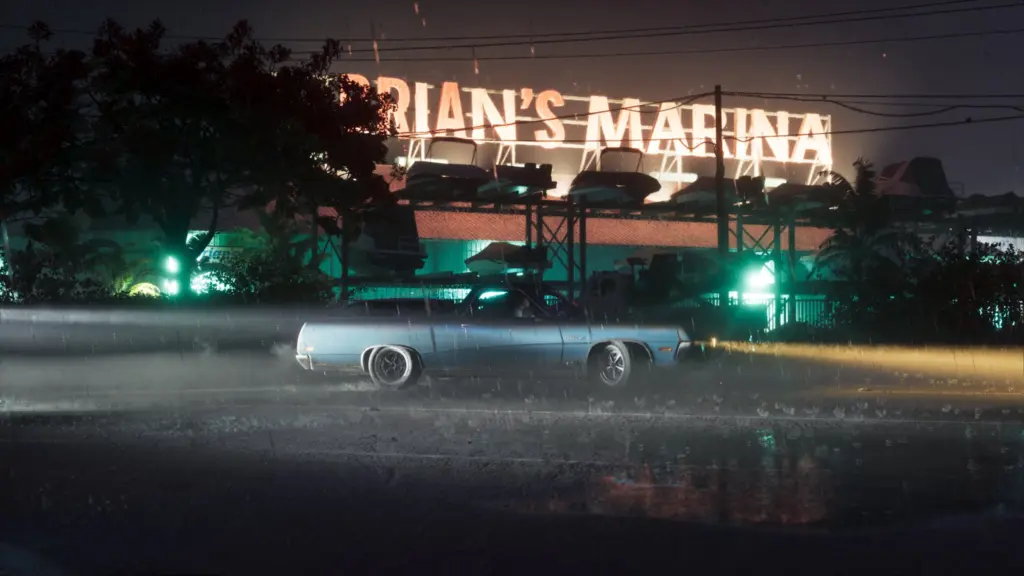
The forecasts are written in The Weather Channel’s familiar on-air voice, but every detail points back to the game. The first warns that heavy rain is making visibility poor across “many places in the Keys”, and adds that local authorities have installed reflectors on some roads. It finishes with a joke about getting your headlights fixed at Coastal Auto Care, which appears to be one of Leonida’s in-game businesses.
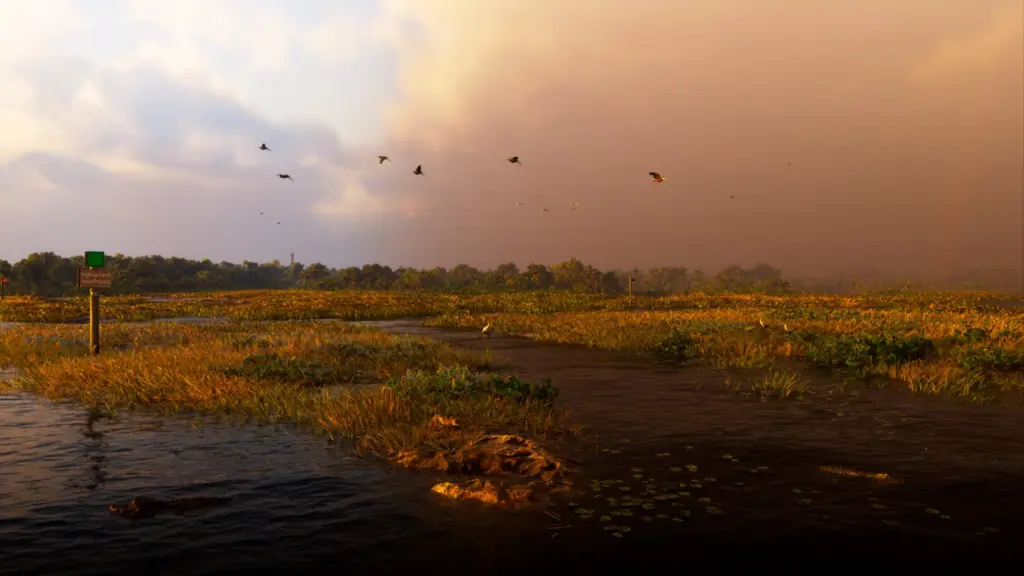
The second forecast moves inland, to the swamps of Pelican Valley. “The water is murky at the best of times but this storm’s made it nearly impossible to spot the big nibblers,” the post reads. That line is a nod to the alligators Rockstar has already confirmed among the animals of Leonida, and the screenshot shows a storm front rolling across flooded grassland.
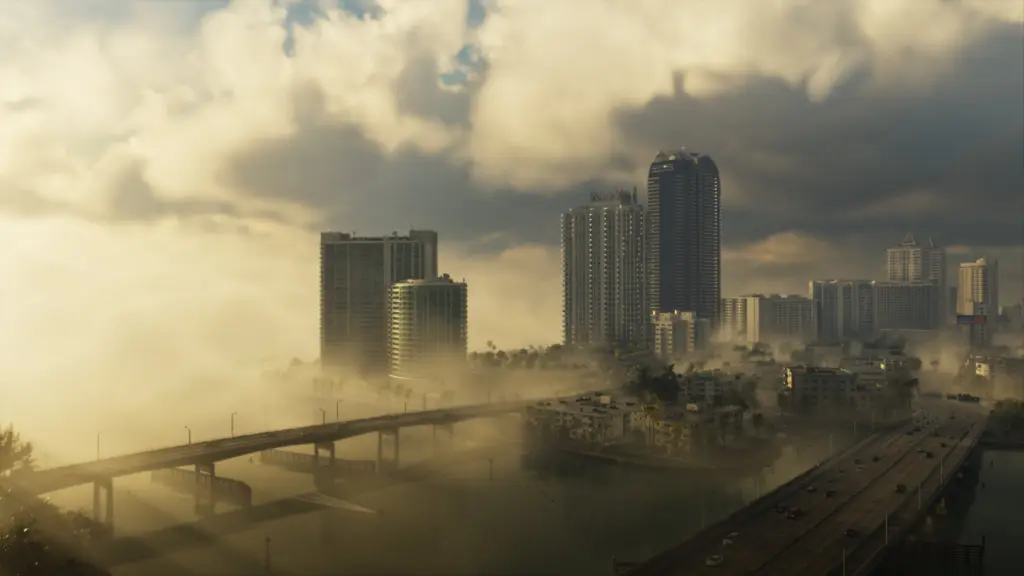
The third shot is the most cinematic of the set. Guests booked into a South Ocean Beach hotel are told their expensive view “might be hidden behind a wall of sea fog coming in off the ocean”. The image shows a bank of fog swallowing the lower floors of a high-rise skyline while traffic keeps moving over the causeways, with patches of blue sky still showing above the cloud.
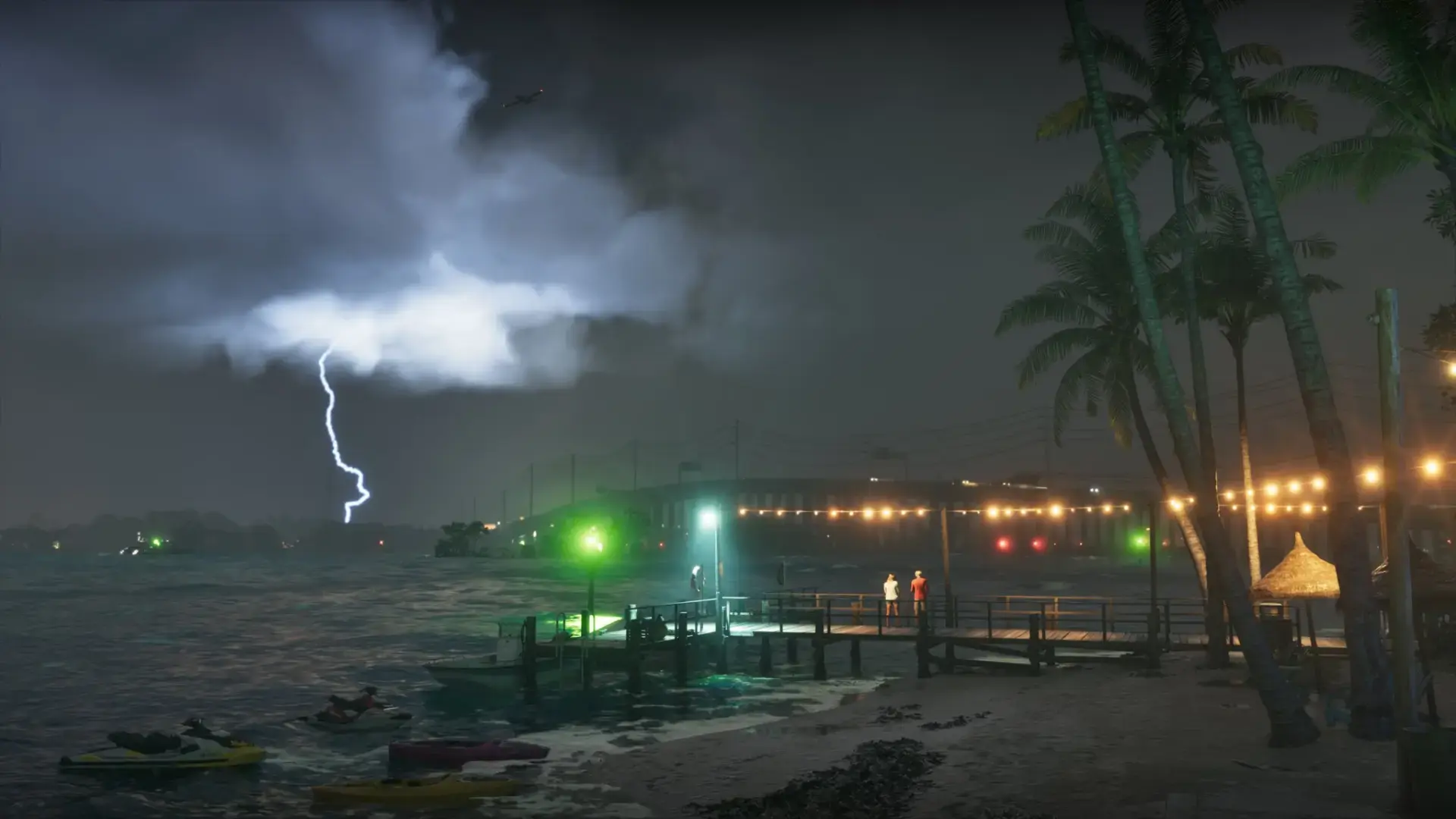
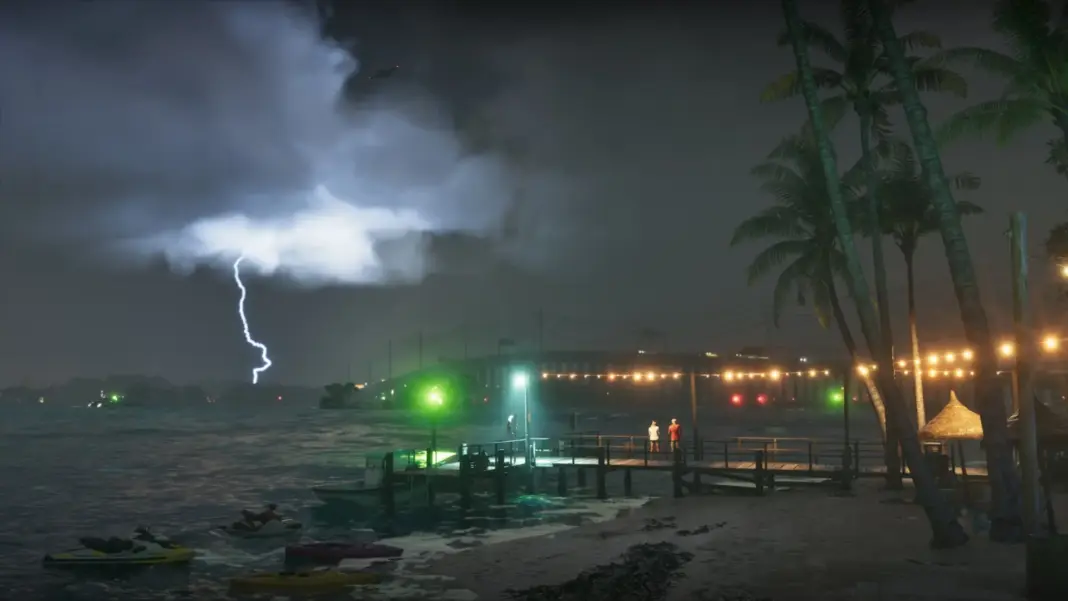
The fourth forecast, and our lead image, is the stormiest. Anyone heading to the Rusty Anchor for a drink “might need a bigger boat”, because a tropical storm is making the water very choppy. In the shot, lightning drops out of a storm cell over the bay while lights stay on along the shore, jet skis bob beside a wooden pier and a few people stand on the dock watching.
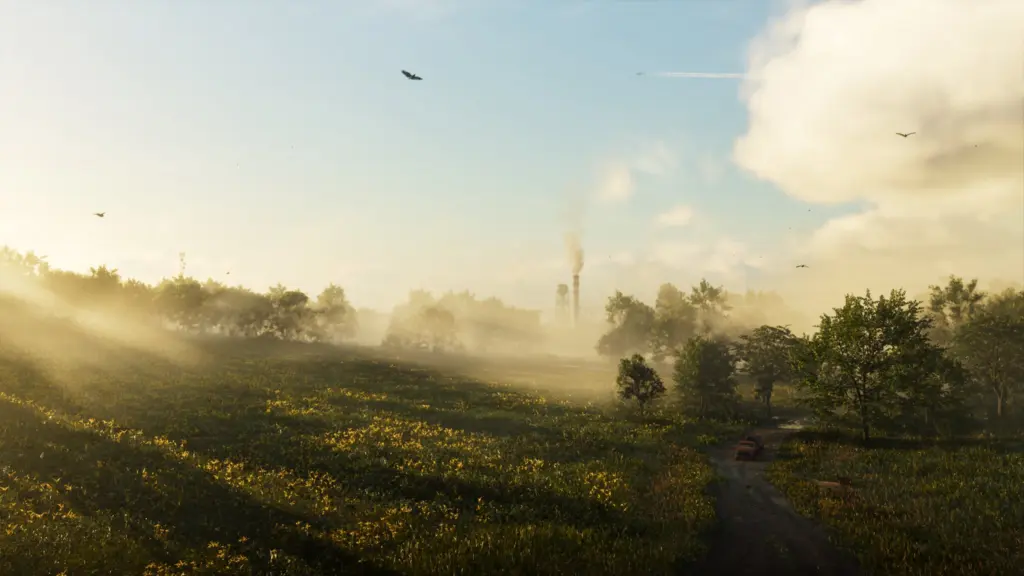
The fifth forecast is the calmest of the six, and it swaps storms for stillness. High humidity covers the waters of Gambit Bay in low-lying mist, “making for a tranquil start to hunting season”. The hunting line fits what Rockstar has said about wildlife so far, since some animals in Leonida are classed as Rare, Discoverable and Legendary and can be tracked.
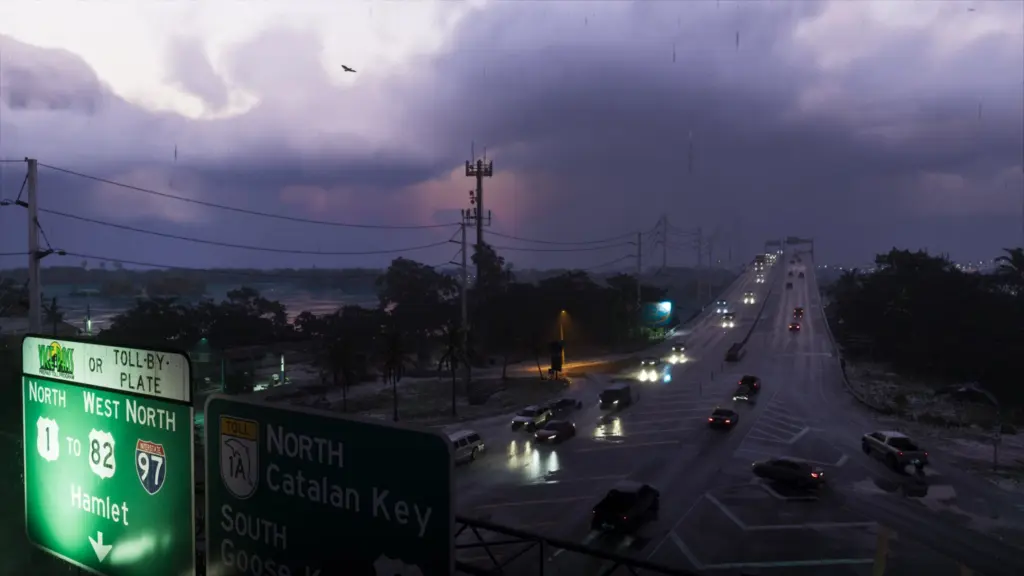
The last post covers the morning commute from Key Lento, which is “spicy” thanks to more rain and wind. Its screenshot may be the most revealing of all, because it shows a wet highway under a purple storm sky with green road signs for North Catalan Key and Hamlet. One sign even copies the Toll-By-Plate system used on real Florida toll roads, which shows how closely Rockstar has modelled the state’s everyday details.
What Rockstar changed in GTA VI’s weather system
Shepherd’s three words, localised, persistent and dynamic, match what Rockstar has described in earlier interviews. In previous Grand Theft Auto games, one weather state largely covered the whole map at once. As we reported when Rockstar first outlined the GTA 6 weather system, Leonida instead lets one part of the map sit in sunshine while another takes a downpour.
Game Informer’s reporting in September added more detail. Players can watch rain fall in the distance, travel into that area after the shower has passed and find puddles and wet surfaces waiting for them. Clouds move across the map, rainbows can appear after rainfall, and Rockstar has confirmed both hurricanes and tropical storms, as we covered in our round-up of GTA 6’s biggest new details.
The new screenshots show those ideas in practice rather than in a description. The Rusty Anchor storm is a single cell over the water, not a blanket of rain across the whole bay. The South Ocean Beach fog sits low enough to hide the lower floors of the towers while the sky stays bright above it. The Gambit Bay mist, meanwhile, clings to one stretch of ground while the trees behind it stay clear.
Shepherd’s job title is a clue to how closely the two subjects are linked. Weather in a game like this is as much a lighting problem as a physics one, because fog, cloud and rain all change how light reaches every surface in the scene. Rockstar has confirmed GTA VI runs at 30fps on PS5 and Xbox Series X|S, with PS5 Pro getting exclusive ray-traced shadows, as we reported when the console frame rates were confirmed.
Persistence is the harder part to judge from still images. Wet roads, standing water and the spray behind cars all appear in the Keys and Key Lento shots, but a screenshot cannot show how long that water stays after the rain stops. Players will only be able to test that once they reach Leonida, and Rockstar has given no figures for how often hurricanes appear or what they do to the map.
How close Leonida’s weather is to the real Florida
Rockstar picked the right state for this kind of system. According to the National Weather Service office in Melbourne, July is the busiest month for lightning across Florida. It says the highest flash rates over the peninsula come from “the collision of the two sea breezes” that form along the Atlantic and Gulf coasts.
The NWS office in Tampa Bay says Southwest Florida’s rainy season runs from 15 May to 15 October. Late May and June bring the most severe storms, with hail, damaging winds and waterspouts common, before the season peaks from July to early September. The Rusty Anchor storm, with lightning striking over open water, looks a lot like that summer pattern.
Fog is a different story, and here Rockstar has taken a little artistic licence. The NWS office in Miami says South Florida’s main fog season runs from late autumn to early spring. It adds that fog usually forms over the Everglades and the southwest coast, which makes the swampy mist of Pelican Valley and Gambit Bay the most true-to-life shots in the set. A sea fog bank rolling into a Miami-style beach is rarer, although the office notes that warm, moist air off the Atlantic can bring fog when it moves over cooler land in spring.
Hurricanes need the least explanation for anyone who follows Florida’s weather. The National Hurricane Center lists the official Atlantic hurricane season as 1 June to 30 November, with a peak on 10 September. GTA VI arrives in the final two weeks of the real season, which suits a game whose tropical storm screenshot has just been forecast by a real weather network.
The Weather Channel thread is also the latest in a run of tie-ins outside gaming before launch, after the Miami Heat released limited-edition GTA 6 jerseys earlier this month. Rockstar’s own GTA VI page lists the game for PlayStation 5 and Xbox Series X|S, with no PC version announced, as our GTA 6 guide sets out. In India, the game unlocks at midnight on 19 November, as our GTA 6 release time guide explains.