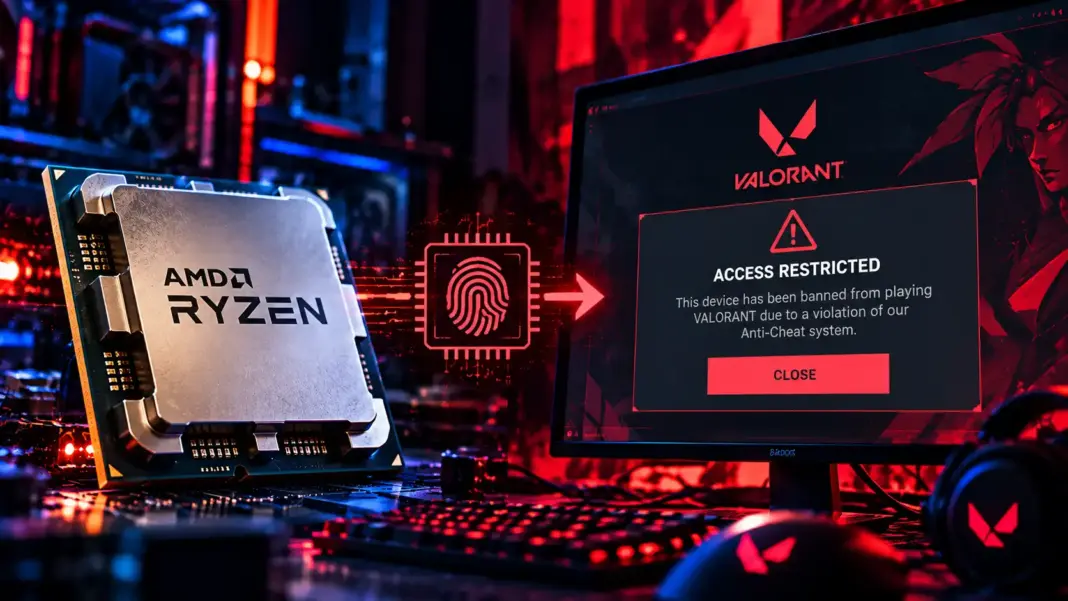
A Valorant player in Germany picked up a used Ryzen 7 5800X3D on Kleinanzeigen on September 21. Vanguard kicked them out on the first launch. They hadn’t cheated. Riot Support told them the chip’s previous owner was caught cheating and hardware-banned on August 12, and that the ban stayed with the CPU after it was sold.
Phillip Koskinas, who runs anti-cheat at Riot, disputed parts of the story on X on October 3. He also couldn’t find the player’s support ticket. Hardware bans last four months at most, he said, and only apply to the game where cheats were detected. So this CPU should be usable again by mid-December.
Can a used CPU get you banned in Valorant?
Yes. Riot’s Vanguard anti-cheat can ban hardware, not just accounts. If someone cheats and their CPU gets flagged, that ban stays with the CPU even after it’s sold. Riot says these hardware bans last a maximum of four months and only apply to games where the cheating was detected.
What happened
The player, who posted on the German PC-building subreddit r/PCBaumeister, bought a used AMD Ryzen 7 5800X3D on Kleinanzeigen, a German classifieds site, on September 21. After installing it, they were removed from Valorant as soon as they launched it.
When they contacted Riot Support, they were told the CPU’s ID was blacklisted in Vanguard because its previous owner had been caught cheating. According to the player, Riot said it couldn’t lift the restriction and that their motherboard and storage drive had also been flagged.
| Date | What happened |
|---|---|
| August 12, 2026 | The CPU is hardware-banned after its original owner is caught cheating |
| September 21, 2026 | The new owner buys the used Ryzen 7 5800X3D |
| Late September | The new owner is kicked from Valorant and contacts Riot Support |
| October 3, 2026 | The story spreads, and Riot’s anti-cheat lead responds on X |
Some reports described the part as a used GPU, but it was a CPU. That detail matters, and we explain why below.
What did Riot say?
Phillip Koskinas, who leads anti-cheat at Riot, responded on X on October 3. He disputed part of the player’s story and clarified how hardware bans actually work:
- Hardware bans last four months at most. They don’t follow the hardware forever.
- They only apply to the game where cheating was detected. A Valorant cheater’s hardware ban doesn’t automatically spread to League of Legends or other Riot games.
- One flagged part doesn’t ban the whole PC. He rejected the idea that installing a flagged CPU gets every other component in the system banned too.
He also said he couldn’t find the player’s support ticket, so the individual case hasn’t been resolved publicly. And he made it clear he wouldn’t mind tougher rules on cheaters, saying that if it were up to him, bans would follow cheaters “even into hell.”
Based on the August 12 ban date and Riot’s four-month limit, this CPU should be clear by around mid-December 2026.
Why the CPU was banned and not the GPU
Vanguard uses the TPM 2.0 chip to identify a PC. On most modern AMD systems, that TPM is built right into the processor (AMD calls it fTPM). So when Vanguard bans the TPM identifier, it’s effectively banning the CPU.
That’s also why Valorant requires TPM 2.0 and Secure Boot on Windows 11. If you’ve ever had to turn them on, our guide on enabling UEFI Secure Boot for Valorant explains how that setup works.
A graphics card doesn’t carry a TPM, which is why a GPU on its own is a much less likely carrier for this kind of ban.
| Part | Can carry a Valorant hardware ban? |
|---|---|
| AMD CPU (with fTPM) | Yes, this is how this case happened |
| Motherboard (with a TPM chip or Intel PTT) | Possibly, depending on the setup |
| GPU | Unlikely, since it has no TPM |
| Storage drive | Riot says one flagged part doesn’t ban the rest |
How to protect yourself when buying used PC parts
There’s no official way to check whether a used CPU has a hardware ban before you buy it. A few steps lower the risk:
- Buy where you can return it. Stores and marketplaces with buyer protection let you send it back if something’s wrong.
- Test it right away. Install the CPU and launch Valorant within the return window, even if you don’t plan to play that week.
- Ask the seller directly. Ask if they played Riot games on it. Most honest sellers won’t know about a ban, but some will.
- Keep your receipt. If you get banned, proof of purchase helps when you contact Riot Support.
- Contact Riot Support with the details. Ask how much time is left on the hardware ban. Riot says support can tell you.
Hardware bans aren’t new. Riot has issued them to high-profile players too, including ENVY’s Canezerra earlier this year. Still, cases like this one are rare. You’re far more likely to run into a scam when buying used parts than an inherited ban.
If Valorant won’t start and you don’t see a ban message, the problem is probably something else. Our guide to fixing the Valorant black screen on startup covers the most common causes.
Frequently asked questions
Can a used CPU get you banned in Valorant?
Yes. Vanguard can hardware-ban a CPU, and the ban stays with it after it’s sold. Riot says these bans last up to four months.
How long does a Valorant hardware ban last?
According to Riot’s anti-cheat lead, a maximum of four months, and only for the game where cheating was detected.
Does a hardware ban affect all Riot games?
No. Riot says hardware bans only apply to the game where cheats were detected.
Can I check if a used CPU is banned before buying it?
No. There’s no official way to check. Buy from sellers that allow returns and test the CPU right away.
Can a used GPU get you banned in Valorant?
It’s unlikely. Vanguard identifies PCs through the TPM, which on AMD systems is built into the CPU. A graphics card doesn’t have one.
What should I do if my used CPU is hardware banned?
Contact Riot Support with your proof of purchase and ask how long the ban has left. If you’re still within the seller’s return window, returning the CPU is the fastest fix.