Marvel Rivals continues to reward its playerbase with exciting skins and other in-game items, and the most recent one in their long list of skins is the Red Panda Squirrel Girl skin. This Squirrel Girl skin gives the character a fresh red panda-based look, and the best part of the skin is that it is completely free to get. If you are one of those players who are eyeing this cosmetic, then this article is for you.
The Red Panda Squirrel Girl skin will be released as a part of the Citizenship of Monster Kingdom event in Marvel Rivals, and like all other seasonal events in the game, there is a reward at multiple tiers of the game. These rewards include skins, sprays, nameplates, and MVP animations, among others, but the skin you are looking for will be available in Tier 18.
🌍 Citizenship of Monster Kingdom is here!
The Monster Kingdom opens its gates in Season 6.5, and chaos has never looked this adorable.
From Rocket Raccoon's Giant Panda and Squirrel Girl's Red Panda to Jeff the Land Shark's Duck Defender, the kingdom welcomes heroes who prove… pic.twitter.com/57g0bexUFQ
Complete Matches and Challenges Earn XP by playing matches and finishing event-specific missions. The more you play, the more you progress, and Tier 18 is the endgame.
Reach Tier 18 on the Free Track The Red Panda Squirrel Girl skin unlocks at Tier 18 of the free rewards track. Once you reach that tier, the skin will be available to claim.
If you are a fan of Squirrel Girl or just a collector who likes to have all the Marvel Rivals skins in your collection, then this might be one you should definitely work to add to your collection. The skin being free to get gives you the perfect limited-time opportunity to get it off the back of missions. Make sure to quickly complete the missions and reach Tier 18 before the event concludes.
The PUBG Mobile 4.3 update is bringing exciting new content for players around the world. After the return of Skyhigh Spectacle mode, players are now waiting for the next major update. One of the biggest highlights of the upcoming update is the arrival of the M1 Garand.
According to reports and beta leaks, this iconic rifle will soon be added to the game. The weapon is already being tested in the beta version, and early details about its damage and performance have surfaced online. Here is everything you need to know about the PUBG Mobile M1 Garand.
M1 Garand is Coming in PUBG Mobile 4.3 Update
As per reports, the M1 Garand will be introduced in the PUBG Mobile 4.3 update. The gun has been spotted in beta testing, which confirms that it is part of the upcoming version.
The M1 Garand is a semi-automatic rifle known for its historical importance and its famous “ping” sound when the clip gets ejected. PUBG Mobile is keeping this unique sound effect in the game, which makes the weapon even more special.
The gun will be added under the Designated Marksman Rifle (DMR) category.
PUBG Mobile M1 Garand Full Details and Stats
Based on beta reports, here are the key details of the weapon:
Weapon Type: Designated Marksman Rifle (DMR)
Ammo Type: 7.62mm
Magazine Capacity: 8 bullets (clip system)
Firing Speed: Very fast for a DMR
Damage Stats (Beta Version)
Body Damage: Around 68 damage
Headshot Damage: Around 149 to 150 damage
Helmet Damage: Can break a Level 1 helmet in one shot
Reports suggest that the weapon currently deals very high damage in the beta version. Some reports even claim that it performs stronger than the Mark 14 in certain situations. However, these stats may be adjusted before the final live release.
Because it only has 8 bullets per clip, players will need to aim carefully. But with high damage and fast firing speed, the M1 Garand could become a strong mid-range weapon.
The PUBG Mobile 4.3 update release date is expected to be 11 March 2026, as the current themed mode is scheduled to end on 10 March 2026. Major PUBG Mobile updates usually arrive right after a themed mode ends.
The M1 Garand is expected to arrive in the live game once the 4.3 update officially rolls out globally.
The BGMI 4.3 update is bringing exciting new content for players, and one of the biggest highlights is the arrival of the M1 Garand. According to reports and beta gameplay leaks, this iconic rifle will soon be added to Battlegrounds Mobile India. The weapon is already being tested, and players are excited to try it in the live game.
The M1 Garand in BGMI 4.3 update is expected to be a powerful addition, especially for players who love using DMR weapons. Here is everything we know so far about the gun.
M1 Garand in BGMI 4.3 Update: Weapon Class and Ammo Type
According to reports:
Weapon Class: Designated Marksman Rifle (DMR)
Ammo Type: Uses 7.62mm ammunition
Magazine Capacity: 8-round clip
Firing Speed: Very fast firing for a DMR
The M1 Garand is a semi-automatic rifle known for its historical importance and its famous “ping” sound when the clip gets ejected. This unique sound effect is also included in the BGMI version, which makes the weapon even more interesting.
M1 Garand Damage and Performance (Beta Stats)
As per reports from the beta testing, the gun currently has very high damage. However, these numbers may change before the final release.
Here are the expected stats:
Body Damage: Around 68.25
Headshot Damage: Around 149 to 150 base damage
Helmet Damage: Can break a Level 1 helmet in one shot
Reports suggest that the M1 Garand “punches very hard” and currently deals more damage than the Mark 14 in the beta version. If these stats remain similar in the live update, it could become one of the strongest DMRs in BGMI.
This weapon can be very useful in mid-range fights and quick knock situations. However, since it only holds 8 bullets per clip, players will need to aim carefully.
BGMI 4.3 Update Release Date
According to reports and the current update cycle, the expected BGMI 4.3 update release date is 16 March 2026. The M1 Garand is expected to arrive in the live game after the completion of the testing.
Following the news of the Overwatch X Fortnite collaboration surfacing, Fortnite players can barely hold their horses at the idea of popular characters like Tracer and D.Va coming to Fortnite as skins. The leak suggests that this crossover will be coming to the game in Fortnite Chapter 7 Season 2, and in this article, we will discuss how you can get said skins.
Fortnite Overwatch Collab Release Date
Epic has yet to confirm this collaboration, but if the leaks are to be trusted, then we might see this collaboration come as fast as March 19, 2026, along with the start of Chapter 7, Season 2. Even though the leaks come from data miners with solid records, it is better to take the news with a pinch of salt.
Collaborations like this generally do not come with missions where the skins or the bundles are offered as a reward. Therefore, it is a mandatory purchase if you are really interested in it. Historically, we have seen skins with hype go for as high as 1,500 and 1,800 V-Bucks, and unless they are put into Bundles, we might see the set go as high as 2,200 and 2,600 V-Bucks. It is highly likely that a few of the heroes will get a bundle of their own, which will include some themed cosmetics like back blings, pickaxes, or emotes.
It goes without saying that all of this is based on speculative, historical, and leaked data. Therefore, it is better to keep an eye out for the official confirmation from Epic. If you are a fan of Overwatch, then it is better to keep the money ready to get the V-Bucks. When the skins and bundles finally come to the game, you can grab them in no time.
Marvel Rivals Season 6.5 is set to drop on February 13, 2026, and a big part of it will be focusing on balancing the characters with nerfs and buffs to make the game more competitive than before. The update will focus on nerfing overpowered heroes and, at the same time, will give buffs to underpowered ones and therefore make the game more balanced.
Dropping in the middle of the season, the update will be nerfing popular heroes like Doctor Strange, Moon Knight, and Phoenix while giving buffs to heroes like Venom, Rogue, and Adam Warlock who remain heavily underused. While these buffs and nerfs may not be significant, they are designed to be more of a quality-of-life tweak, which will throw a spanner in the works of the current metas.
Buffs
Hero
Buff Change
Rogue
Base health increased, and ultimate ability scaling improved
Venom
The projectile speed of his blockade ability increased
Deadpool
Defensive Stance conversion increased, and Fatal Attraction cooldown reduced
Squirrel Girl
Projectile speed of her blockade ability increased
Star-Lord
Ultimate energy cost reduced
Storm
Weather Control aura range expanded and bonus health effects enhanced
The Punisher
Ultimate energy requirement reduced
Wolverine
Ultimate energy cost reduced
Adam Warlock
New flight ability added to his kit
Ultron
Drone ability range increased
Nerfs
Hero
Nerf Change
Doctor Strange
Shield regeneration reduced from 70 to 60 per second
Thor
Damage falloff increased, and ultimate damage reduced
Moon Knight
Bonus maximum health reduced from 100 to 75
Phoenix
Base health reduced from 275 to 250
Psylocke
Bonus health gained from Storm Surge reduced, and the Hammer Throw bonus is adjusted
Invisible Woman
Force Physics cooldown increased from 8 seconds to 10 seconds
Loki
Bonus health gained from Storm Surge reduced, and the Hammer Throw bonus is adjusted
Fans pointed out how some heroes were overused due to their overpowered nature, while others remain underused. This update focuses heavily on making all the heroes more usable in a plethora of situations, making the hero selection more diverse and the overall game more competitive. It will take time to see what becomes of the existing metas after this update, but a more balanced game is always appreciated.
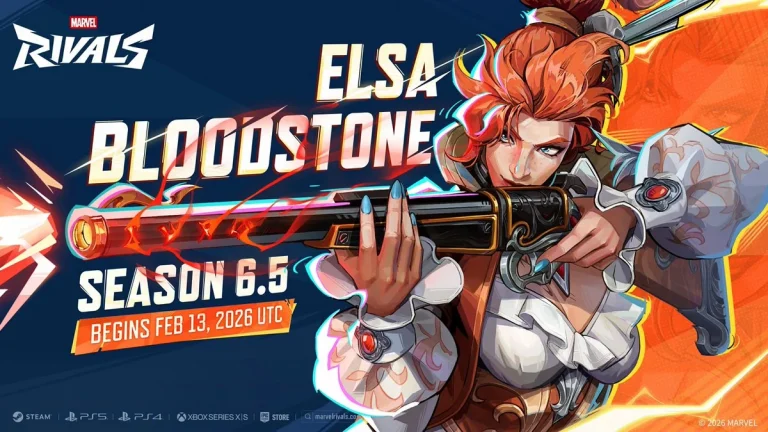
NetEase has quietly secured its popular talent for the upcoming monster hunter character in Marvel Rivals. Helen Sadler, a renowned actress from the UK, has voiced the character Elsa Bloodstone for the upcoming Season 6.5 content update.
As a character actress in Fandom-based properties, Sadler is a well-known face within the production world. She has worked extensively within games, animation, and live-action properties, including Lego Star Wars, Netflix’s Love, Death & Robots animated anthology series, and HBO’s True Blood. It’s that trifecta of dry wit, genre know-how, and emotional depth that makes her a fit for Elsa, a character known for walking the line between snarky catchphrases and emotional vulnerability within Marvel’s supernatural landscape.
Elsa Bloodstone is introduced to Marvel Rivals on February 13, 2026. She is part of Season 6.5, colloquially named ‘Night at the Museum.’ In-game descriptions refer to her as a Duelist specialist. This works out to a hyper-mobile hunter character who rushes into engagements and out of engagements again while setting traps and raining down explosive ordinance on foes, until calling upon the Glatrox demon to juggle enemies for dispatching.
For Marvel, the casting continues a trend of pairing deep-cut comics favorites with established voice talent rather than celebrity stunt casting. Elsa has been steadily rising in visibility through comics and her live‑action debut in Werewolf by Night, and Marvel Rivals now adds another distinct interpretation to that lineage.
Yiğit “Yigox” Arslan, a professional Valorant player from the FUT Esports Academy roster, has entered the Guinness World Records after setting a new benchmark for the most mouse clicks recorded in one minute.
The 18-year-old mechanical prodigy secured the record by hitting an astonishing 760 clicks in one minute, which averages about 12.6 clicks per second.
For reference, the average gamer typically registers between 5 and 7 clicks per second, putting the sheer scale of Yigox’s record into perspective.
Yigox’s achievement was formally authenticated by Guinness World Records officials, who also presented him with an official certificate. The Valorant pro went on to share a photo of the recognition on social media, where the document confirmed “the most mouse clicks in one minute” record while also listing the mouse model used during the attempt.
The certificate further notes that the Guinness World Record was set in Istanbul, Türkiye, on February 10, 2026.
“First of all, I’d like to thank Logitech and FUT Esports for giving me this opportunity,” the star said in his X post. “We’ve become world record holders.”
The highly anticipated Honkai Star Rail 4.0 update is just around the corner, and fans of the action RPG are eager to know more about the release date and time of the upcoming patch.
For the uninitiated, the Honkai Star Rail version 4.0 update is set to be one of the biggest patch releases the game has seen recently, bringing with it tons of fresh content, including new playable characters, skins, events, banners, and more.
Fans can check out the official extended gameplay trailer of the HSR version 4.0 for a detailed look at what the new patch will bring to the HoYoverse title.
With tons of exciting new content on the horizon, players should be aware of the exact release date and time of the Honkai Star Rail version 4.0 update so they can get in on the action as soon as the patch drops.
In this article, we’ll go through everything you need to know about the Honkai Star Rail Version 4.0 release date and time.
Honkai Star Rail Version 4.0 Release Date and Time
The Honkai Star Rail version 4.0 update is expected to hit the live servers on February 12, 2026, at around 7 pm PT.
We’ve converted the release date and time across major global time zones below for your convenience:
Time Zone
Release Time
Date
Pacific Time (PT)
7:00 PM
Feb 12, 2026
Eastern Time (ET)
10:00 PM
Feb 12, 2026
Greenwich Mean Time (GMT)
3:00 AM
Feb 13, 2026
Central European Time (CET)
4:00 AM
Feb 13, 2026
India Standard Time (IST)
8:30 AM
Feb 13, 2026
Japan Standard Time (JST)
12:00 PM
Feb 13, 2026
Australian Eastern Daylight Time (AEDT)
2:00 PM
Feb 13, 2026
New Zealand Standard Time (NZST)
4:00 PM
Feb 13, 2026
That’s everything you need to know about the Honkai Star Rail 4.0 update launch times across the globe.
In a significant move for the Indian gaming community, Rajya Sabha Member of Parliament Kartikeya Sharma has urged the central government to officially recognize esports as a sport. Speaking during the Zero Hour of the parliamentary session on Tuesday, Sharma highlighted the massive economic potential of the sector while simultaneously calling for stricter regulations to ensure child safety.
The MP advocated for a balanced approach that nurtures the professional aspect of competitive gaming while safeguarding younger players from the risks associated with unregulated online environments.
Economic Growth and Employment Potential
Sharma presented compelling data to underscore the importance of the gaming industry to India’s economy. He noted that the nation’s creative economy is currently valued at approximately $30 billion and employs nearly 8 percent of the working population. He described this sector as a critical pillar in the government’s vision of achieving a $1 trillion digital economy.
According to the figures shared by the MP, India boasts the largest gaming audience in the world with over 500 million amateur gamers and lakhs of professional players. The domestic gaming market is currently estimated at $3.7 billion and is projected to surge to $10 billion by 2030. Furthermore, Sharma pointed out that the AVGC sector will require nearly 2 million skilled professionals by the end of the decade.
The Case for Sports Recognition
The call for official sports status is aimed at structuring the rapidly expanding industry. Sharma argued that formal recognition is essential to establish professional leagues and regulated training systems.
Granting sports status would create legitimate career pathways for Indian youth, allowing them to pursue gaming as a viable profession rather than just a hobby. He emphasized that this move would also strengthen India’s standing in the global digital economy, positioning the country as a serious contender in the international esports landscape.
Addressing the Crisis of Unregulated Gaming
While pushing for professional recognition, the Rajya Sabha member also sounded a strong alert regarding the “crisis of unregulated amateur online gaming.” He expressed deep concern over its impact on children and adolescents.
Sharma linked unregulated gaming environments directly to rising cases of gaming addiction, anxiety, and depression among young users. He stated that technological advancement should not come at the cost of child safety. Concluding his address, he stressed that protecting children in digital spaces is not just a policy necessity but a moral responsibility for the nation.
HyperX’s Cloud Jet – Dual Wireless Gaming Headset is a new entry-level wireless model in their popular Cloud family, launched in 2025. It targets budget-conscious gamers who play across devices – from PC and consoles to mobile games like BGMI and Free Fire. In a crowded headset market, the Cloud Jet stands out by offering dual wireless connectivity (USB dongle + Bluetooth) at a modest price (~₹6,900).
This means it can switch seamlessly between low-latency PC gaming and mobile play. As HyperX’s latest budget offering, it promises “signature HyperX sound and comfort” for casual and even esports-oriented players.
In this review, we’ll dive into the Cloud Jet’s design, audio performance (especially for shooters and battle-royale titles), mic quality, wireless features, comfort, and real-world gameplay on games like BGMI and Free Fire. We’ll also compare it to general expectations for mid-range gaming headsets, and conclude with pros, cons, and a verdict on its value.
Up to 25 hours (Bluetooth), up to 20 hours (2.4 GHz)
Charging Time
Approx. 4.5 hours
Charging Cable
USB-C to USB-A (1.5 m / 4.92 ft)
Weight
298 g (0.65 lb)
Ear Cushions
Breathable mesh foam
Headband
Elastic suspension band
Frame Material
Plastic with elastic band
Controls
On-ear volume, power, mode toggle, swivel-to-mute mic
Compatibility
PC, Mac, PS5, PS4, Mobile
Xbox Support
Not supported
Included Accessories
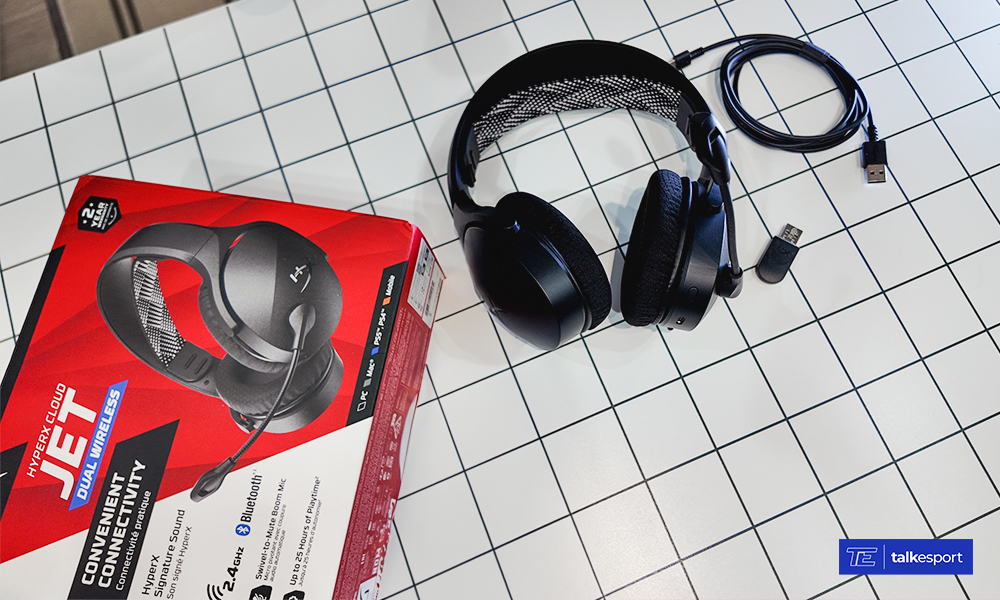
Headset, USB-A wireless dongle, USB charging cable, Quick Start Guide
Manufacturer Warranty
2 years
Design and Build Quality
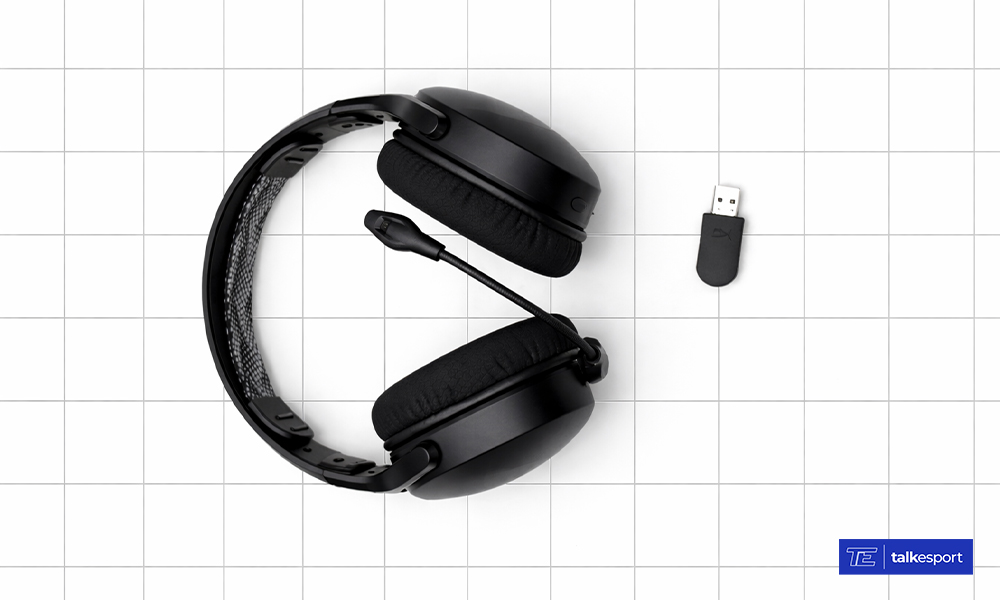
The Cloud Jet features a simple, practical design. It’s built mostly from hard plastic, which keeps the weight down to about 0.65 pounds. The headband uses an elastic suspension strap (instead of a padded headband), helping distribute weight evenly without tight clamping. Overall the build feels somewhat less premium than higher-end models – there’s no metal frame and the joints are basic – but this keeps it light and durable enough for everyday use.
The ear cups use mesh fabric cushions that are soft and breathable. The padding is plush, providing good cushioning over long sessions. This breathability is a plus on hot gaming marathons, preventing the ears from getting too sweaty. On the downside, the cloth has a slightly scratchy texture which might irritate very sensitive skin. Gamers who disliked fabric pads in the past might notice this, though most will appreciate the airflow benefit. The ear cups can swivel and tilt to fit different head shapes, but they do not fold flat or collapse. HyperX only includes a thin cloth pouch for storage, so the Cloud Jet isn’t the most packable headset if you’re traveling.
In terms of controls and ports, the design is minimal and gamer-friendly. On the left ear cup there’s a simple volume rocker, a power button, and a switch to toggle between the 2.4GHz dongle and Bluetooth modes. The metal-framed retractable mic arm swivels up to mute (swivel-to-mute), which is handy in gameplay. Overall the layout is intuitive and reliable – you can adjust volume or mute mid-battle by feel, without fumbling.
Audio Performance and Soundstage
The Cloud Jet’s 40mm drivers and tuning aim squarely at gaming audio. In practice, this headset excels at directional sound cues. Technical tests give it a high “immersion” score (4.0 out of 5). That means it creates a clear virtual surround field: enemy footsteps, gunfire, and other positional audio are easy to locate in space. For first-person shooters and battle-royale games, this is a big plus. In games like BGMI or Free Fire, hearing where shots are coming from or catching approaching footsteps can make the difference between victory and defeat. The Cloud Jet does a surprisingly good job conveying these spatial details.
That said, the Cloud Jet is not tuned as a audiophile headset. Its frequency response is middle- and treble-forward to emphasize clarity. Measurements show a lack of deep bass (<60 Hz), recessed midrange, and an emphasized peak around 8 kHz (which actually helps headphone spatialization). The result: explosions and big gunshots have less rumble than on bass-heavy headsets, but bullet cracks and movements stand out. In other words, the sound signature prioritizes gameplay cues over rich music fidelity. Music or movies will sound a bit thin and colored. If your playlist is heavy on EDM or orchestral music, you might find the sound lacking. But for gaming, especially competitive or mobile shooters, this focus on positional accuracy is a strength.
Overall audio clarity is decent but not outstanding. SoundGuys gave it a “mediocre” overall gaming score (3.4/5). Distortion is low (the audio is clean), but the tonal balance is not flat. Casual gamers will likely be satisfied hearing footsteps and directional gunfire with precision, while serious music listeners might note the lack of bass punch.
Microphone Quality and Communication
The Cloud Jet uses a fixed boom microphone (it’s not detachable). It’s unidirectional and meant to pick up your voice while rejecting noise from behind the mic. In practice, the mic is serviceable for gaming chat but nothing special. Team-mates report that your voice comes through clearly, but with a slightly muffled timbre. Words are intelligible, and push-to-talk or mute via the flip-up switch is very easy to use (the swivel-to-mute is tactile and reliable).
However, the mic does exhibit some common cheap-headset issues. Plosive sounds (“p” and “b” sounds) may pop, and background noises (keyboard clacks, fan noise) can be picked up if they are loud. There’s no high-end noise cancellation or windscreen – so if you speak loudly or there’s strong ambient noise, teammates might notice. In short, the mic is adequate for casual play and in-game chat, but you probably wouldn’t use it for streaming or podcasts. If voice chat clarity is vital in pro play, this mic will get the job done, but it’s not a standout feature.
Wireless Connectivity and Battery Life
A highlight of the HyperX Cloud Jet is its dual wireless capability. It comes with a USB-A dongle for 2.4GHz wireless, and also supports Bluetooth 5.3 for mobile/other devices. Switching between modes is very simple: there’s a toggle switch on the headset that flips between dongle (low-latency) and Bluetooth.
2.4GHz Mode: Ideal for PC, Mac, or console use (PS4/PS5) – just plug in the dongle and power on. You get stable, low-latency audio up to about 15 meters away. This ensures sound syncs perfectly in fast-paced games. (Note: It doesn’t work on Xbox – only PS and PC.)
Bluetooth 5.3 Mode: Handy for mobile devices, Switch handheld, or any Bluetooth source. Pairing is straightforward (hold the power button in BT mode for 5 seconds until it beeps). Latency is higher in Bluetooth, so it’s better for casual play (mobile shooters, music, etc.) than competitive PC gaming.
This versatility means you can use the Cloud Jet on both PC and phone easily. For example, you might play BGMI or Free Fire on your smartphone via Bluetooth, then flip to USB dongle for PC gaming without needing two headsets. The convenience is a selling point for mobile/esports gamers who switch platforms.
Battery life is respectable but not class-leading. HyperX advertises up to 20 hours on a full charge. In our tests (using the 2.4GHz mode at ~50% volume), the headset lasted about 19 hours 37 minutes, nearly matching the spec. It takes about 4.5 hours to fully charge, which is fairly slow by today’s standards. In practical terms, you can expect a couple of days of moderate gaming before needing a recharge. This is fine for most users, but there are some competing headsets at this price that boast 30+ hour batteries.
If you’re mid-session and low on battery, the Cloud Jet can be used while charging, so you won’t be forced off if you forget to plug it in. One caveat: Bluetooth mode tends to use battery faster than 2.4GHz mode, so keep an eye on it when gaming on phone or Switch. Overall, battery life is adequate for weekend marathons, but heavy users who go all-night without breaks may find it a bit limiting.
Comfort for Extended Sessions
HyperX positions all its Cloud headsets as extremely comfortable, and the Cloud Jet mostly delivers. Its overall weight is very light (around 0.65 lb), so you hardly feel strain on your neck. The suspension band style headband automatically adjusts to your head size without clamping too tightly. Combined with the light build, this yields a nice, even distribution of pressure. In practice, you can wear the Cloud Jet for several hours (or even an all-day LAN session) without noticing discomfort.
As mentioned, the ear cushions are plush and breathable, preventing ear-warmth build-up. While the fabric texture is a bit coarse, it’s not overly harsh for most. The mesh design is even more comfortable for long use than leatherette pads (which can get sticky). The lack of any harsh pressure points (no rigid clamping, thanks to the band) means these cups adapt nicely to your ears.
One minor comfort trade-off is that the clamp force is on the lighter side (for comfort), which also means they don’t isolate as much. You can hear quiet room noises if someone’s speaking nearby. For many, this is acceptable – it’s a conscious design choice to favor comfort over tight noise sealing. In a quiet environment (like a bedroom or office), it’s fine. But in a loud living room you might prefer ANC (which the Cloud Jet lacks).
Overall, the Cloud Jet is comfortable for marathon gaming. Casual and serious players alike will appreciate the breathable cushions and light feel. If you often lie back and prop your head, note that the ear cups can’t fold in, but they do swivel a bit, so you can lie on one ear without breaking anything.
Cross-Platform Performance (Mobile, PC, Console)
One of the Cloud Jet’s strengths is its cross-platform flexibility. Here’s how it performs on various systems:
PC (Windows/Mac): Plug the included USB-A dongle into a free port. The headset auto-connects in 2.4GHz mode and you’re ready to game. Audio quality and responsiveness are excellent with virtually zero lag. Works out-of-box on Windows and Mac without drivers.
PlayStation (PS5/PS4): The dongle also works on these consoles (just plug it in). Chat and game audio will route correctly.
Nintendo Switch: In docked mode, you can plug the dongle into the dock’s USB or use a USB adapter. In handheld mode, there’s no dongle support – you must switch to Bluetooth. Bluetooth on the Switch introduces more latency, so timing in shooters is slightly less snappy. It’s okay for casual play, but pro players might feel it.
Xbox: The Cloud Jet does not support Xbox consoles at all (no dongle compatibility). This is common for many PC/PS-focused headsets. Xbox players will need a different model.
Mobile (iOS/Android): Pair via Bluetooth 5.3 (the headset shows up as “HyperX Cloud Jet”). Once connected, you can play BGMI, Free Fire, PUBG Mobile, or other titles. Audio sync is decent, though some hardcore gamers may notice a slight delay compared to wired earbuds. In BGMI/Free Fire specifically, gamers report that directional sound (footsteps, enemies) is clear and precise, aiding in competitive play. The Bluetooth convenience means you can use this headset for mobile battle-royale without any cables. HyperX even markets it for titles like BGMI, COD Mobile, Free Fire and more on mobile.
Other Devices: Any Bluetooth-capable device (laptops, tablets, phones) will pair easily. The 2.4GHz dongle requires USB-A, but you can use a USB-C adapter on modern devices.
The mode switch on the headset makes jumping between these devices quick. You don’t need to reset or repair; just slide the switch to Bluetooth or 2.4GHz. Overall, if your gaming spans PC and phone (like eSports pros who play LAN and mobile tournaments), the Cloud Jet is a convenient one-headset solution.
Real-World Gaming: BGMI and Free Fire
For gamers focused on mobile battle-royale titles like BGMI (Battlegrounds Mobile India) or Free Fire, the Cloud Jet brings PC-headset comfort to mobile play. In these games, auditory cues are crucial: footsteps, gunshots, and voice chat all matter. We found that using the Cloud Jet via Bluetooth on a phone gave a notably immersive experience. The game’s 3D audio mixes clearly through the headset; you can easily tell if an opponent is behind or to the side. HyperX’s tuning (with a high-frequency emphasis around 8 kHz) actually helps accentuate subtle sounds like distant gunfire or echoes.
During extended mobile sessions of BGMI and Free Fire, comfort was a big plus: the lightweight design and breathable pads kept fatigue low even after hours. The cordless experience also eliminated cable snags. The battery life meant we could play all afternoon on Bluetooth without recharging. However, as mentioned, Bluetooth mode does have a tiny bit of latency. In practice we found it negligible for casual play, but in clutch pro scenarios you might prefer using a USB adapter and 2.4GHz mode if the phone supports it.
In summary: On mobile shooters, the Cloud Jet “just works” and provides better audio spatialization than typical gaming earbuds. Casual players will love how footsteps and action are punchy. Esports pros will appreciate the comfort for multi-hour tournaments. Just be aware that for absolute minimum lag, a wired dongle is still faster – but that’s hardly possible on most phones.
Comparison to Market Expectations
At its ~$80 price point, the HyperX Cloud Jet meets many standard expectations for a modern gaming headset, but also shows the trade-offs of the budget category. Pros: It delivers the much-desired feature of dual wireless connectivity (rare at this price), an easily adjustable ergonomic fit, and solid in-game sound positioning. These check the boxes for most gamers who want convenience and gaming-centric audio without spending $150+.
Trade-offs: You won’t find the highest-end materials (no aluminum frame), nor features like active noise-cancellation (ANC) or RGB lighting that some competitors offer at higher prices. The battery life, while decent, is shorter than the longest-lasting headsets on the market. Sound quality, while good for gaming, is deliberately skewed; audiophiles expecting flat, rich sound will be disappointed. The microphone works for voice chat, but is noticeably less crisp than a standalone gaming mic or pricier headset.
In everyday use, most casual and pro gamers will find the Cloud Jet adequate. It performs all the basics well and its dual-mode freedom is a standout. But if you compare to general market expectations (not naming brands), think of it this way: it’s similar to other popular Cloud-series headsets but wireless. If you were happy with the wired Cloud Stinger or Alpha at $50, the Cloud Jet gives you wireless – with the same comfortable fit and user-friendly controls – while setting some limits in sound fidelity and battery. Compared to any “absolute best-in-class” headset, it falls short in every single category (battery, build, audio precision) – but those top-tier models cost hundreds more.
Overall, the Cloud Jet’s performance aligns well with its value proposition. It doesn’t outperform mid-range headsets in any one metric except versatility (you get two wireless modes). Gamers who mostly play mobile/PC shooters will likely be satisfied. Audiophiles, audiomaniacs, or those needing Xbox support will not.
Pros and Cons
Pros:
Dual wireless modes (2.4GHz dongle + Bluetooth 5.3) for cross-platform use.
Lightweight and comfortable design with breathable mesh cushions.
Good spatial and directional audio performance for gaming (high immersiveness).
Intuitive controls (volume, mode switch) and reliable swivel-to-mute mic.
Affordable price with HyperX brand reliability.
Cons:
Battery life is just OK (~20h); some competitors offer 30+ hours.
No active noise cancellation; passive isolation is average (earcups don’t clamp tightly).
Sound tuned for gaming means bass and music fidelity suffer.
Cloth ear cushions have a slightly coarse texture that may irritate very sensitive ears.
Build is mostly plastic with no folding mechanism; only a thin storage pouch included.
Microphone is functional but has a muffled tone and picks up some background noise.
No support for Xbox consoles (2.4GHz dongle works on PC/PS only).
Final Verdict
The HyperX Cloud Jet – Dual Wireless Gaming Headset is a well-rounded budget wireless option for gamers who need flexibility. It shines at offering convenience and gaming-centric performance at an attractive price. If your gaming life involves jumping between PC, PS5, and your smartphone (BGMI or Free Fire), the Cloud Jet’s dual-mode wireless is a huge advantage. It’s comfortable enough to wear all day, and its audio is tuned to help you track enemies and stay competitive.
That said, it’s not a perfect headset. Its battery life is decent but not exceptional, and it lacks some modern bells and whistles (no ANC, limited folding ability). Its sound won’t please those seeking high-fidelity music. The microphone, while functional, won’t replace a pro-grade mic for streaming.
Who should buy it? Casual and esports-focused gamers on a budget. Especially those who play a lot of mobile shooters and want a single headset for phone and PC. The Cloud Jet delivers the core needs: wireless freedom, comfort, and crisp in-game sound cues. It’s one of the best values you’ll find in this price range.
Who might look elsewhere? If you demand studio-quality audio for music, ultra-long battery, or features like noise-canceling, you may need to step up to higher-priced models. But for most players focused on gaming experiences (think BGMI, Free Fire, CS2, Valorant, etc.), the HyperX Cloud Jet hits the sweet spot of performance versus cost.
The HyperX Cloud Jet is a versatile, budget-friendly wireless headset that does well for gaming across devices. It follows the HyperX tradition of solid comfort and user-friendly design. It just asks you to remember: it’s built for gaming first, music second. So if you game as hard as your pros and play as long as you can, it can be a great companion – just don’t expect it to masquerade as a high-end audiophile headset.
Overall: A smart pick for multi-platform gamers seeking comfort and decent game audio on a budget