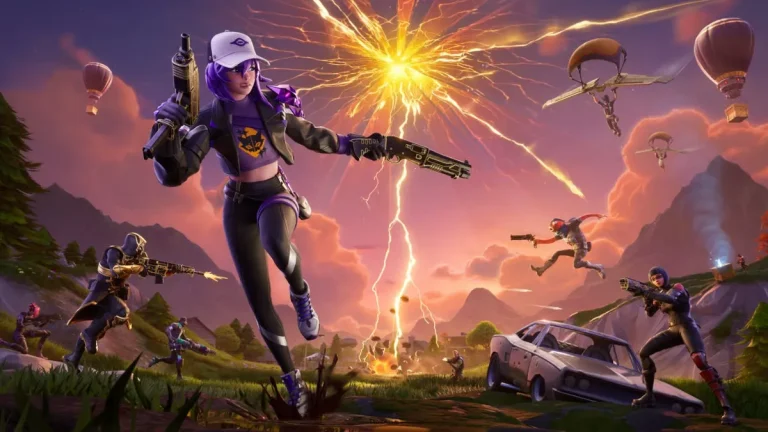
Fortnite’s highly anticipated proximity chat feature has finally arrived. Fortnite proximity chat is now coming to the new Delulu limited-time mode, which was released on September 19, 2025. Here’s the lowdown on how to turn on and use this game-revolutionizing communication feature.
It’s not your usual Battle Royale – it’s a weekend-only, Zero Build mode for up to 80 players where betrayal and forming alliances using voice comms are top priority. Without wasting time, let’s dig into it.
How to Set Up Proximity Chat?
To enter proximity chat, you must properly set up your voice settings before queuing into Delulu mode. Go to the Communication settings of Fortnite and make sure your Voice Chat is on “Everybody.” This setting is required – if not, you can’t join the Delulu playlist.
📢Content Creators! Go Delulu – 2X your SAC!
To celebrate Support-A-Creator's Early Access to our new Delulu mode today, all creators who check it out and play for 1 Hour will double their Support-A-Creator code earnings this weekend!
Also, your Voice Chat Mode should be set as either “Open Mic” or “Push to Talk” according to your liking. Open mic is what most players prefer for the fluid conversations that proximity chat facilitates.
How Proximity Chat Works in Fortnite?
Unlike older Fortnite voice chat, which merely links up teammates, proximity chat lets you talk to any player in hearing distance, even competitors. The feature shows a speaker icon beside players’ names when they’re currently engaged in a conversation, so it becomes simple to tell who’s chatting nearby.
The system features adjustable volume ranges and distance controls, or voices fade progressively as players move away from one another. This produces natural audio dynamics that add to the tactical gameplay experience.
Delulu mode reimagines classic Battle Royale gameplay by inviting mid-match teaming. Players spawn alone at random sites and have to rely on proximity chat to make temporary teams. The Team Up emote lets players officially team up, though betrayal is still a fundamental gameplay aspect because only one can win in the end.
The mode operates solely on weekend times with set time periods, so it’s more of an event than a regular offering. Its limited availability contributes to its charm and fosters devoted community moments around proximity chat play.
BGMI 4.0 just flipped the battleground with Ghost Mode, where you’re not just a player, you’re a phantom with supernatural powers! Ready to unleash your inner Ghostie and terrorize the battlefield? It’s time to grab your spectral gear and leave your enemies in the dust.
Ghost Mode drops you into electrifying fights with a twist: your ghost companion packs lethal powers that can turn the tides in one blink. But mastery is more than grabbing powers; it’s about wielding them with ninja-like precision and timing.
BGMI 4.0 Ghost Mode is the pulse-pounding, adrenaline-pumping makeover BGMI needed, mixing stealth, strategy, and supernatural fun. Stride into Classic matches, wielding Ghostie’s might and become the legend that legends whisper about.
Ready to ghost-bust your way to the top? Suit up, squad up, and let the haunting begin!
Stay tuned to the TalkEsport app for detailed gaming and esports coverage, latest news, and much more!
Cricket superstar KL Rahul just made a move that caught everyone off guard. The Indian batting sensation stepped into the esports arena to announce a massive partnership between GodLike Esports and Red Bull India, coining the memorable phrase “Dil se Godlike” in the process.
Here’s what makes this interesting: Rahul didn’t just show up for a quick photo op. As a Red Bull athlete himself, he personally welcomed India’s most celebrated esports organization into the Red Bull family with genuine enthusiasm. The timing couldn’t have been better, dropping just before the highly anticipated Battlegrounds Mobile India Masters Series Season 4.
What this really means is that traditional sports figures are finally recognizing esports as legitimate competition. Rahul’s involvement sends a clear message that the skills, dedication, and strategic thinking required in gaming mirror what we see in cricket stadiums. It’s not about crossing over anymore – it’s about understanding that both worlds demand peak performance.
The “Dil se Godlike” slogan perfectly captures this sentiment. It’s not corporate speak or marketing fluff. It’s Rahul acknowledging that esports players pour their hearts into competition just like traditional athletes do. The phrase has already caught fire across social media, with gaming communities embracing the crossover moment.
GodLike Esports gets more than just a sponsorship deal here. Red Bull’s global resources, training facilities, and strategic support give the team a serious competitive edge heading into BGMS Season 4. This partnership represents the kind of mainstream backing that Indian esports has been building toward for years.
The announcement created ripples across both cricket and gaming communities. Videos of the reveal show Rahul genuinely excited about the collaboration, even receiving a personalized GodLike jersey. It’s authentic enthusiasm, not scripted corporate messaging.
This move signals something bigger happening in Indian sports. Major corporations and influential athletes are paying attention to esports, recognizing its massive potential and dedicated fanbase. When someone of Rahul’s stature steps into the gaming world with this level of commitment, it validates what gamers have known all along – this is serious competition that deserves serious recognition.
The Indian gaming community just got its biggest endorsement yet, and it came with a slogan that’s already becoming legendary.
Riot Games has introduced a new Multi-Factor Authentication (MFA) system via its Riot Mobile app, a major step forward in the fight against smurfing in VALORANT. The beta program, launched on September 16th in North America, Latin America, Brazil, and Korea, is the firm’s most extensive anti-smurfing measure to date.
Targeting High-Risk Accounts
The mobile verification requirement is directly aimed at Ascendant-tier players and up, as well as suspicious activity accounts. This tactical measure targets the most skilled players who can dish out the most competitive harm while smurfing in lower-tier matches. Players who qualify under these criteria need to download and verify via the Riot Mobile app in order to continue playing ranked gameplay.
The system works by asking users to go through a one-time verification process when suspicious behavior is noticed. These include accounts that are suspected of being shared, bought, or used for boosting services – all terms against Riot’s Terms of Service. The company also revealed that from patch 11.09, they will ban accounts that are found to be purchased or caught for boosting.
Improved Detection and Enforcement
Riot’s strategy goes beyond mere phone verification. The firm has built advanced behavioral analysis tools that probe player performance stats, such as headshot rates, reaction time, and movement, to identify experienced players on new accounts. These detection tools can differentiate old-school shooter players from true newcomers by inspecting subtle gameplay indicators that are out of sync with an account’s perceived level of excellence.
The system also uses hardware-based identification techniques that monitor accounts from one login session to another, making it much more difficult for frequent offenders to avoid detection by switching accounts. The technology assists in identifying patterns of behaviors that are considered problematic, such as account sharing, pay-for-promotion services, and concerted deranking strategies.
The Way to the Right Direction?
The announcement has received divided reactions among the VALORANT community. Although numerous players are in favor of more anti-smurfing initiatives, others are questioning why the requirements were not applied to every competitive rank. Some critics perceive that smurfing is most common in gold and below lobbies, where the new restrictions could have little effect.
Players complained that the mobile verification process only requires the primary accounts of top-ranked players, as opposed to being aimed at the smurf accounts themselves. Others are concerned that persistent registration smurfers will simply utilize alternate phone numbers or other forms of verification to bypass the measures.
While these have their limitations, the mobile verification beta is a positive step in dealing with competitive integrity issues that have plagued VALORANT’s ranked environment for so long.
Valve has shipped out a new update to Counter-Strike 2 on September 18, and while the patch isn’t as big as the one we saw yesterday, it does bring with it a couple of interesting changes to the competitive shooter.
The most notable change in the CS2 September 18 update is the improvements to the game’s subtick system. According to the official patch notes, the “timestep-independence of subtick movement acceleration” has been improved with the update. As a result, players in the CS2 community have reported experiencing smoother overall player movement following this update.
Apart from this, the newly added Genesis Terminal is also seeing some changes. Moving forward, customers in Belgium, Netherlands, and France will now be able to unseal their Sealed Genesis Terminal items. Additionally, purchasing errors for users with Steam Wallet funds in the following currencies have also been fixed: Chilean Peso, Colombian Peso, Costa Rican Colón, Indonesian Rupiah, Indian Rupee, Japanese Yen, South Korean Won, Kazakhstani Tenge, New Taiwan Dollar, Ukrainian Hryvnia, Uruguayan Peso, and Vietnamese Dong.
Without further ado, let’s check out the detailed patch notes of the CS2 September 18 update:
[ GENESIS COLLECTION ]
Customers in Belgium, Netherlands, and France can now unseal their Sealed Genesis Terminal items.
Fixed purchasing errors for users with Steam Wallet funds in Chilean Peso, Colombian Peso, Costa Rican Colón, Indonesian Rupiah, Indian Rupee, Japanese Yen, South Korean Won, Kazakhstani Tenge, New Taiwan Dollar, Ukrainian Hryvnia, Uruguayan Peso, and Vietnamese Dong.
[ ITEMS ]
Fixed position of the nametag and StatTrak module on Shadow Daggers.
[ MAP SCRIPTING ]
Added javascript to the list of asset types.
Fixed type declaration for the newAngles parameter of Entity.Teleport.
Fixed a bug where GetTraceHit would crash when the config parameter was not specified.
[ MISC ]
Improved timestep-independence of subtick movement acceleration.
Valve is experimenting with a new method of selling Counter-Strike 2 cosmetics with the introduction of the Sealed Genesis Terminal in its latest update. Unlike your traditional cases, the CS2 Genesis Terminal doesn’t require a key to open, and instead, players can browse five weapon skins and directly purchase one of their choice at a fixed price.
The Sealed Genesis Terminal is available as a weekly drop from the CS2 Care Package starting September 17th, but it replaces the regular case drop in your package. Once you receive the Sealed Genesis Terminal as a drop, you can either choose to open it to take a look at the “offers” you get or sell it directly on the community marketplace.
The new Genesis Terminal in CS2 was met with mixed reactions from the community, with some players praising the fact that it enables you to take a look at the skins before choosing to buy them. The majority of the community, however, has expressed their disapproval at this new form of skin acquisition, arguing that it gives Valve too much control over pricing, diminishes the thrill of the case-opening experience, and feels like a way to push more microtransactions.
All CS2 Genesis Collection Skins
The Genesis Collection in CS2 includes 17 new weapon skins across 4 rarities. Take a look at its contents below:
EA Sports has unveiled the first-ever Team of the Week (TOTW) for EA FC 26 officially, a milestone event as the much-awaited football simulation inches closer to its early access release. The news comes at the same time as the Ultimate Team Web App goes live, presenting players with their first taste of the content from the upcoming game before the September 19 early access.
The TOTW 1 squad features two of football’s most clinical strikers at the front and center. Manchester City’s Erling Haaland gets a stunning 91-rated inform card after his masterclass show in the Manchester derby, netting two goals against Manchester United. The Norwegian striker’s improved card features a rousing 87 pace, 92 shooting, and 89 physical stats, making him one of the most sought-after early-game assets.
Bayern Munich’s Harry Kane takes the second striker berth with a 90-rated card, a reward for his excellent two-goal showing against Hamburger SV. The England captain’s addition solidifies his status as one of the world’s leading forwards.
It's that time of the year: #TOTW 1 is soaring into #FC26.
The team showcases EA Sports’ support for international representation in football, featuring players from diverse leagues and countries. AC Milan’s Luka Modrić is rewarded with an 85-rated card after scoring the winner vs. Bologna, earning him an inaugural season’s best performance as the Croatian maestro. Bayern Munich’s Lena Oberdorf, on the other hand, is given an 86-rated CDM card, showcasing the ongoing dominance of women’s football in the brand.
Atlético Madrid’s polymath Marcos Llorente occupies the 86-rated slot in one of three positions where he can play right-back, right midfield, or central midfield. His multi-position nature renders him exceptionally useful for Ultimate Team squad construction.
TOTW 1’s release occurs strategically contemporaneous with the early access phase of the game, establishing short-term market forces that have long contributed to increased card values. With fewer players opening the game early, the constrained supply of TOTW cards generally means premium pricing for high-end players such as Haaland and Kane.
The timing also coincides with the web app launch of Ultimate Team, enabling hardcore players to start trading and building squads before gaining complete access to the game. This early market action tends to set pricing trends that shape the overall Ultimate Team economy during the game’s lifetime.
Since 2021, Krafton has invested more than $200 millionin India, making the country one of its biggest global priorities. Now, with a renewed pledge of $50 million annually from 2025, the company is doubling down on the region’s potential. At the heart of this journey is Minu Lee, VP and Head of the India Publishing Department at Krafton Inc.
In an in-depth conversation with TalkEsport, Minu Lee shared why India matters, how Krafton decides which games to bring here, the challenges and surprises of the market, and his vision for the future.
Interview With Minu Lee, VP and Head of India Publishing, KRAFTON India
Minu Lee, who has been closely involved in shaping Krafton’s India journey, has a front-row view of the country’s rapid transformation into a gaming powerhouse. Over the years, he has witnessed firsthand why India holds such a unique place in Krafton’s global roadmap.
Why India is The Future of Global Gaming
For Minu, the answer is clear, “India is the fastest-growing mobile-first gaming market in the world. It has a young population, affordable data, and a strong community-driven culture. Together, these factors make us confident that India is not just a kind of a regional market in the gaming industry, but it will be the future of the global gaming industry.”
This belief drives Krafton’s investments, from capital and content to nurturing startups and IPs born in India. “Starting from 2025, we have announced an annual investment of 50 million USD, which will go into the India startup ecosystem, local contents, the new IP and overall ecosystem development,” he said.
Fun, Fit, and Accessibility: Krafton’s Framework for Choosing Games for India
When asked how Krafton decides which titles from its portfolio to bring to India, Minu laid out a simple but strict framework: fun, fit, and accessibility. Talking about the first criteria, i.e. fun, he said, “The most important factor is how fun the game is. It is very important that the core gameplay itself should be very good. That’s why we are looking at the games that already make a meaningful result in the traditional gaming regions like the US, Japan or Korea.
Coming on to the next criteria, i.e. fit, he said. “We need to consider whether the game aligns well with the preference of Indian players. It includes, but is not limited to the art style, a way of monetization, and initial user journey.”
He then spoke about the final criteria, “Accessibility is critical. Many players in India still use low-spec devices and sometimes face network limitations. So, the game must be very well optimized and easy to enjoy even in those kinds of difficult conditions.”
Cookie Run India: Global Originality with Local Flavor
One of Krafton’s most ambitious localization efforts is Cookie Run India, which features Hindi voice acting, Indian festivals, and culturally resonant characters. “We want Indian players to feel familiar and comfortable when they play our games, and we also want to make them feel a cultural connection in our game. Local Indian elements could be a very good way to achieve this. But, you know, this Indian element should blend naturally without harming the original work,” Minu said. To achieve that, Krafton worked closely with Cookie Run’s developer, DevSisters, even inviting the CEO and original designer to India for a week-long immersion.
Together, they explored local culture and created characters like Gulab Jamun and Kaju Katli for the game. “These additions fit seamlessly into the game,” he explained.
Surprises In the Indian Market
India, Minu admitted, has constantly surprised him. The rapid growth of tier-2 and tier-3 city gamers, the youthful passion for esports, and the social way games are consumed all stood out. “The most important part is the rapid growth and the young and passionate users and the way they consume games. All are quite surprising for me,” he said. “The Indian gaming industry has been expanding significantly year after year. In particular, we are observing huge growth of gamers in tier 2 and tier 3 cities. It is truly remarkable. I think this is clear evidence of the strong potential of the Indian gaming industry.”
“Another important thing is young and passionate users. When you attend a BGMI (Battlegrounds Mobile India) Esports event in person, you will feel the strong and interesting passion of users. It gave us a feeling that it’s not just a game, it’s more than just a game,” Minu added.
Minu further explained how the consumption behavior of Indian gamers is different from Korean gamers. “The way they consume games is totally interesting. Usually in Korea, people play the BGMI to win. But here in India, of course they want to win the game, but they focus more on relaxing and having a conversation with their friends. They consume the game as a kind of social media. That was quite an interesting part for me”, he said.
Challenges Unique to India
Despite the potential, India comes with its own hurdles. When asked about challenges faced in the Indian industry, Minu was quick to highlight the infrastructure-related challenges. “Because BGMI is developed on Unreal Engine, it requires high-spec devices. But many young gamers in India still use low-end phones, as parents don’t buy premium devices for them. This makes smooth gameplay difficult. In addition, the network infrastructure isn’t yet fully prepared to handle growing demand, which creates obstacles in delivering an optimal gaming experience,” Minu explained.
Managing Krafton’s Diverse Portfolio
Krafton today manages a diverse mix of genres in India; battle royale with BGMI, casual with Cookie Run India, and strategy with Road to Valor: Empires. But rather than seeing overlap, Minu sees opportunity. “Each title targets a different audience and has its own objectives. They complement each other, and managing multiple genres actually gives us more insight into Indian players. Our goal is not just to be the publisher of BGMI, but to become a leading gaming company in India. Releasing a wide variety of games is critical for that, and we’ll continue to introduce more going forward.”
What’s Next for Indian Players
Without revealing too much, Minu hinted at what’s to come. “We’re focusing on genres that strengthen social play and community experience. Games will be fun, fit, and accessible, with multiplayer at the core.”
Supporting Local Developers Through KRAFTON India Gaming Incubator (KIGI)
Krafton is also investing in the Krafton Gaming Incubator (KIGI), aimed at nurturing Indian talent. “Indian developers can bring unique cultural perspectives and fresh ideas. Our vision is to develop great games in India and export them to the world. That’s why I look forward to excellent games emerging from KIGI and publishing them under the Krafton name.”
The Power of Community Feedback
The Indian community is famously vocal, and Krafton sees that as an advantage. “Feedback from the Indian gamers can sometimes be very harsh. But if you read and listen carefully about the feedback from the Indian viewers, I can easily realize that the feedback mainly came from affection and passion. If they didn’t care, they wouldn’t complain. That’s why we monitor feedback closely and incorporate it as much as possible. In fact, the gaming community is our true core development partner.”
Minu also shed light on how Krafton is leveraging feedback to improve the game and user experience. “For BGMI, for every update, we run a massive scale of user surveys and more than 200,000 users reply to that survey. We can learn many things from those kinds of surveys. Along with this, we are also focus groups trying to host focus group interviews to understand the more underlying demands or needs or difficulty users are facing.”
Krafton’s Goals For 2026 And Beyond
Looking ahead, Minu’s vision is for Krafton to be recognized not just as a publisher, but as a partner in India’s gaming ecosystem. “Sustaining BGMI’s growth is important, but another key goal is to work with local developers to create globally successful games from India. I recently set up a team for this initiative, and we’ve already started investing in it.”
Minu’s Advice for aspiring publishers in India
For aspiring game publishers, Minu emphasized that succeeding in India requires far more than just following global playbooks. “It’s very important to truly understand the market and the users. India is not a single, uniform market. Each region and state has its own unique preferences. If you approach India as one homogeneous market, it’s very difficult to succeed. I often explain to my team in Korea and HQ that they should think of India like Europe. Just as each European country has its own tastes and culture.”
Understanding India’s young and passionate users is equally vital. “They see games as social media. Publishers need to create opportunities to meet players directly, listen to their needs, and understand their pain points.”
Flexibility, he stressed, is another cornerstone. “India is one of the fastest growing markets, and everything here changes at a rapid pace. Regulations, payment systems, platform environments, even art and genre preferences evolve quickly. For example, Indian players previously preferred realistic art styles, but now they are embracing anime-style characters. If an organization just sticks to previous experience, it will struggle to succeed. Agility and adaptability are essential.”
Finally, Minu underscored the importance of building strong networks. “It is extremely difficult for a publisher to succeed in India alone. You need to collaborate with key partners like platform providers, payment solution companies, and adjacent industries. Building a strong business development team, forging partnerships, and nurturing those relationships is one of the key success factors for publishing in India.”
Minu Lee’s words reveal the scale of Krafton’s ambition in India: an investment-driven, community-focused, and deeply localized approach that sees India not just as a market, but as the future of global gaming.
Credible sources now suggest Call of Duty: Black Ops 7 may launch on November 14, 2025, which would make it the latest fall release in franchise history, edging just past Black Ops: Cold War’s launch. It’s not set in stone, but the timing aligns neatly with Microsoft’s packed October calendar and leaves November wide open for the next Black Ops to take center stage. That means fans can anticipate the worldwide reveal live at Gamescom on August 19, where details about maps, gameplay features, and the official trailer will finally emerge.
How Black Ops 7 Could Shape the Call of Duty League
The timing here isn’t lost on competitive fans. If Black Ops 7 drops mid-November, the Call of Duty League (CDL) could capitalize by syncing its kickoff event with the initial hype, perhaps as early as December. In the past, seasons that started as late as March failed to capture the momentum. Last year’s December kickoff had better results, and a November release could keep that momentum rolling.
Black Ops 7: No Jetpacks, Wall Running, But “Evolution of Omnimovement”
Now let’s talk gameplay innovation. Rumors about jetpacks or wall-running coming back? Not happening. Activision has stated outright: Black Ops 7 will introduce neither jetpacks nor wall-running. Instead, it will debut what they call an evolution of omnimovement, a nod to movement mechanics that add depth and skill, but with feet firmly on the ground. For context, the game is set 30 years before Black Ops 3, so sci-fi movement is a no-go.
Why This Movement Matters
In past releases, major updates to player movement have shifted skill gaps and upended the power rankings in the CDL. Aggressive SMG players like aBeZy, Shotzzy, and Simp often thrive when the pace is faster or skill expression is higher. If the new omnimovement system lands somewhere between the older boots-on-the-ground gameplay and the fluidity fans crave, expect new meta shakeups.
What to Watch for at the Black Ops 7 Reveal
Here’s what players and fans should watch for during the official reveal on August 19:
Gameplay footage with first looks at the evolution of omnimovement
In-depth breakdown of campaign storyline
Multiplayer and CDL-specific features
Cutscenes or mechanics that tie into classic Black Ops story arcs
Just days before the start of the Esports World Cup’s Call of Duty: Black Ops 6 (BO6) event in Riyadh, tournament organizers dropped a bombshell. For the first time in Call of Duty history, coaches will be allowed on-stage voice communication with their teams during live matches, a move that’s splitting the pro scene and sending analysts scrambling to re-evaluate favorites.
What’s the New Coaching Rule?
Coaches can join live comms during Hardpoint and Control.
For Search & Destroy, coaches can interact with teams between rounds.
Never before have Call of Duty pros competed with their coach’s voice guiding them during play. Traditionally, success has hinged on in-game leaders and players’ split-second decisions. This shift adds a new tactical variable that teams have only days to absorb.
Why Are Pros and Coaches Divided?
Octane, world champion and respected commentator, made his view clear: letting coaches call shots during matches blurs what separates elite players—reacting under pressure. He warned that this might undermine top-tier competition and urged the Call of Duty League (CDL) not to make this standard practice.
But not everyone agrees. JKap, former world champ and coach, and others see this as a way for strategy-minded teams to thrive. “It makes coaches more impactful,” JKap noted, emphasizing the potential for better structure and in-game adaptability.
Parasite, another former pro, argued the change could raise the overall level of play and make matches more entertaining, as teams with strong coaching could address chemistry gaps and make better mid-game adjustments.
Which Teams Stand to Gain?
Let’s break it down:
Veteran squads with experienced coaches—like Atlanta FaZe, LA Thieves, and OpTic Texas—are projected to benefit most. Their coaches are ex-pros, familiar with every nuance, and often have longstanding chemistry with their teams.
Newer rosters or less cohesive squads could mask communication issues or inexperience, gaining extra direction from sideline experts.
Still, tournament favorites remain largely unchanged: FaZe, LAT, and OpTic stay on top of most analysts’ lists, though the coaching twist could help dark horses like Vancouver Surge mount a surprise run.
What Does This Mean for Competitive Call of Duty?
Strategic ceiling gets a boost: Coaches can dissect opponents in real time and guide their sides through complex rotations or recoveries.
Pressure on IGLs (in-game leaders): With coaches in comms, in-game leadership dynamics may shift or playmakers’ instincts could be muted.
Entertainment factor: More tactical diversity may lead to closer, more unpredictable matches.
A last-minute rule change is throwing every team, coach, and analyst into uncharted territory. With $1.8 million up for grabs and the world’s top teams competing, this Esports World Cup is already one for the history books—no matter who takes home the trophy