

When was the last time you opened up the patch notes for the latest Valorant update and were genuinely shocked by an Agent change? I’m not talking about a 0.15-second increase to a flash windup time or an ability cost being reduced by 100 Credits, but changes that you felt were significant enough to switch up the game’s meta. The last one that really comes to mind is the Phoenix rework, and even that feels like it happened ages ago.
Lately, it feels like Riot’s approach to Agent balancing has become increasingly “safe.” We’re seeing fewer and fewer bold reworks or tweaks that are impactful enough to completely shake the game’s meta. In fact, the Agent changes in most of the recent Valorant updates are little more than micro-adjustments to the abilities alongside an occasional tweak in the numbers. The result? A game that feels more stable and polished, yes, but also less exciting.
The patch notes for Valorant are starting to feel increasingly stale with each update, and the only real hype in the community now seems to come from the introduction of a new map or a new Agent.
This has led many avid Valorant players to raise the question: Has Riot become so afraid of altering the game’s competitive balance that they’ve stopped evolving it entirely?
Riot’s Balancing Track Record

Since the dawn of Valorant’s release, Riot’s balance methodology has always leaned towards the safer side. The devs have opted to deliver a slow but constant stream of Agent changes to the shooter, often backed by data and aiming to keep win rates hovering around the 50% mark.
Take a moment to remind yourself about the early days of Valorant – double Raze nades, release Reyna wreaking havoc in pubs, Omen teleporting into enemy backlines without a care in the world, or the infamous broken Chamber era. The gameplay at the time felt wild, unpredictable, and outright chaotic. The meta was constantly evolving, with players regularly finding new and innovative ways to utilize Agent mechanics and climb the ranked ladder.
Today, that sense of unpredictability seems to have died down significantly, replaced by a meta that feels a lot more rigid. Agent roles have become a lot more defined, the meta is stagnant, and each new patch release feels more like routine maintenance. There’s no doubt that in its current stage, the game is more balanced than ever, but it’s also starting to feel less alive than ever.
The Predictable Meta
Despite the constant flow of updates that Valorant has been receiving, the meta of the shooter has hardly seen a significant shift in years.
Agents like Jett, Omen, Sova, and Cypher continue to dominate the pro scene with consistently high pick rates, while others like Sage, Reyna, Brimstone, and Phoenix go nearly unpicked in every single event.
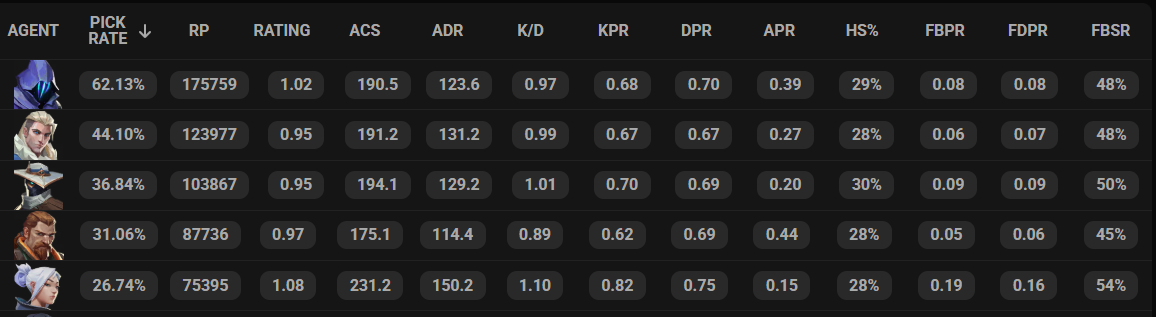
While the meta in pubs is vastly different than that of the pro scene, there are still some select picks that dominate the competition while others are rarely picked across the ranks. I’ve lost count of how many times teammates have threatened to throw my games just because I locked in Sage in the Immortal bracket.
Riot’s “safe” approach to balancing Valorant has undeniably resulted in the game’s meta being predictable and stagnant without leaving much room for experimentation. The real question is whether the competitive stability is worth the cost of the game no longer feeling dynamic or losing its strategic depth.
Balancing the Fun Out
A cautious and data-driven approach to Agent balancing can also have an unintended side effect of taking the fun out of playing the game. We’ve seen multiple instances of this happening in the past with the release of certain Agents in an overpowered state, followed by patches that would remove their viability entirely.
Reyna used to have four charges on her Devour and Dismiss. Chamber used to have two teleport anchors, and Sage used to be able to raise her wall before the round even started. Riot quickly toned down all of these abilities. While the changes may have improved the overall game balance on paper, they also rendered these Agents almost irrelevant in pro play, as evident by each of their pick rates.
As per data from TheSpike, Reyna went completely unpicked during Valorant Masters Toronto 2025, while Sage and Chamber saw dismal pick rates of just around 5% and 3% respectively.
These examples should be enough to highlight the fact that whenever an Agent shows even a glimpse of being too strong, Riot is quick to roll back changes rather than finding a middle ground. The balance philosophy of Valorant seems to be the complete removal of any potential threats instead of refining them, which ultimately takes a toll on the game’s overall fun and discourages creative play.
Why This Matters More Than Ever
With 27 Agents being available to pick from, Valorant’s current character pool is nothing short of massive, and with the devs constantly adding new Agents every few months, it’s only expected to increase further. However, the newer Agents in Valorant have been feeling more and more like echoes of former releases. Instead of experimenting with game-changing mechanics and fresh design ideas, newer Agents often arrive with abilities that feel like slight variations or recycled versions of what we’ve already seen.
Not only does it take out the hype and excitement surrounding new Agent releases, but many of these Agents also end up being completely non-viable in the pro scene, which isn’t exactly healthy for the competitive integrity and long-term balance of the game. Competitive metas in any video game thrive when teams have real options to pick from instead of just a few default Agents that are must-picks every game.
Rather than urging teams to try out new team comps and strategies, the “safe” meta of Valorant rewards teams running the same lineup over and over again while optimizing their approach.
What Riot Could Do Instead
So, what can Riot Games actually do to address the constant stagnation of the Valorant meta?
If Valorant wants to keep its gameplay feeling fresh, Riot may need to look outside its own design bubble and take a page from the MOBA playbook. Granted, tactical shooters and MOBAs operate under vastly different design constraints, but as an avid Dota 2 player, I’ve seen how a game can thrive in imbalance.
In Dota, every new patch introduces overpowered hero synergies, makes an item or two completely broken, and adds mechanics that send the pros back to the drawing board. However, most importantly, the developers don’t always rush to fix it, but let the chaos unfold instead.
This kind of approach to game balance fuels creativity, constantly forces players to adapt, and makes every patch feel like a fresh challenge. This in turn leads to a more fun experience for casual and hardcore players alike, as fans can witness the meta living, dying, and reinventing itself in real time.
On the other hand, Valorant often feels a little “too polished,” with the developers constantly tweaking ability numbers in attempts to drag the Agent winrates as close to 50% as possible.
Instead of nerfing any hero that stands out in the roster, Riot could instead focus on providing counterplay options for Agents that are particularly strong in any given meta.
Verdict
Valorant is undoubtedly one of the biggest modern-day competitive FPS titles, and there are plenty of reasons for Riot to stick to a formula that’s working instead of trying out new stuff with an already established title.
However, a vast portion of the community also agrees that Valorant just doesn’t hit the same as it used to. The excitement surrounding new patches and Agent reveals has started to fade, and the stagnant meta has become a cause of frustration within the player base.
Competitive integrity is vital, but so is maintaining the bold identity that made Valorant stand out in the first place. Valorant’s next big leap likely won’t come from a new Agent, but from a paradigm shift on Riot’s approach to the game balance.
For a game like Valorant, which set itself apart in the FPS genre through its unique abilities and strategic depth, playing it safe might just be the riskiest move of all.