

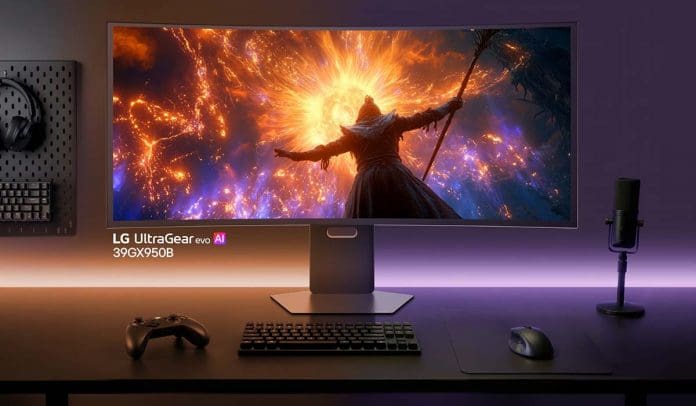

LG has officially announced a new lineup of high-end gaming monitors under the UltraGear evo brand, showcasing what the company describes as industry-leading display technology ahead of CES 2026. The range pushes not only resolution and refresh rates but also introduces dedicated AI upscaling and enhancement features directly embedded into the displays themselves.
The UltraGear evo series reflects how display manufacturers are integrating artificial intelligence into hardware to enhance visual performance — a trend expected to influence the next wave of gaming setups in the US, UK and Europe.
A New Generation of UltraGear: Three Flagship Models
LG’s UltraGear evo family initially consists of three flagship monitors, each designed to deliver high-resolution visuals and competitive performance:
39GX950B – 39-Inch 5K2K OLED (Tandem OLED):
This model is positioned as a premium ultrawide gaming display, featuring a 5K2K resolution (roughly equivalent to 5120×2160) on a 1500R curved OLED panel. It supports high refresh rates up to 165Hz at native 5K2K, with a dual-mode option that increases refresh to 330Hz at reduced resolution for fast-paced action. LG says its Tandem OLED panel offers strong brightness, precisely controlled contrast and deep blacks suitable for both cinematic and competitive gaming.
27GM950B – 27-Inch 5K MiniLED:
The 27-inch model aims to solve a common weakness of traditional high-resolution LCDs — blooming and halo effects. By incorporating 2,304 local dimming zones and Zero Optical Distance engineering, LG claims this MiniLED panel dramatically improves contrast and brightness control while maintaining sharp 5K clarity. Dual refresh modes and AI upscaling are also part of its feature set.
52G930B – 52-Inch Curved 5K2K Gaming Display:
Rounding out the lineup is a massive 52-inch 5K2K monitor with a panoramic 12:9 aspect ratio and a 240Hz refresh rate. Designed for both immersive gaming and large-format productivity, its size and curved design aim to envelop the user’s field of view, while HDR support and high refresh ensure responsiveness in fast games.
Prices and availability details have not yet been announced, but all three evo models are confirmed to make their public debut at CES 2026 in Las Vegas, Nevada in early January.
What Makes UltraGear evo Different: AI Upscaling and On-Device Enhancements
The standout feature of the UltraGear evo line is the introduction of on-device AI upscaling technology, which is a first for gaming monitors at native 5K resolution. Instead of relying on GPU-based or driver-level upscaling, LG’s approach uses dedicated processing within the display to analyze and enhance images in real time.
This has several potential benefits:
- Sharper visuals without extra GPU load: Games or video content rendered at lower resolutions can be upscaled to near-5K clarity, reducing the performance hit typically associated with software upscalers.
- AI-driven scene optimisation: Displays can adjust contrast, detail and colour dynamically based on what’s on screen, a useful capability for both competitive gaming and cinematic experiences.
- Enhanced audio support: Some models also use AI sound features, which adapt audio output for cleaner voice clarity and environmental effects.
This built-in intelligence is significant because it turns the monitor into an active component of the display pipeline, rather than a passive output device. For gamers in the US and UK especially, where high-resolution competitive and immersive gaming are both strong trends, this could shift expectations for what premium monitors should offer.
Gaming and Competitive Impact
From a performance and esports perspective, the UltraGear evo family is tailored to both competitive play and content creation:
- High refresh rates at varied resolutions mean players can prioritise responsiveness when needed, such as dropping to 330Hz at lower resolutions for FPS titles.
- AI upscaling can make strategy games or RPGs appear more detailed without taxing GPUs on ultra-demanding settings.
- Massive displays like the 52-inch evo model open up new possibilities for streamers and broadcasters, where screen real estate is as critical as motion clarity.
These features could have practical appeal for gaming setups that bridge both competitive play and content production, a growing market segment in North America and Europe.
How Competitors Are Responding
LG’s announcement arrives at a time when other display makers are also pushing the boundaries:
- Samsung recently unveiled gaming displays with over 1,000Hz refresh rates and 3D viewing technologies at CES previews, showing that high-end monitors are rapidly diversifying.
- OLED and MiniLED technologies continue to proliferate across premium segments, intensifying competition between panel makers.
LG’s evo series stakes a claim not just through resolution and refresh, but by embedding AI directly into the monitor experience. Whether this approach becomes a must-have feature in future generations of gaming hardware remains to be seen, but it sets a new benchmark for what premium monitors might achieve beyond traditional specification wars.
Looking Ahead
As CES 2026 approaches, LG’s UltraGear evo series will be among the most watched announcements for PC and console gamers alike. With AI upscaling built into the hardware itself, 5K resolution at competitive refresh rates, and a range spanning ultrawide, traditional, and large-format displays, LG appears ready to redefine expectations for gaming visuals in the year ahead.
CES demonstrations and hands-on reviews in January will clarify real-world performance and how these monitors handle the demands of modern gaming. For enthusiasts in the US and UK markets — where both competitive and immersive gaming experiences continue to grow — the UltraGear evo lineup may represent the next step in display evolution.
