



Xbox is having a rough fiscal year. Microsoft’s Q3 FY2026 earnings, covering January to March 2026, confirm what analysts had already anticipated: Xbox revenue fell across every major category, while the rest of Microsoft posted record numbers.
Key Takeaways
- Microsoft total revenue hit $82.9 billion in Q3 FY2026, up 18% year-over-year
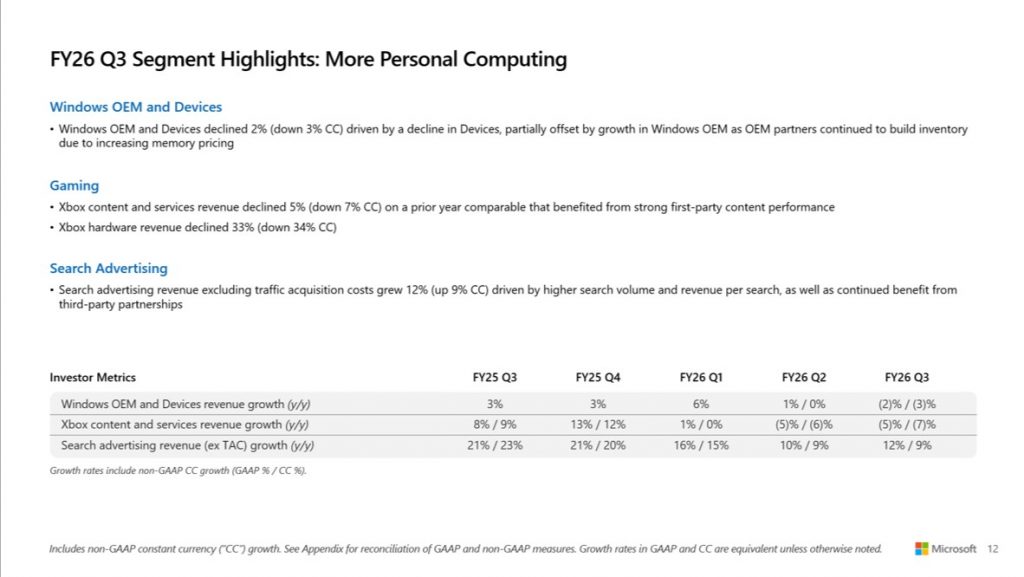
- Xbox hardware revenue dropped 33% year-over-year
- Xbox content and services revenue fell 5% year-over-year (7% in constant currency)
- Total gaming revenue came in at $5,341 million, down 7% from $5,721 million in Q3 FY25
- Azure grew 40%, and Microsoft’s AI business crossed a $37 billion annual revenue run rate
Xbox Hardware Revenue Drops 33% Year-Over-Year
Microsoft’s Q3 FY2026 earnings release shows Xbox hardware revenue fell 33% compared to the same quarter last year. That is a steep drop for a segment that has been underperforming for several quarters now.
This is not a one-quarter blip. In Q2 FY2026, Xbox hardware revenue had already fallen 32% year-over-year. The consecutive declines point to weakening consumer demand for Xbox consoles in the current hardware cycle.
The More Personal Computing segment, which houses Xbox alongside Windows and search, brought in $13.2 billion. That is down 1% year-over-year, or 3% in constant currency. Lower hardware sales across Devices and Gaming pulled the segment down, with search advertising revenue growth offering only partial offset.
Xbox Content and Services Also Decline
Beyond hardware, Xbox content and services revenue fell 5% year-over-year. In constant currency terms, the drop was 7%.
Microsoft attributed the decline to a tough comparison period. The same quarter in the previous fiscal year benefited from strong first-party game releases, which inflated the baseline. This was an expected result. Microsoft CFO Amy Hood had guided for a mid-to-high single-digit decline in total gaming revenue for Q3 FY2026, and a mid-single-digit fall specifically in content and services.
The actual numbers came in at the lower end of that range, which means the decline was not worse than forecast.
It is worth noting that the recently announced Xbox Game Pass Ultimate price cut to $22.99 per month was not yet in effect during this reporting period, which covers January through March 2026. The price change, announced in April 2026, will show up in Q4 FY2026 numbers instead.
Total Gaming Revenue: $5.34 Billion, Down 7%
Microsoft’s total gaming revenue for the quarter was $5,341 million. That compares to $5,721 million in Q3 FY2025, a fall of roughly $380 million or 7%.
For context, gaming is reported under the More Personal Computing segment. It is not broken out as its own business unit in Microsoft’s financials. This means Xbox results move alongside Windows OEM, device sales, and search advertising, all of which also shifted this quarter.
This is the third consecutive quarter where Xbox has posted a year-over-year decline across both hardware and services.
Microsoft Overall Posts Record Results
While Xbox struggled, Microsoft as a whole delivered its strongest quarterly results to date.
Total company revenue reached $82.9 billion, up 18% year-over-year. Operating income was $38.4 billion, up 20%. Net income came in at $31.8 billion on a GAAP basis, up 23%. Diluted earnings per share were $4.27, also up 23%.
Microsoft Cloud revenue reached $54.5 billion, up 29%. Azure and other cloud services grew 40%. Microsoft’s AI business crossed a $37 billion annual revenue run rate, which Satya Nadella called out as representing 123% growth year-over-year.
CFO Amy Hood said the company “delivered results that exceeded expectations across revenue, operating income, and earnings per share.” The quarter’s overall performance was driven by cloud and AI demand rather than consumer hardware or gaming.
Microsoft also returned $10.2 billion to shareholders through dividends and share repurchases during the quarter.
A Segment Under Pressure
The Xbox hardware decline reflects a broader reality in the gaming console market. Physical hardware sales across the industry have been slowing as the current console generation matures. Microsoft has increasingly shifted its focus toward subscription-based gaming through Xbox Game Pass, but even that segment faces headwinds when there are fewer major first-party releases to drive sign-ups.
According to the official Form 10-Q SEC filing, the Q3 gaming revenue decline was primarily driven by the content and services comparison issue and continued weakness in hardware.
Looking ahead, Microsoft has not provided specific guidance for Q4 FY2026 in this press release. The company says forward-looking information will be shared during the earnings conference call, held at 2:30 PM Pacific Time on April 29, 2026.
