


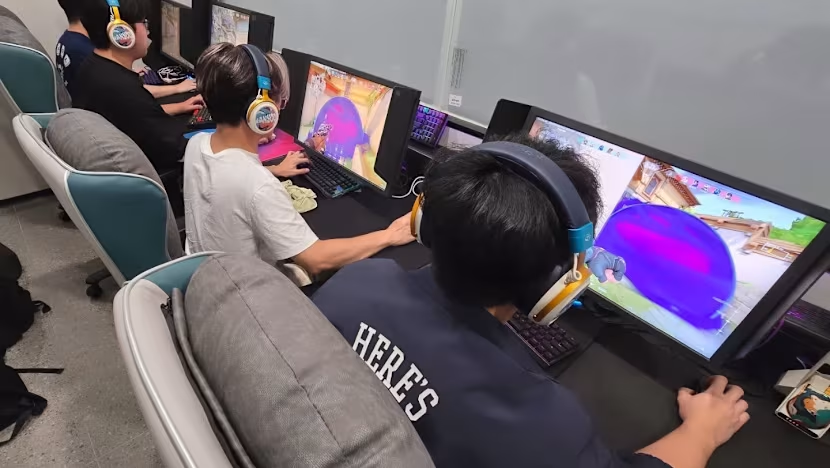
Singapore has taken another major step toward strengthening its competitive gaming ecosystem with the launch of a National Esports Training Centre, aimed at preparing local athletes for upcoming international competitions including the Asian Games and the 2029 Southeast Asian (SEA) Games.
Located at GR.iD Mall in Selegie, the newly opened facility is designed to serve as a central training hub for Singapore’s esports athletes and national teams as the country looks to build a stronger presence in global esports competitions.
A Dedicated Hub for Singapore’s Esports Talent
The national training centre spans approximately 600 square metres and is equipped with over 100 gaming stations, alongside a competition arena capable of hosting up to 150 spectators.
Operated by the Singapore Esports Association (SGEA), the facility is intended to support the development of professional esports players while also serving as a venue for training programs, competitions, and community initiatives.
Officials say the centre will act as the primary base for Singapore’s esports athletes as they prepare for major international events, including the Asian Games in Nagoya, Japan, where esports will feature multiple medal events.
Looking further ahead, the facility will also support preparations for the 2029 SEA Games, which Singapore will host on home soil.
Strengthening Singapore’s Competitive Esports Ecosystem
The launch of the training centre reflects Singapore’s broader efforts to formalise esports within the country’s sporting landscape.
Earlier in 2026, Singapore passed legislation that formally recognises esports as a sport, placing it alongside traditional and mind sports such as chess and bridge.
The move allows national sports bodies to provide more structured support for esports athletes, including training pathways, competition programs, and athlete development initiatives.
For many players in Singapore’s esports community, the new training facility represents a significant milestone in the country’s evolving esports infrastructure.
Former professional player Benedict “Benkai” Tan described the development as an important step for future generations of competitive gamers.
He noted that while earlier players lacked access to dedicated training environments, the new centre could help emerging talents pursue esports as a viable professional career.
Preparing for Major International Events
Singapore’s esports ambitions are closely tied to upcoming international multi-sport competitions where esports has been included as an official medal event.
The Asian Games has increasingly embraced esports, creating opportunities for national teams to compete at the highest level. Singapore’s new training facility will play a key role in preparing athletes for these competitions.
At the regional level, the country is also gearing up to host the 2029 SEA Games, where esports is expected to remain an important part of the event’s competitive lineup.
By investing in a national training centre, Singapore aims to strengthen its chances of fielding competitive esports teams across multiple game titles.
Growing Institutional Support for Esports
The establishment of a national esports training centre signals how governments and sports institutions are increasingly treating competitive gaming as a structured sporting discipline.
Beyond athlete training, facilities like this also contribute to building professional pathways in esports, including coaching, performance analysis, and event production.
Singapore has already hosted several major international esports events in recent years, including The International 2022, the global Dota 2 championship tournament.
With new infrastructure now in place, the country is positioning itself to play an even greater role in the global esports landscape.
A New Era for Singapore’s Esports Community
For Singapore’s esports players and aspiring professionals, the national training centre represents a turning point.
What was once considered a niche gaming activity is now supported by national sports bodies, government legislation, and dedicated training infrastructure.
As esports continues to gain recognition worldwide, Singapore’s investment in competitive gaming facilities suggests that the country intends to remain an active player in the global esports ecosystem.
