


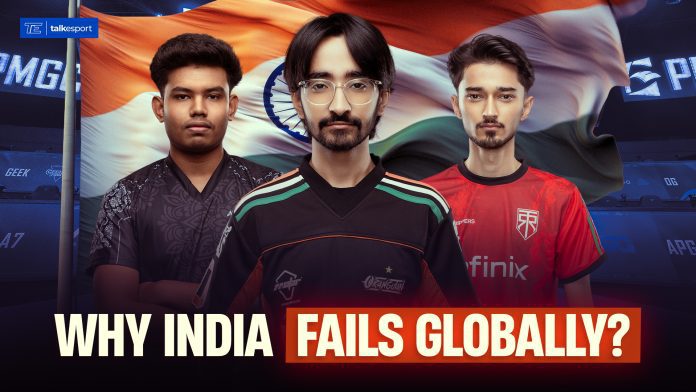
Indian teams have been competing in esports for almost 15 years, yet the international results have remained almost the same. Only one Indian team has ever lifted an international trophy, Team NSD in 2012 at the Tokyo Game Show for Counter-Strike. Since then, every time India enters a global event, expectations rise but the outcome stays disappointing.
This gap becomes even more noticeable when we see new global teams, playing their first international tournaments, still performing better than India in terms of gameplay, confidence, and basics. So why does this keep happening? Here are the simple and clear reasons behind India’s struggles on the world stage.
Why Indian Esports Teams Struggle at International Events: PMGC 2025 Reality Check
Lack of Strong Basics
One of the biggest issues is the lack of solid fundamentals. Indian teams often struggle with simple things like using utilities correctly, creating crossfires, holding positions, and taking trades. Even when the in-game leaders (IGLs) give strong rotations or good positions, the team fails to convert them.
This basic gap becomes more visible during world events where every team is mechanically strong and extremely disciplined. India’s inconsistency in gunfights and unnecessary reliance on close-range plays — even in mid-range battles — costs them important fights.
Very Limited International Exposure
Exposure is the biggest difference between India and top esports regions. Indian teams mostly play domestic events throughout the year and only get one or two chances to compete internationally. Meanwhile, global teams scrim and compete with other top-level rosters regularly.
Read More: PUBG Mobile 4.2 Update Beta Revealed Prime Wood Genesis Mode and New Features
Watching international matches is one thing, but actually playing inside that lobby is completely different. If Indian teams face world-class competition only once a year, improvement becomes extremely slow. Without continuous exposure to stronger lobbies, the gap will always remain.
IGLs Lack Firepower
Indian IGLs are great with rotations and strategies, but struggle when it comes to firepower. In global events, IGLs like Sylas, DOK, and Rosemary not only lead the team but also perform as top fraggers. Their presence boosts the team’s morale and consistency.
In India, even top IGLs often cannot deliver the same level of impact in fights. This affects both confidence and round conversions.
Struggle in 4v4 Fights
Indian teams repeatedly fail to convert 4v4 fights, even when they have positional advantage. In PMGC and other tournaments, multiple moments showed India in better positions but still losing fights they should have won.
These lost 4v4s are usually the difference between qualifying and getting eliminated early.
Weak Coaching and Lack of Discipline
A strong coach is the backbone of any championship team. International coaches are highly involved — from strategies to mental preparation. In India, coaching is still new and not taken as seriously. Many teams do not give enough importance to structured coaching or regular review sessions.
Player discipline is another major issue. Discipline builds consistency, improves mentality, and prepares players for high-pressure international stages. Without it, teams struggle to play with focus and structure.
The talent in India is huge, and the passion for esports is growing every year. But to perform globally, India must improve the basics, increase international exposure, develop stronger IGLs, convert crucial fights, and most importantly — build discipline and proper coaching systems.
With the right changes, India can definitely close the gap. Until then, international results will continue to repeat the same pattern.
