



The Valorant Champions Tour is getting its biggest structural change since it launched.
On April 8, 2026, Riot Games officially revealed the VCT 2027 format. The core message is simple: leagues are gone. Tournaments replace them. And for the first time in VCT history, any team, partnered or not, has a direct path to Masters and Champions.
Leo Faria, Global Head of VALORANT Esports, said: “VCT 2027 is about reimagining how teams compete and how fans experience VALORANT esports. By shifting to a tournament-driven system with open access to our biggest events, we’re creating a more dynamic, high-stakes ecosystem where every match matters and every team has a shot at the global stage.”
Here is everything confirmed so far.
What Is Actually Changing in VCT 2027
The current system splits the season into Stage 1 and Stage 2 league formats. Those are gone in 2027.
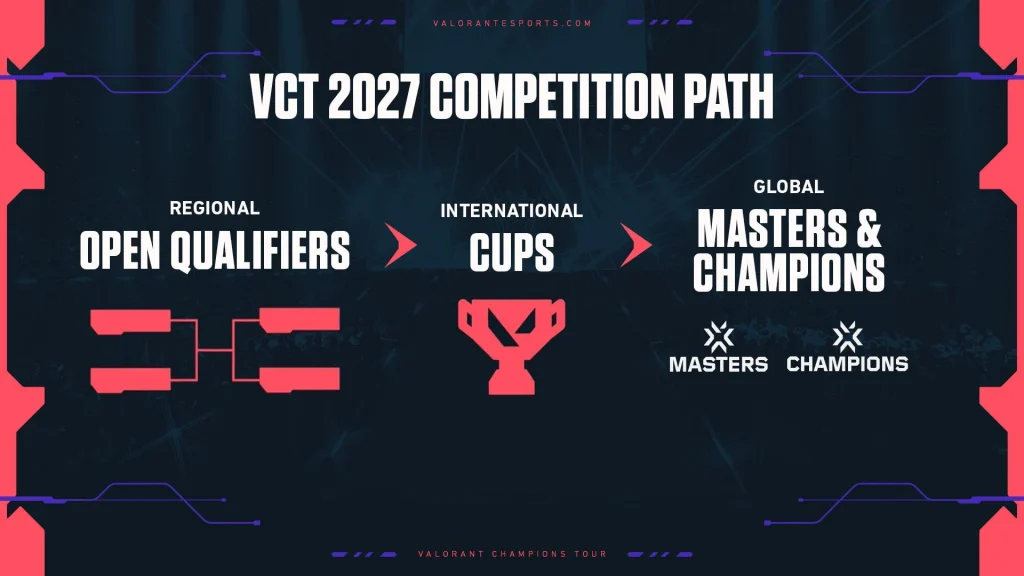
The VCT is moving away from its current league-based format and shifting to a tournament-driven model. Starting in 2027, any team can qualify for Masters and Champions through open qualifiers. All teams will compete in a single tier of competition.
That last part is the biggest shift. There is no longer a hard wall between Tier 1 partner teams and Tier 2 challengers. Everyone competes in the same bracket ecosystem, starting from open qualifiers.
Every team in the ecosystem will compete within a single competitive tier from 2027, with open qualifiers acting as the starting point for each season.
The format is built on three principles Riot has laid out: every match should carry weight, the path to global events should be open, and live events should visit more locations.
VCT Cups: What Are They and How Do They Work
VCT Cups are the biggest new structural addition.
Traditional regional leagues are replaced with VCT Cups, which are LAN tournaments that determine the top teams in each region, featuring open qualification and live finals in new cities.
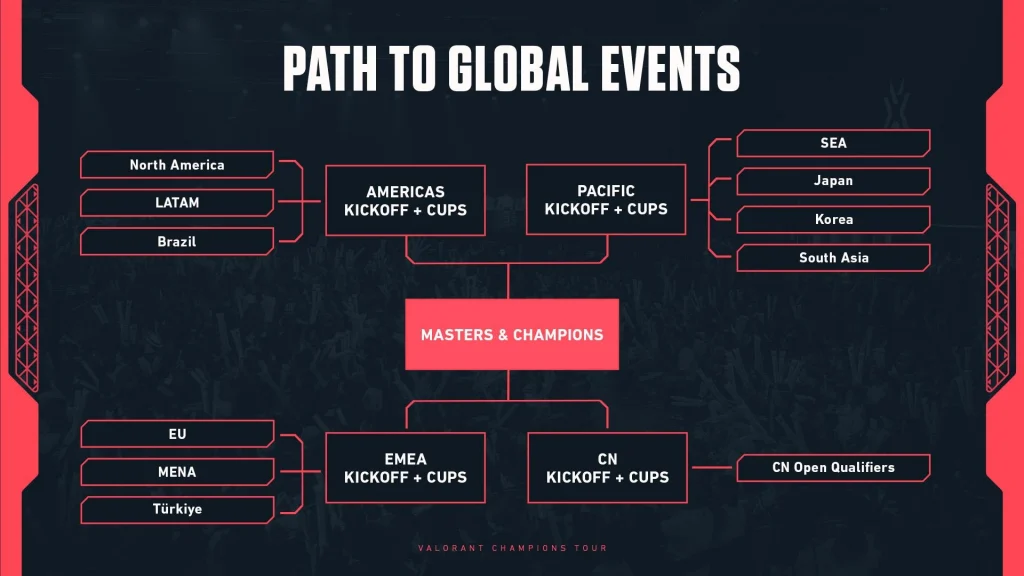
Each of the four VCT regions, which are EMEA, Americas, Pacific, and China, will host two Cups per year. That is eight Cups in total across the global calendar. Each Cup is a LAN-based tournament that determines the top teams in a given territory, concludes with a finals weekend event, and directly qualifies teams to Masters and Champions.
These are not round-robin leagues. They are bracket-style events. Short, high-stakes, and open to anyone who qualifies through the open qualifier system.
The finals of each Cup will be held in a new city, different from existing league hubs. Riot has not confirmed those locations yet.
How the Full Season Structure Works
The 2027 VCT season runs in three cycles.
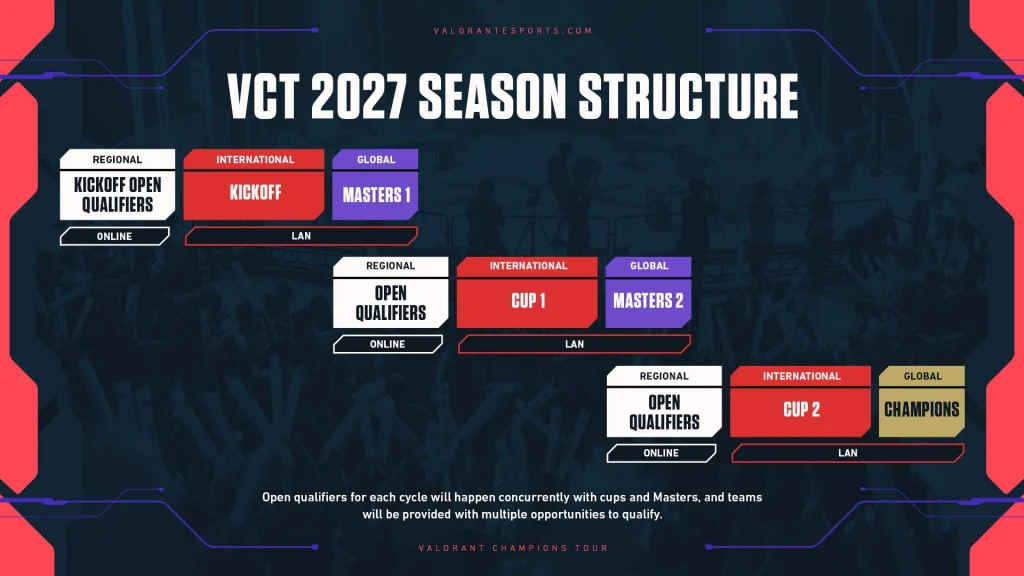
The season opens with regional Kickoff Open Qualifiers online, feeding into the international Kickoff on LAN, which leads to the global Masters 1. The second cycle runs regional Open Qualifiers online into the international Cup 1 on LAN, with the top teams advancing to global Masters 2. The third cycle feeds into Champions.
Kickoff remains part of the calendar as the season-opening event. Kickoff qualifiers will take place in Q4 of the prior year, after Champions concludes.
Open qualifiers for each stage run at the same time as Cups and Masters. That means if a team misses one qualification window, they have another shot in the next cycle. Multiple tries, multiple times per year.
The 2027 Champions location has not been confirmed. Riot Games had previously indicated in 2024 that the 2027 VCT season should conclude in the Americas.
For a broader look at how Valorant’s competitive seasons have been structured, see our Valorant Season 2026 Act 2 patch breakdown on TalkEsport for context on where the game currently stands before the overhaul kicks in.
What This Means for Non-Partner Teams
This is where things get genuinely different compared to the current system.
Under the current model, non-partner teams had to grind through an entire Ascension season just to earn one promotion slot into VCT. Even then, they were only in the league for one or two years. Reaching Masters or Champions was essentially impossible unless you were already a partner team.
For the first time in VCT history, any team in the world can qualify for Masters and Champions. Under the new model, teams will have multiple shots per year at reaching the biggest stages.
Non-partner teams also get more financial support in 2027. Non-partnered teams will receive greater support under the new model, including cash incentives tied to qualification, access to regional and global prize pools, travel support, and faster payout cycles intended to support operations during the season.
Top non-partner teams can earn Championship Points and prize money throughout the year and, “in extraordinary cases, even earn more than bottom of the pack partner teams.”
What Happens to Partner Teams
Partnerships are not ending. They are changing.
Starting in 2027, Riot shifts to a two-year partnership model with revised selection criteria. Partner teams remain a core part of VCT, benefiting from financial stability and long-term support.
Applications for prospective partner teams opened today. Established non-partner teams are encouraged to reach out to their respective regional Riot Esports contacts. Partnership applications will be evaluated across five criteria: commitment to growing the VALORANT community, community resonance across fandom and content, business and operational strength, infrastructure, and competitive success.
Partner teams still get direct seeding into later rounds of qualifiers. They do not have to start from the very first open qualifier stage. That safety net remains. But it no longer guarantees a path to global events without performing.
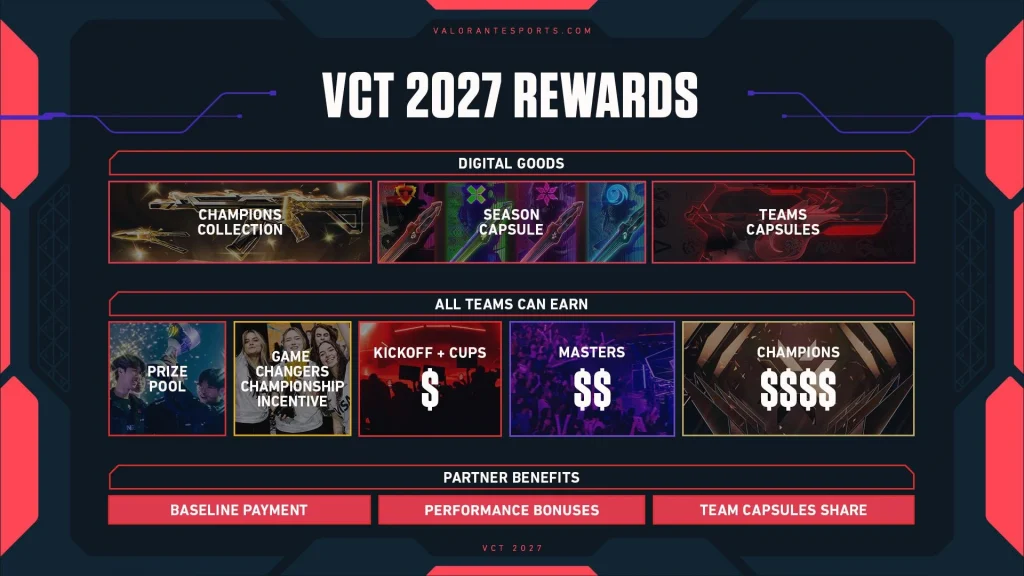
Riot Games also recalled that it distributed nearly 86 million dollars to all partner teams in 2025 through digital goods revenue.
Prize Pool and Financial Structure
VCT 2027 will feature over 20 tournaments per year across more than 16 cities worldwide, with total prize pools exceeding $6 million USD annually.
Travel to global events is fully funded by Riot. Cash incentives are attached to each stage of competition and scale with the stakes involved. The payout approximately doubles from Cups to Masters, and doubles again from Masters to Champions.
For non-partner teams specifically, funds for Cup attendance will be distributed early to help cover travel and visa logistics.
Game Changers will also receive a portion of the total annual funds, though Riot has not confirmed the exact amount yet.
What Is Still Unknown
A lot of the finer details are not confirmed yet. Riot has said the following will be announced closer to Champions 2026, which takes place in Shanghai later this year:
- Specific regional calendars and slot allocations
- Exact event locations for Kickoff and Cups
- Game Changers program distribution breakdown
- Regional qualification path details by territory
Qualification paths may vary by region and could include community tournaments, partner events, collegiate events, Valorant Premier, and other formats. None of that is locked in yet for each territory.
If you want to understand more about how the current agent meta is shaping up heading into this transitional period, the Valorant 12.06 patch notes on TalkEsport cover the latest balance changes in the live game.
Context: Why Riot Is Making This Change
This overhaul did not come out of nowhere.
Riot’s leadership had been signaling this direction throughout 2025. Leo Faria posted on Reddit in May 2025: “We’re cooking something for 2027+.” The 2026 season was already a partial step in this direction, with Path to Champions giving non-partner teams more access to international events and Stage 2 playoffs moving to destination cities.
The original VCT partnership model launched in 2023. This marks the end of the first VCT partnership cycle, which began in 2023. Riot Games had originally planned that cycle to run through 2027, but decided to end it in 2026 to prepare for the restructured system.
The four international leagues, VCT EMEA, VCT Americas, VCT Pacific, and VCT China, will remain as the regional structures. But the nature of how teams compete within them changes completely.
For the full picture of what Valorant esports looks like right now, Riot’s official Valorant esports website has the current VCT 2026 standings and schedule.
FAQ
What is the VCT 2027 format? VCT 2027 replaces league play with a tournament-driven system. Teams enter through open qualifiers, compete in regional VCT Cups, and the top performers qualify for Masters and Champions. All teams compete in a single tier.
Can any team qualify for Masters and Champions in 2027? Yes. For the first time in VCT history, any team can reach Masters and Champions through open qualifiers. Non-partner teams no longer need to go through Ascension to access Tier 1.
What are VCT Cups? VCT Cups are LAN regional tournaments that replace Stage 1 and Stage 2 league formats. Each of the four VCT regions hosts two Cups per year, for a total of eight globally. The Cup finals are held live in new cities and directly qualify teams to global events.
Are VCT partnerships ending in 2027? No. A new two-year partnership cycle runs from 2027 to 2028. Applications are now open. Partner teams still receive base payments, Team Capsule in-game revenue, and direct seeding into later qualifier stages.
How much prize money is in VCT 2027? Total prize pools across the circuit exceed $6 million USD per year. Travel to global events is fully funded. Cash payouts scale up from Cups to Masters to Champions.
When does VCT 2027 start? An exact start date has not been announced. Further details are expected before Valorant Champions 2026, which takes place in Shanghai.
Where will VCT Champions 2027 be held? The location has not been confirmed. Riot previously indicated in 2024 that the 2027 season would conclude in the Americas.
