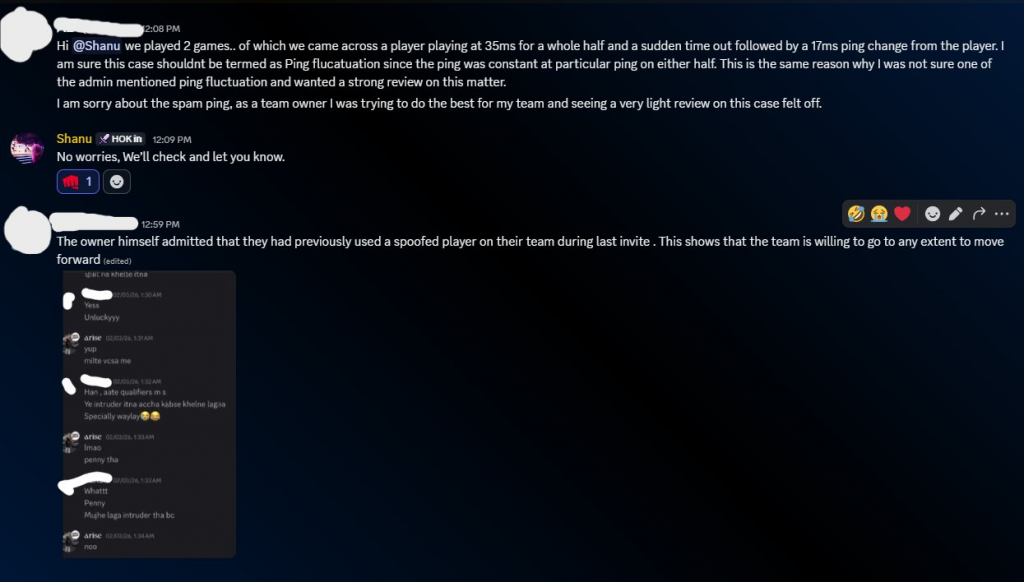
A serious competitive integrity complaint has surfaced against a team in the Valorant Challengers South Asia 2026 circuit. ARISE Esports India has publicly alleged that a participating team was allegedly allowed to continue competing in VCSA despite one of their players receiving a Riot ban for cheating – and that prior reports of suspicious account switching had reportedly gone unaddressed by tournament management.
What Was Alleged
ARISE Esports India posted the allegations on X, stating that a team in the Riot-sanctioned VCSA South Asia tournament was reportedly permitted to keep playing even after one of their players was issued a Riot ban for cheating. They also claimed to have flagged suspicious account-switching behaviour to tournament management earlier, and that those concerns were reportedly ignored at the time.
Neither Riot Games nor NODWIN Gaming, which organises VCSA in partnership with Riot, has publicly responded to the allegations at the time of writing. TalkEsport has reached out for comment. The tournament management’s position on both claims is unknown. The identity of the team and the banned player have not been publicly named in the complaint.
What VCSA 2026 Is and Why It Matters
VCSA 2026 is organised by NODWIN Gaming in partnership with Riot Games and serves as the official competitive pathway for South Asian teams aiming to reach the VCT Last Chance Qualifier. It is the highest-stakes domestic Valorant competition in the region. The 2025 edition drew over 12 million views with a peak of 50,000 concurrent viewers, and Velocity Gaming secured a VCT Ascension Pacific slot through the circuit.
For teams competing in VCSA, the implications of a result go beyond domestic standing. Placement in the circuit directly determines which South Asian team earns the right to compete internationally, making the competitive integrity of every series critical.
Riot’s Competitive Rules on Banned Players
Riot’s competitive policies are clear on this point. All players competing in any Riot-sanctioned Valorant event are required to agree to the Global Code of Conduct. Players who receive a Riot ban for cheating are ineligible to compete in official tournaments for the duration of that ban.
Riot’s own rulebook states that the anti-cheat team works directly with tournament operators to review suspicious behaviour during competitive events, and that players pursuing unfair tactics are to be identified and removed. If the allegation is accurate and a banned player was allowed to continue competing, that would represent a breach of this framework.
Tournament operators are also expected to enforce roster compliance. Account switching, as separately alleged by ARISE, raises questions under Riot’s rules around player identity verification and account ownership during sanctioned play.
This Is Not a New Problem for Indian Valorant
Competitive integrity concerns in Indian Valorant esports are not without precedent. In 2021, a player named Xhade was caught using cheats during a professional match, later admitting to using wallhacks during a livestream. Before that, the CS:GO scene was rocked in 2018 by the Nikhil “forsaken” Kumawat scandal, when a player for OpTic India was caught using an aimbot at the eXTREMESLAND Finals – an incident that caused franchises including Fnatic and Team Liquid to reconsider entering the Indian market entirely.
Each of those incidents sparked the same community debate: that a failure to enforce competitive integrity domestically damages India’s credibility when teams reach international stages. The ARISE Esports post made this argument directly, stating that “India gets embarrassed on bigger stages because competitive integrity isn’t taken seriously.”
Whether or not that characterisation is fair to the broader scene, the concern it reflects is genuine. India has been building legitimate international representation in Valorant for years, with Global Esports qualifying for VCT Masters London 2026 as the first Indian organisation to reach a Masters event. Any question about whether domestic competition is clean undermines that work.
What Needs to Happen Next
The allegations from ARISE Esports India are, at this point, a public complaint from a competing organisation. They have not been verified by Riot Games or NODWIN. The named team has not responded publicly. No official investigation has been announced.
For the allegations to be resolved credibly, either NODWIN or Riot Games needs to acknowledge the complaint and clarify what action, if any, was taken when the account-switching behaviour was first reported. If a banned player was indeed permitted to compete, the question of how that was missed or overlooked requires a formal answer – not just for the teams involved, but for the legitimacy of the entire VCSA circuit.
Competitive integrity is not a footnote in an esports ecosystem. It is the product itself.