

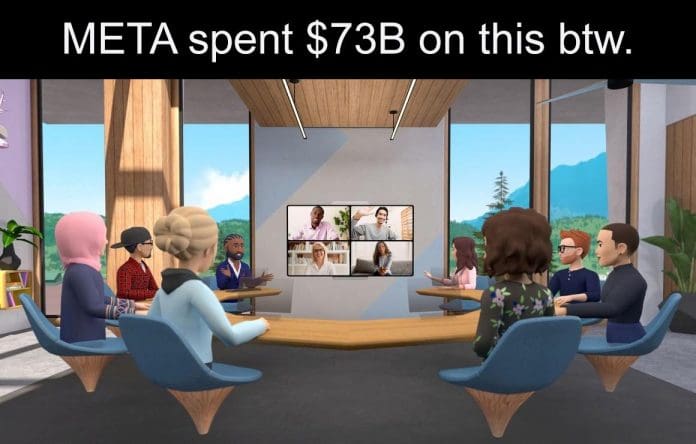

Meta’s decision to scale back Horizon Worlds does not arrive as a shock, rather a confirmation.
Over the past few weeks, the company has moved away from positioning Horizon Worlds as a central VR-first platform, softening earlier plans of a full shutdown while clearly reducing its long-term commitment. The platform will continue to exist, but without meaningful expansion. In strategic terms, this is not continuity. It is containment.
For a company that rebranded itself around the metaverse in 2021, this moment carries weight. It signals not just a product shift, but a recalibration of one of the most ambitious technology narratives of the last decade.
Yet what makes this transition notable is not the pivot itself. It is the timeline.
Because the limitations of Meta’s metaverse vision were not discovered recently. They were visible, discussed, and documented years ago.
The Early Signals That Were Hard to Miss
As early as 2022 and 2023, creators and analysts began dissecting Horizon Worlds with a level of detail that left little ambiguity. The platform, despite its positioning, did not deliver an experience that justified its ambition.
Users who entered Horizon Worlds often described the same pattern. Initial curiosity was followed by rapid disengagement. The environments felt sparse, interactions were limited, and the overall experience lacked the depth required to sustain long-term participation.
This was not a fringe perspective. It was a recurring conclusion across multiple independent analyses.
What stood out was not just the criticism itself, but its consistency. Different creators, different formats, and different audiences all pointed toward the same structural weaknesses. Horizon Worlds was not failing because it was unfinished. It was struggling because it was not compelling.
And this distinction mattered. Because products that are early can still grow.
Products that fail to engage rarely do.
A Vision Built Ahead of Its Time, or Out of Sync With It?
The deeper critique of Meta’s metaverse strategy extended beyond Horizon Worlds as a standalone product. It questioned the underlying premise.
Meta was attempting to build a large-scale social ecosystem on top of virtual reality hardware that had not achieved mainstream adoption. This created a structural dependency. The success of the platform was tied not only to its own quality, but to the willingness of users to adopt an entirely new interface. That willingness never materialized at scale.
VR headsets, while technologically impressive, remained niche. They required financial investment, physical adjustment, and a level of behavioural commitment that most users were not prepared to make. Unlike smartphones or PCs, VR did not integrate seamlessly into daily routines.
This created a gap between ambition and accessibility. Meta’s vision assumed that users would transition into immersive environments because of the potential those environments represented. In reality, users tend to move toward convenience, familiarity, and immediate value.
The metaverse, as presented, demanded too much before offering enough.
The Problem of Forcing Behavioural Change
Technology adoption has historically followed a clear pattern. The most successful platforms do not require users to change behaviour. They enhance behaviour that already exists.
Social media did not invent communication, it simply amplified it. Streaming platforms did not invent entertainment. They simplified access to it.
Mobile devices did not invent computing. They made it portable.
Horizon Worlds operated in the opposite direction. It asked users to enter a new environment, adopt new interaction methods, and spend extended periods within a space that did not yet provide a proportionate return in value. This inversion of the adoption model created friction at every stage of the user journey.
The result was predictable. Users experimented, but they did not stay. And retention, more than acquisition, defines the success of any social platform.
Investment Without Adoption
Meta’s commitment to the metaverse was not incremental. It was absolute.
The company rebranded itself, reorganised its strategic priorities, and channelled enormous financial resources into Reality Labs. Over time, this investment has approached the $80 billion mark, making it one of the most significant long-term bets in modern technology.
From a capital perspective, the effort was unprecedented. From a user perspective, the response was limited. This divergence is critical. Large-scale investment can accelerate development, improve infrastructure, and expand reach. What it cannot do is manufacture organic demand. User adoption is not a function of capital alone. It is a function of relevance.
And relevance, in the case of Horizon Worlds, remained elusive. While Meta continued to invest, competing platforms with far fewer resources built stronger communities. The difference was not technological sophistication. It was alignment with user expectations.
Platforms that prioritised creativity, accessibility, and community-driven experiences were able to sustain engagement. Horizon Worlds, despite its resources, struggled to achieve the same outcome.
The Cost of Narrative Commitment
At some point, Meta’s metaverse strategy transitioned from a product decision to a narrative commitment.
The company had publicly defined the metaverse as the future of digital interaction. It had aligned its brand, messaging, and long-term positioning with that vision. Reversing course early would not have been a simple strategic adjustment. It would have required a visible redefinition of that narrative.
This created inertia. Even as feedback remained consistent and adoption lagged, the broader direction remained unchanged. Investment continued. Messaging remained aligned. The vision was sustained. This is not unusual in large-scale technology bets. When a company commits to a long-term narrative, especially one tied to its identity, the threshold for recalibration becomes significantly higher.
The challenge is that markets do not operate on narrative timelines. They operate on adoption. And adoption, in this case, was not keeping pace.
The Industry Moved, Just Not Toward the Metaverse
While Meta continued to invest in the metaverse, the broader technology landscape evolved rapidly. Artificial intelligence emerged as the new centre of gravity.
Unlike the metaverse, AI did not require users to adopt new hardware or enter new environments. It integrated directly into existing workflows, platforms, and behaviors. The barrier to entry was minimal, and the value proposition was immediate. This difference reshaped priorities across the industry.
Capital, talent, and strategic focus began shifting toward AI-driven solutions. Companies that had previously explored metaverse initiatives began reassessing their direction. The narrative that had dominated headlines in 2021 and 2022 gradually lost momentum. In contrast, AI gained it. Meta’s own pivot reflects this shift. The company is now investing heavily in AI infrastructure, models, and applications—areas where adoption is not speculative, but measurable.
The contrast between the two trajectories is instructive. One required users to adapt to a new paradigm. The other adapted to users.
Horizon Worlds Today: Maintenance, Not Momentum
The current state of Horizon Worlds reflects this broader recalibration.
The platform is no longer positioned as the centerpiece of Meta’s long-term strategy. Its development has slowed, its ambitions have been moderated, and its role within the company’s ecosystem has been redefined. It continues to exist, but without the momentum that once defined it.
This is not a complete withdrawal from the metaverse. Meta has not abandoned immersive technologies entirely. However, the scale and intensity of its commitment have changed. The metaverse is no longer the future, it remains one of many possibilities.
A Lesson in Timing and Alignment
Looking back, the most significant aspect of Meta’s metaverse journey is not the outcome, but the timeline.
The limitations of Horizon Worlds were not hidden. They were identified early, discussed openly, and reinforced through user behaviour. The feedback loop was active and visible. What followed was not a lack of information, but a delay in response.
This highlights a broader principle in technology strategy. Vision is essential, but it must remain aligned with user reality. When that alignment breaks, even the most well-funded initiatives can struggle to sustain momentum.
Meta’s investment in the metaverse was not misplaced in intent. The idea of immersive digital environments continues to hold potential. However, the execution, timing, and underlying assumptions created a disconnect that proved difficult to overcome.
Technology narratives often begin with conviction. They are built on the belief that the future can be shaped through vision and investment. But ultimately, those narratives are tested in the market. Users respond through behavior, not agreement. They return, or they don’t. They engage, or they move on. In the case of Horizon Worlds, the response was clear, and it was visible early.
Three years ago, the concerns were already being articulated. Today, the strategy is beginning to reflect them. Not because the vision changed. But because the market never did.
