


In April 2025, WinZO Games co-founders Saumya Singh Rathore and Paavan Nanda stood on stage at one of India’s most visible startup showcases, delivering insights on innovation, community building, and the creator economy. Just three months later, the same duo find themselves at the centre of a high-profile investigation by India’s Enforcement Directorate (ED), accused of alleged money-laundering and financial misconduct, with Rathore granted bail and Nanda denied relief by a Bengaluru court.
The meteoric switch from celebrated entrepreneurs to subjects of intense legal scrutiny underscores not only the volatile intersection of tech, regulation, and finance in India’s digital economy but also the growing pains of an industry in transition.
In April, WinZO — one of India’s fastest-growing gaming and skill-gaming platforms — was basking in public admiration. At the Startup Mahakumbh, a flagship event backed by government and industry stakeholders, the founders were part of conversations about innovation, employment, and India’s digital future. The platform was lauded for its role in supporting India’s creator economy, enabling gamers, streamers, and indie developers to monetise content and reach audiences at scale.
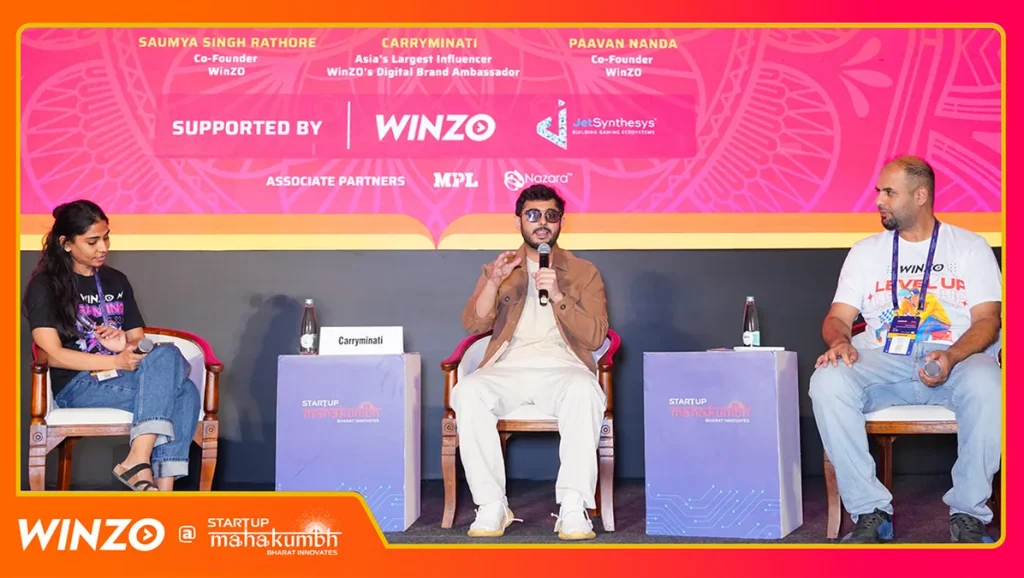
Their contributions extended to engaging youth and tier-2/3 talent pools, particularly through regional language content and accessible gameplay. Not just this, they comfortable worked by aligning with government initiatives aimed at nurturing startups as engines of job creation and technological growth. The Mahakumbh panel, which featured founders alongside public-sector leaders, underscored WinZO’s perceived contribution to both community and economic development.
The tone was celebratory. Coverage highlighted WinZO’s rapid user-base expansion, creative partnerships, and role in legitimising games as a source of livelihoods — from competitive players to content collaborators.
For the founders, being invited to speak at a government-affiliated startup forum was a marker of prestige, signalling that their platform was not just commercially successful but also socially relevant.
Sharp Nosedive
The world changed abruptly for WinZO and its leadership in the months after April. Two major developments reshaped their narrative.
In mid-2025, the Indian Parliament passed the Promotion and Regulation of Online Gaming Act, 2025 (PROGA), which included sweeping measures to ban real-money gaming (RMG) nationwide, among other provisions. The law sent shockwaves through the online gaming ecosystem, forcing market pivots and resignations of business models once seen as growth engines. This regulatory shift placed platforms like WinZO at the centre of both commercial and legal scrutiny.
The ban was intended to curb gambling-linked gaming, protect consumers, and establish a clear legal framework — but it also disrupted revenue streams and pushed companies to reevaluate compliance mechanisms.
Against this backdrop, the Enforcement Directorate (ED) launched a money-laundering investigation in November 2025, based on predicate offences detailed in multiple First Information Reports (FIRs) filed in Bengaluru, Delhi, and Rajasthan. The probe targeted alleged financial irregularities linked to WinZO’s operations.
On 26 November 2025, both Rathore and Nanda were arrested by the ED and remanded to custody as investigators pursued evidence on alleged:
- Algorithmic manipulation in gaming operations, which the agency claims generated wrongful gains.
- Divergent fund flows and layering of proceeds, including possible transnational transfers.
- Discrepancies between reported financials and underlying transactions, as part of a broader money-laundering case under the PMLA (Prevention of Money Laundering Act).
The case quickly became one of the most watched in the Indian tech and gaming sector, given WinZO’s prominence and previous goodwill.
Divergent Outcomes Further Complicating The Issues
On December 26, 2025, a sessions court in Bengaluru delivered a split bail order that has further emphasised the complexity of the case. While, Saumya Singh Rathore was granted bail, leveraging a statutory proviso under the PMLA that provides procedural safeguards for women accused under the Act. The court noted she had already undergone extensive custodial interrogation and deemed further detention unnecessary at this stage.
On the contrary, Paavan Nanda was denied bail, with the court finding that the ongoing investigation warranted his continued custody. The judge cited concerns that releasing him prematurely could impede aspects of the probe.
The three-month transformation of WinZO’s public positioning, from government-aligned startup exemplar to defendants in a financial crime case, mirrors larger tensions in India’s tech ecosystem. As lawmakers grapple with evolving categories like skill gaming, real-money play, and consumer protection, companies face shifting compliance expectations. Rapid growth and public celebration can quickly give way to enforcement scrutiny when legal and financial boundaries are contested or unclear. Corporate reputations built on community support and tech optimism can be destabilized by legal proceedings, regardless of eventual outcomes.
For observers, this case serves as a cautionary tale about the speed at which fortunes can shift in India’s digital economy, particularly for companies operating in legally sensitive domains like gaming, fintech, and digital assets.
What Happens Next
With continued investigation expected through early 2026, the WinZO case remains far from resolved. The ED is likely to present additional evidence and documentary material in the coming hearings, and legal teams for both founders are preparing substantive responses.
Regardless of the final outcome, the narrative arc from startup honours in April to ED custody by November–December underscores how closely regulatory climates, legal frameworks, and public perception intersect in the modern era — especially for companies at the intersection of gaming, technology, and money movement.
For the Indian startup community, the WinZO story may well shape how founders, investors, and policymakers approach both compliance and narrative management in the years ahead.