


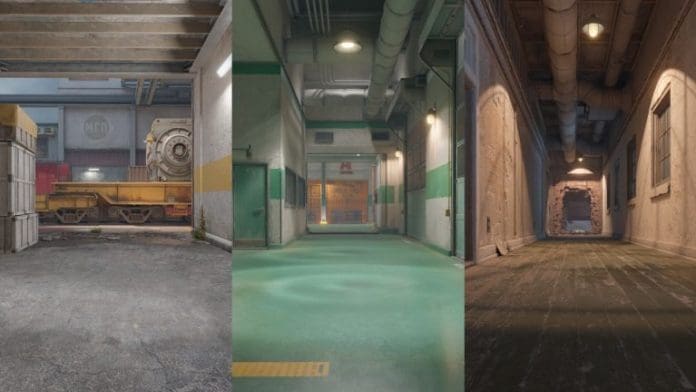

Train returned to Counter-Strike 2 in January 2025 with a fresh coat of paint and major gameplay changes. Valve replaced Vertigo with the remade Train, hoping the classic map would win over both casual players and professional teams. But here we are, and the reception has been anything but warm.
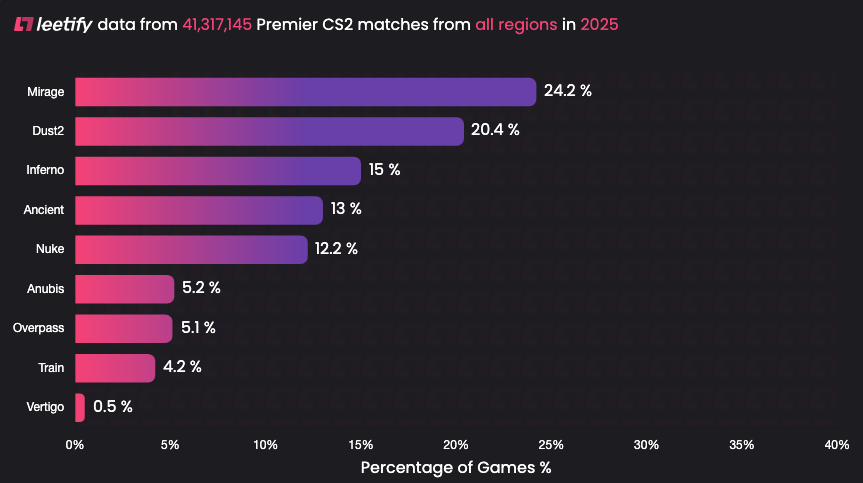
The numbers tell a story that’s hard to ignore. Train sits at the bottom of the map pool in terms of play rate, and it’s not even close. Players just aren’t picking it.
The Numbers Don’t Lie
By early May 2025, Train had been played only 486 times in professional matches. Compare that to Ancient, which topped the charts with 1,433 matches. Even Inferno, the second least-played map, saw 832 matches during the same period. Train was getting picked roughly half as often as the next lowest map.
In matchmaking, the situation looks even worse. During Premier Season 2, Train showed up in just 4.6% of roughly three million matches. That’s actually lower than Vertigo’s 9.7% pick rate from the previous season, which is ironic since Valve removed Vertigo specifically because it was unpopular.
Here’s how the maps stacked up in professional play through early 2025:
- Ancient: 1,433 matches
- Mirage: 1,225 matches
- Anubis: 1,078 matches
- Dust 2: 1,072 matches
- Nuke: 1,055 matches
- Inferno: 832 matches
- Train: 486 matches
What Went Wrong?
Train isn’t new to Counter-Strike. The map first appeared back in 1999 and became a staple of competitive play for years. But it was removed from CS:GO in May 2021 because, well, people didn’t want to play it then either. The CS2 remake was supposed to fix that problem.
Valve made significant changes to address Train’s biggest issue: it was heavily CT-sided. They removed the infamous heaven position overlooking A site, widened entry points for Ts, and streamlined confusing corridors. The beloved ladder drop? Gone. Popdog became longdog. Both bomb sites got opened up with fewer hiding spots and, ironically, fewer trains.
On paper, these changes made sense. In practice, they created new problems.
The CT-Sided Dilemma
Despite Valve’s efforts to balance the map, many players still feel Train favors the Counter-Terrorists too much. The wide-open bomb sites that were meant to help Terrorists actually make it harder to hold positions once the bomb is planted. Meanwhile, CTs still have strong defensive positions that make entry difficult.
The layout feels like it’s stuck between two identities. It’s not the old Train that veterans remember, but it’s also not different enough to feel fresh. Players who mastered the original version had to relearn everything, while new players found a map that didn’t quite fit modern CS2 gameplay.
Performance Problems
Frame rate issues haven’t helped Train’s case. Multiple players report significant FPS drops in contested areas, with frame rates sometimes becoming unplayable. This has been an ongoing problem with CS2 in general, but it seems particularly bad on Train. When you’re trying to hold a critical angle or make a precise shot, stuttering frames can cost you the round.
The Vicious Cycle
Here’s where things get tricky. Train is unpopular, so teams don’t practice it. Because teams don’t practice it, they ban it. Because it keeps getting banned, it stays unpopular. Queue times get longer for players who actually want to play Train, which makes even fewer people willing to wait.
Most professional teams that had Vertigo as a permanent ban simply switched to banning Train instead. It was the path of least resistance. Why spend hours learning a new map when you can just ban it and play the six maps you already know?
Complexity stands out as one of the few top teams that actually tried to make Train work. They invested time into learning the map and attempted to use it as a competitive advantage. But when every other team just bans it, that advantage never materializes.
What Happens Next?
Valve made a decision in January 2026 that basically confirmed what everyone already knew: Train wasn’t working. They removed it from the active map pool and brought back Anubis for Premier Season 4.
Over its one-year run, Train was played 1,942 times in total across all competitive levels. For comparison, Anubis, which was only in the pool for part of 2025 before being removed in June, still managed 1,552 matches.
The Train experiment lasted exactly one year. It returned in January 2025 and was removed in January 2026. That’s a pretty clear signal that something wasn’t working.
Learning from Vertigo’s Mistakes
Remember why Vertigo got removed? Players didn’t like it. So Valve brought back Train thinking nostalgia would carry it. But bringing back a map that was already unpopular in CS:GO, even with a remake, was always going to be a tough sell.
The Counter-Strike community can be resistant to change, but they’re also quick to embrace maps that work. Look at Ancient, which debuted in CS:GO and quickly became one of the most-played maps in CS2. Or Anubis, which found its footing after some initial adjustments. These maps succeeded because they offered something fresh while still feeling like Counter-Strike.
Train’s problem wasn’t that it was new. It’s that it felt like a compromise between old and new, satisfying neither camp fully.
The Bigger Picture
Valve typically shakes up the map pool after major tournaments. The Austin Major came and went with Train still in the pool, despite its low numbers. By the time the Budapest Major wrapped up in late 2025, it was clear Train’s days were numbered.
When Season 4 started in January 2026, Anubis replaced Train. Teams now have a map they’re more familiar with, one that saw strong play in 2024 before its temporary removal. Whether Anubis stays or becomes the next casualty of the map rotation remains to be seen.
For casual players, map preference might seem like a minor issue. But in competitive Counter-Strike, the map pool shapes everything. It determines which teams have advantages, which strategies work, and which players shine. A map that nobody wants to play creates dead weight in the rotation.
Train’s failure also raises questions about how Valve handles map updates. Is it better to tweak existing maps or introduce completely new ones? Should unpopular maps get multiple chances, or is it better to move on quickly? The Train experiment suggests that sometimes, even nostalgia isn’t enough to revive a map that players have already rejected once before.
At the end of the day, the numbers speak for themselves. Players vote with their picks and their bans. Train got neither the matches nor the love it needed to succeed. Whether it will return again in the future with even more changes, or if it’s destined to remain in Counter-Strike’s history books, only time will tell.
For now, Train is back on the sidelines, and the competitive scene is moving forward without it.