

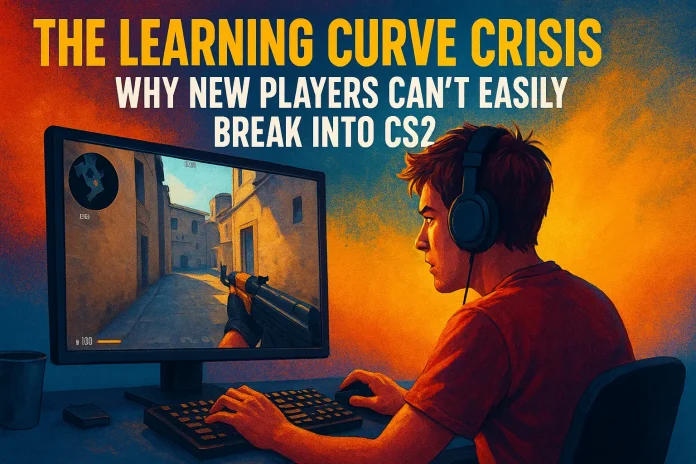
What was initially supposed to be a refreshing chapter in the history of the game became a wall for fresh faces while making veterans suffer with adaptability issues at every step of the game. CS2 was designed to eliminate the problems that came with CS:GO. A new engine, better graphics, and refined mechanics were curated to give players a better experience.
CS2 was presumed to present new players with an opportunity to get on par with their peers who played the previous iteration of the game for decades. However, reality could not be far from it. CS2 is brutally hard if you are coming into the game having not played any version of Counter-Strike before, and not only does it demotivate you, but the learning curve crisis demoralises anyone attempting to acquire a taste of the game.
What is the Learning Curve Crisis?
Learning Curve could be defined as a graph plotted with skill as a function of time. A shallow learning curve suggests that players require more time to reach a certain level of proficiency, as is the case with CS2. New players are brutally punished, leading to them giving up before exploring the game and building their skills to the level required so that they can hang at the entry level of competition.
The game itself can be incredibly toxic, where teammates rarely line up to help, and as a result, players find it very difficult to adapt to the tough, unforgiving, and demoralising environment of CS2. The mechanics of the game take a while to get used to, and it punishes the smallest of mistakes, leading to a longer lead time before players can get used to the clunky mechanics of CS2.
The Skills Gap Problem
The game, being over a decade old, has players who have been grinding it since its incept, making the average skill level very high, leading to new players having a difficult time aligning with others of the same skillset. To play the game at a basic level, players must memorise maps, utilities, callouts, and master sprays, movement, and other micro-mechanics.
When a new player comes into the game, they face challenges in the form of experienced players who have mastered the above-mentioned areas for a considerable time. If they did manage to mitigate the skill gap, they would face smurfers and cheaters, thus ruining their motivation even further.
Veteran-Dominated Ecosystem
The Majority of the playerbase comprises veterans with years of experience behind them, leading to the lack of a layer of players with an unpolished skillset. These pseudo-pros have refined game sense, deep-rooted map awareness, and well-established mechanical skills.
This takes away the breathing room for new players to grow. With the majority playing the game like it is in their second nature, newbies are pushed away, demotivated, and demoralised, leading to them not taking the journey to overcome the learning curve. For someone who is well-versed in every area of the game, it becomes difficult to make use of a fresh face in a game when executing a strategy where every player plays an important role. However, things are changing nowadays; younger talents are coming up and challenging veterans.
Matchmaking as a Double-Edged Sword
Matchmaking or Premier is the highlight of the game, and that is where the majority of the playerbase primarily plays. While it is designed to give a player balanced matches, the reality is far from it. Mixed queues and a lack of players often prompt the algorithm to find a match out of the ELO bracket for newbies, leading them to have a frustrating experience.
Instead of easing into the game, new gamers are offered a harsh environment where they find it very difficult to thrive and learn. As long as Valve makes the matchmaking algorithm more precise to matchmake less experienced players together, Matchmaking will continue to offer these players a tough environment to sustain.
Why CS2 Feels So Unforgiving
CS2 was designed for precision, and players must fit into the unforgiving nature of the game. The design philosophy in the game lies in its unforgiving nature, and the precision-oriented mindset of players is what made the game into what it is today. There are no beginner-friendly modes, and the only way the game offers a learning environment is through the space filled with discouragement offered to the new players.
While many games provide a secure environment for experimentation and learning, serious, extremely talented players may still be found in CS2’s casual settings. There isn’t a real beginner-friendly setting where errors may be made without serious repercussions. Furthermore, the game requires strategic depth in addition to aim. You have to understand the opponent’s economics, time your utility precisely, manage recoil patterns, and even engage in mind tricks. The sheer amount of stuff to learn is intimidating to a novice, and failure carries instantaneous consequences.
Why This Crisis Matters for CS2’s Future
CS2 is already facing tough competition from Valorant, where the FPS by Riot is pulling away players, leading to a crisis for CS2 in the future. One can argue that very few young players are being attracted to the game over other, more beginner-friendly choices like Valorant, and without a steady influx of young players, the game will eventually cease to exist. Not only does the game need to acquire players, but they must retain them. Once a player gets used to the mechanics of the game, they rarely leave Counter Strike, but to get a new player to that level is a task of a tall order.
A Game Worth the Climb
While the entry to the game can be brutal, CS2 can offer a very rewarding space at the top. With a thriving competitive scene and tournaments happening at every corner of the world, this game can be one of the most mentally satisfying games that you can play. Once you get the vibe aligned with yours, it becomes increasingly difficult to leave it for something else.
CS2 is a world worth entering. Those who can surpass the harsh point of entry, the game gets considerably forgiving and offers a space to vent. For everything good that can come out of the game, there lies a road that most leave with a mile travelled.

 feels unforgiving for new players. We explore its steep learning curve, veteran-dominated ecosystem, matchmaking flaws, and what the game must change to keep players engaged.)