


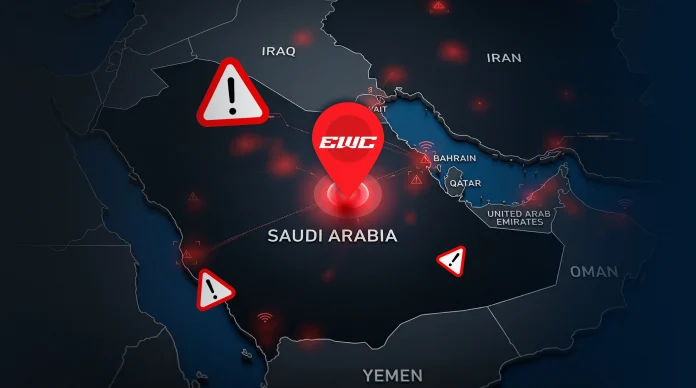
The Esports World Cup 2026 was supposed to be the story of the year. A record-breaking $75 million prize pool. 2,000 players from over 100 countries. 25 tournaments across 24 game titles including PUBG Mobile, VALORANT, Counter-Strike, and Honor of Kings all under one roof in Riyadh, Saudi Arabia, from July 6 to August 23.
Instead, the story of the year might be whether it happens at all.
On February 28, 2026, the United States and Israel launched coordinated military strikes on Iran, killing Supreme Leader Ayatollah Ali Khamenei and several senior military officials. Iran responded within hours, firing over 130 ballistic missiles and 200+ drones across the Gulf region targeting US military assets in the UAE, Qatar, Bahrain, Kuwait, and critically, Saudi Arabia itself.
Riyadh the very city where the Esports World Cup is set to take place was directly targeted by Iranian missiles. Saudi authorities say all incoming projectiles were intercepted, but the message was unmistakable: the Gulf is no longer a safe distance from the conflict.
What Exactly Happened?
Here’s the timeline that matters:
The US-Israel joint operation struck targets deep inside Iran, including Tehran, in what officials described as an effort to neutralize Iran’s nuclear capabilities and destabilize its leadership. Iran’s Revolutionary Guard Corps (IRGC) launched what it called “True Promise 4” a retaliatory wave aimed at every US military installation within reach.
The UAE took the hardest hit among Gulf states. At least three people were killed, Dubai’s iconic Burj Al Arab reportedly suffered a minor fire from intercepted drone debris, Jebel Ali Port was hit, and both Dubai and Abu Dhabi airports suspended all operations. The UAE ordered schools and universities to switch to distance learning and urged private companies to implement remote work through at least March 3.
Saudi Arabia confirmed strikes targeting Riyadh and the oil-rich Eastern Province, though it maintains all were repelled. The Saudi Pro League home to Cristiano Ronaldo and Karim Benzema is facing potential suspension. Regional airspace has been closed across multiple countries, with airlines like Emirates, Etihad, flydubai, and Air India cancelling hundreds of flights.
As of this writing, Iran has vowed to continue its strikes until “the enemy is decisively defeated.” The conflict shows no signs of immediate de-escalation.
Why This Matters For The Esports World Cup
Let’s be clear about what the EWC represents. It isn’t just a tournament it’s Saudi Arabia’s crown jewel in its bid to become the global capital of esports and gaming culture. Backed by the Saudi Public Investment Fund through the Esports World Cup Foundation, the event is a cornerstone of Vision 2030, the kingdom’s strategy to diversify its economy beyond oil.
The 2025 edition featured over 25 game titles, 28 club teams, and more than 2,500 participants from 100 countries. The 2026 edition was set to be even bigger, with the introduction of the inaugural Esports Nations Cup a country-based competition running alongside the club format.
Now, with Iranian missiles being intercepted over Riyadh, several critical questions emerge:
1. Security and safety of participants
The EWC draws players, staff, media, and fans from across the world. Asking 2,000+ international esports professionals to fly into a city that was targeted by ballistic missiles even if those missiles were intercepted is a fundamentally different proposition than it was a week ago. Insurance costs, security logistics, and the sheer optics of the situation create enormous challenges.
2. Travel and logistics
Regional airspace closures have already stranded over 20,000 passengers in the UAE alone. If the conflict escalates or persists, international flight routes through the Gulf could face prolonged disruption. Many EWC participants would need to transit through Dubai or Doha both of which were directly targeted by Iranian strikes.
3. The Iran factor in esports
Iran has a growing esports community, particularly in games like Dota 2, Counter-Strike, and PUBG. While Iran hasn’t historically been a dominant force at the EWC, the broader question of whether players from conflict-affected nations can safely participate or are even permitted to remains unresolved. The FIFA World Cup 2026 is already grappling with this exact scenario, with Iran’s football federation openly questioning whether it can send its team to play in the United States.
4. Sponsor and broadcast confidence
The EWC’s value proposition to sponsors is built on global reach, massive viewership, and association with the world’s biggest gaming brands. A security crisis in the host city could spook sponsors, particularly Western brands that are already navigating complex geopolitical considerations around Saudi partnerships.
5. The Saudi Pro League precedent
If Saudi Arabia’s football league a far more established and locally significant competition faces suspension due to security concerns, it becomes very difficult to argue that an international esports festival should proceed without similar caution.
What About Indian Esports?
For the Indian esports ecosystem, the EWC is a massive opportunity. PUBG Mobile is one of the featured titles, and with BGIS 2026 qualifiers already underway, the pathway from Indian competition to the global stage runs directly through Riyadh.
Indian teams competing in Free Fire also have a stake; the 2026 season has expanded to 24 international slots, and India’s return to the Free Fire international circuit (through FFMIC) was being celebrated as a major milestone.
Also Read: India’s Esports World Cup 2026 Dream: 3 Indian Orgs in Riyadh?
If the EWC faces delays, relocations, or cancellations, the ripple effects would be felt across the Indian esports calendar. Qualification timelines, team bootcamp schedules, visa processing, and sponsorship deals tied to EWC participation would all be thrown into uncertainty.
Beyond the competitive side, Indian esports media and content creators who were planning EWC coverage would also be impacted. Travel to Saudi Arabia which typically involves transiting through Dubai is already complicated by the current airspace closures and flight cancellations.
Could The EWC Be Relocated Or Postponed?
This is the question everyone’s asking, and the honest answer is: it depends entirely on how the next few weeks play out.
The case for proceeding as planned: Saudi Arabia has significant political will and financial resources to make the EWC happen. The kingdom has positioned itself as a victim of Iranian aggression, not a party to the conflict. Four months is a reasonable buffer for the situation to stabilize. The Saudi air defense systems appear to have performed effectively, and the government has moved swiftly to reassure citizens and residents.
The case for concern: The conflict could escalate further. Iran has explicitly stated it will continue strikes. Saudi Arabia has reserved the right to retaliate. If this becomes a prolonged regional conflict, the security environment in July could be far worse than it is today. Even if Riyadh itself remains safe, the perception of risk could deter international participation.
The relocation question: Moving the Esports World Cup to another country on short notice would be extraordinarily complex. The event requires massive venue infrastructure, broadcast setups, and coordination across 24 game publishers. It took years to build Riyadh’s Boulevard City venue to EWC specifications. Finding an alternative host to Singapore, Seoul, or a European city would require months of planning that simply don’t exist in the current timeline.
The most likely scenario, if things worsen, would be postponement rather than relocation.
The Bigger Picture
This crisis highlights a fundamental tension in esports’ current trajectory. The industry has become increasingly dependent on Gulf state investment from the EWC in Saudi Arabia to team acquisitions, league sponsorships, and infrastructure projects across the region. That investment has brought unprecedented prize pools and production value, but it also means the industry’s biggest events are now tied to one of the world’s most geopolitically volatile regions.
The Esports World Cup Foundation has not yet issued any statement regarding the impact of the current conflict on EWC 2026 plans. Given that events are still actively unfolding, that silence is understandable but it won’t remain acceptable for long.
Players, teams, sponsors, and fans deserve clarity. The esports industry deserves a contingency plan. And the 2,000 competitors who have been training for the biggest event of their careers deserve to know whether the stage they’ve been promised will still be standing in July.
This is a developing story. We will continue to update this article as more information becomes available from the Esports World Cup Foundation, game publishers, and participating teams.
