


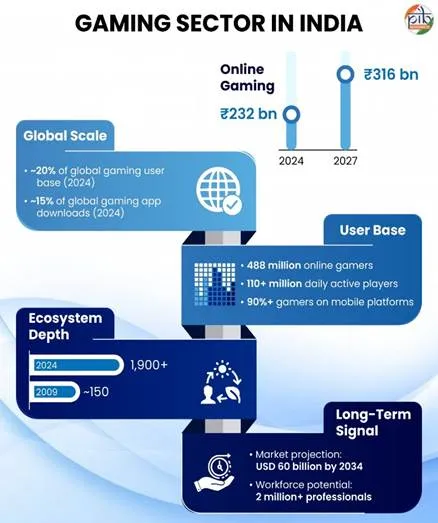
India’s gaming sector is experiencing remarkable growth, with government data revealing a trajectory that positions gaming among the fastest growing segments of the country’s media and entertainment landscape. According to official figures released by the Press Information Bureau, the online gaming industry is set to grow from ₹232 billion in 2024 to ₹316 billion by 2027, marking a 36% increase over three years.
The Numbers That Define India’s Gaming Revolution
The gaming industry’s expansion is part of a broader transformation in India’s creative economy. Fresh data from the Ministry of Information and Broadcasting shows gaming as the fourth largest segment within the media and entertainment sector, trailing only digital media, television, and print.
Online gaming recorded a valuation of ₹232 billion in 2024. The sector is projected to reach ₹260 billion in 2025, ₹288 billion in 2026, and ₹316 billion by 2027. This growth rate outpaces several traditional entertainment segments, including filmed entertainment and radio.
Gaming vs Other Entertainment Sectors
The government data provides a clear comparison across all major entertainment segments. Digital media leads the sector at ₹802 billion in 2024, growing to ₹1,104 billion by 2027. Television follows at ₹679 billion in 2024, though projections show a slight decline to ₹667 billion by 2027.
Gaming’s ₹232 billion valuation places it ahead of filmed entertainment at ₹187 billion, animation and VFX at ₹103 billion, and live events at ₹101 billion. The sector also surpasses music, which stands at ₹53 billion, and radio at ₹25 billion.
What makes gaming’s position particularly notable is its growth trajectory. While television shows marginal decline and print remains relatively stable at ₹260 billion to ₹267 billion, gaming demonstrates consistent year over year expansion. This comes at a critical time when esports could define India’s gaming future in 2026 following regulatory changes in the sector.
The Broader Media and Entertainment Landscape
India’s total media and entertainment sector was valued at approximately ₹2.5 trillion in 2024. Government projections estimate this figure will reach ₹3,067 billion by 2027, representing an annual growth rate of around 7 percent.
Digital media accounts for roughly one third of total sector revenues, fundamentally reshaping production and distribution models. The sector supports over 10 million livelihoods directly and indirectly, with annual output standing at approximately ₹3 lakh crore.
Animation, VFX and Gaming as Growth Drivers
Animation, Visual Effects, Gaming, Comics and Extended Reality, collectively termed AVGC XR, represent the technology driven frontier of India’s creative economy. The animation and VFX segment alone is valued at ₹103 billion in 2024, with projections reaching ₹147 billion by 2027.
Gaming has evolved beyond entertainment into a mainstream digital medium woven into daily life. Millions of users across metros and smaller towns engage with gaming platforms daily, transforming mobile devices into competitive arenas and social spaces.
The scale of participation has translated into structured market growth. India now ranks among the world’s largest gaming markets, supported by a vast and deeply engaged user base. Rising monetization, expanding domestic studios, and stronger integration with global platforms are transforming gaming from mass engagement into a scalable digital industry. Major technology companies have taken notice, with Nvidia’s cloud gaming platform GeForce Now coming to India to tap into this growing market.
Infrastructure and Talent Development
The government’s commitment to the AVGC XR ecosystem goes beyond market projections. Official policy documents outline plans to create pathways for designers, animators, coders, and storytellers to build global careers.
The Indian Institute of Creative Technologies has been established as a National Centre of Excellence for AVGC XR and gaming. This institution brings structured training, advanced infrastructure, and industry collaboration under one framework, bridging the gap between classroom learning and production demands.
Plans include establishing AVGC Content Creator Labs in 15,000 secondary schools and 500 colleges. The initiative aims to prepare a new generation of talent, with projections indicating the AVGC sector will require nearly 2 million professionals by 2030.
Regional Hubs and Employment Potential
Established centers including Bengaluru, Hyderabad, Mumbai, Pune, Chennai, and Thiruvananthapuram anchor the industry. Emerging cities are building their own creative clusters, expanding opportunities beyond metropolitan areas.
With projections of nearly 20 lakh direct and indirect jobs over the next decade, the AVGC gaming sector is being positioned as a significant employment engine for India’s digital generation. The formal recognition of competitive gaming gained momentum when India officially recognized esports as part of the multisport event category under the Ministry of Youth Affairs and Sports.
Live Events Show Parallel Growth

While gaming represents digital engagement, live entertainment shows similar expansion. The live events segment is valued at ₹101 billion in 2024, with projections reaching ₹167 billion by 2027. This 65% growth rate demonstrates how experiential entertainment complements digital gaming.
India now features regularly on global touring routes, with major cities hosting international performers and homegrown artists. Venue infrastructure has expanded from Narendra Modi Stadium to premium spaces supported by professional production networks operating at global standards.
Policy Frameworks and Global Integration
The World Audio Visual and Entertainment Summit serves as a focal point for India’s creative ecosystem. The platform brings together creators, startups, industry leaders, and policymakers, facilitating deal making and collaboration.
Supporting initiatives include WaveX for startup innovation through investor engagement, and WAVES Bazaar operating as a marketplace for scripts, music, comics, and audio visual rights. The Create in India Challenge identifies emerging talent and connects them directly to global platforms.
The regulatory framework has evolved significantly, with esports granted national status in India through draft rules that place competitive gaming under the Sports Ministry. This development marks a shift from earlier discussions when India’s Parliament first talked about esports and gaming policy frameworks.
Corporate Investment and Industry Partnerships
Major corporations are investing heavily in India’s gaming infrastructure. In a landmark development, Reliance partnered with BLAST for esports business in India, bringing international tournament expertise to the domestic market. This joint venture demonstrates how established Indian business houses view gaming and esports as strategic growth sectors.
What the Data Means for India’s Gaming Future
Government figures position gaming not as a peripheral cultural pursuit but as a technology intensive, globally tradeable sector embedded within modern services economies. The industry combines creative talent with real time rendering, immersive design, and digital production tools that power global platforms.
The transition from ₹232 billion to ₹316 billion represents more than numerical growth. It signals the consolidation of gaming as a strategic capability within India’s economy, linking growth with global influence in an increasingly platform driven world.
As digital media continues its dominance and traditional segments like television face headwinds, gaming emerges as a durable growth engine. The sector’s trajectory, backed by institutional support and talent development initiatives, suggests India’s position in the global gaming market will strengthen significantly by 2027.
The data tells a clear story. Gaming in India has moved from niche entertainment to economic infrastructure, creating jobs, attracting investment, and positioning the country as a major player in the global gaming economy.
