

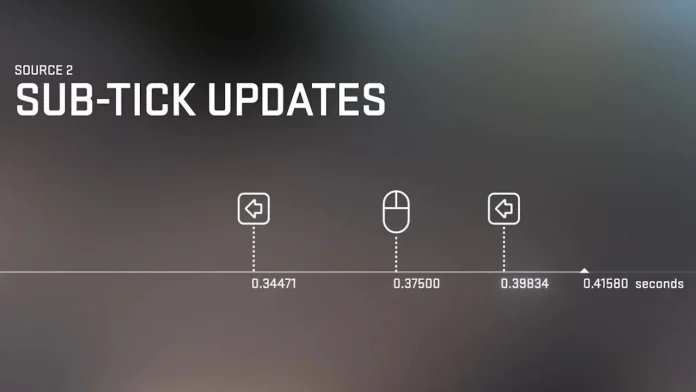
The transition from CS:GO to CS2 was far from smooth, and the latest iteration of the world’s favourite shooter received more than its fair share of criticism across multiple areas in the new game. However, most of the criticism was directed towards the new subtick system. It impacted the decade-old mechanics of the game, leading to its poor reception among professionals and casuals alike. What many fail to recognise is how it has become a silent nerf, fundamentally altering the gameplay mechanics and reshaping several metas across the game.
What is the Subtick system?
The traditional tick system made sure that the game server was updated at a frequency of 64/128 with CS:GO, but the new subtick system took a different approach by assigning a timestamp to every action, which gets updated together in the server and as a result players notice improved hit registration, smoother movement, and a more responsive feel of the game or at least, that was the intention.
While the new system was supposed to bring a massive difference in the smoothness of the server, it failed miserably, leading to pro players calling out the developers for releasing an undeveloped game. NAVI captain Aleski ‘Aleksib’ Virolainen openly pointed out how CS:GO felt way smoother compared to CS2. While everything felt way off, it was difficult to point out what exactly needed to be changed to fix it.
As time went by, the developers addressed each and every concern from professionals to casuals, and the game saw a significant improvement in almost all areas, but the difference in mechanics was readily apparent.
How did it change the mechanics of CS2?
Arguably, the most frustrating change from CS:GO. The new subtick system takes a different approach in processing sprays mid-gunfights. Given each movement is paired with its timestamp, input precision takes a front-seat over tick synchronisation with the server, and while this makes it more accurate than before, you are likely to get more random misses despite your cross-hair being on point in your monitor. While this move enables room for players with more precision, the gap between the top aimers has significantly increased from the rest.
Not only does this make the spray feel out of place, but the bullet timings and first shot accuracy feel way off compared to before. While the hit registry got more accurate, on the surface level, the game looked sluggish and inconsistent, making it quite an annoying area to work on.
Movement feels inconsistent
Given subtick system impacts everything going on in the server, the movement mechanics, while remaining mostly the same, required a transition period for the players coming after mastering movement on CS:GO for over a decade. Given how each movement is registered with an individual timestamp, the movement is unpredictable, and often what we see on the screen may feel slow, floaty, and non-responsive. Despite remaining largely the same, players needed some time to get used to the new mechanics before they could get the hang of them.
End of Jump Throw binds
CS2 utility is now interpolated more smoothly and accurately with the introduction of the new subtick system, but this makes perfect lineups harder to pull off, especially if it requires a jump-throw. With inconsistent line-ups on several occasions, teams underwent a radical change in how they use the utilities during executions.
While utilities became more and more inconsistent in certain extreme cases, players with sharp aim have greatly benefited from the new system, which led to teams overly relying on smart utility usage, taking a backseat to the ones with more mechanically gifted players.
Client-Server Desync
With the game prioritising the input accuracy over visual accuracy, the developers have created a disconnect between what the players see and what is registered by the servers. YouTube is flooded with videos showing the vast desync existing between the client and the server, leading to players preferring the old system over this one, despite Valve being hell-bent on proving the new system to be better than the previous one.
Pro Player Feedback on Subtick
Let’s take a look at what CS2 pro players are saying:
- s1mple: “Subtick feels weird, shooting is off. Something’s not right.”
- ropz: “You can’t trust the spray anymore. Every time it’s different.”
- EliGE: “There’s more peeker’s advantage now than ever before.”
- NiKo: “Holding angles is a gamble. You’re better off swinging first.”
How It Changes the CS2 Meta
Players who overly relied on more cerebral approaches like clever positioning and smart utility usage are suffering against the sharpshooters, and this is quite evident at the highest level of the game, given the first-peek advantage has significantly become a cheat code.
The bit of unpredictability in the game has bridged the gap between top teams and the lesser-known ones. If the last Major is to be taken as a reference, it was very hard to separate the top teams from the lower-ranked ones, leading to fans enjoying several dark horses coming out on top. This may be fun from the viewers’ standpoint, but incredibly frustrating from teams on the receiving end.
The new meta has been challenging the fine blend of tactics and skills that have been mastered by the top teams over the years, and the volatility in the game mechanics has ensured that lesser-known CS2 teams get more appearances in premier tournaments.
Is It a Nerf or Just a Relearning Curve?
While many may argue that the new subtick system poses a steep learning curve for even the absolute best in the business, it can hardly be considered a nerf, given hardly any player has noticed a significant decline in their skill level transitioning to CS2. All of the stars from CS: GO have maintained their star status with the release of CS2.
Verdict
What was released as a technical update silently revolutionised the whole game, leading to a shift in strategies, metas, and dynamics. While many perceived it as a downgrade, the thriving esports scene of CS2 would indicate that not only have players adapted to it, but are taking full advantage of the improvements that the highly controversial subtick system brings to the table.