


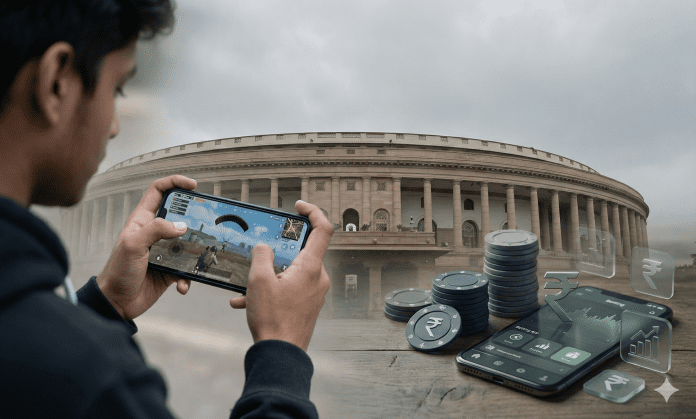
 in India, triggering a massive industry reset. Explore how esports is emerging as the new growth engine for 2026)
In 2025 Indian gaming underwent one of the most disruptive regulatory shake-ups in its history. Lawmakers passed the Promotion and Regulation of Online Gaming Act, 2025 (PROGA), effectively outlawing real-money gaming (RMG) formats nationwide and triggering a massive industry reset. This drastic policy move dismantled a sector once projected to be worth billions of dollars, forcing companies, players and investors to ask a fundamental question, What comes next for Indian gaming?
Emerging at the other end of this upheaval is esports, increasingly viewed not just as a substitute for RMG’s economic activity but as a future growth driver with strong structural advantages. As India enters 2026, the esports ecosystem is poised to seize an opportunity that extends far beyond tournament crowds and celebrity streamers — it could underpin a vibrant segment of the digital economy if navigated with clarity and strategic investments.
The RMG Ban: A Watershed Moment
Real-money gaming in India had been a booming segment up until 2025. Platforms that paired skill games with monetary stakes commanded vast user bases, generated significant tax revenues, and attracted global venture capital. Analysts estimated the Indian RMG industry contributed a large share of the nation’s $3.2-$3.8 billion online gaming market by FY24, with some reports suggesting RMG comprised upwards of 80 % of that value pool.
Then, in mid-2025, Parliament passed PROGA that banned all online games played with any form of financial stakes or deposits, disallowed their payment flows and prohibited related advertisements out of concerns ranging from addiction risk to economic harm.
Industry reaction was swift and severe. Major players such as Dream11, MPL, WinZO, PokerBaazi and others either shuttered their RMG offerings or pivoted to free-to-play models, halting the revenue engines that had sustained heavy investment and workforce growth. Reuters reported that prominent platforms paused or pulled RMG services entirely after the law’s enactment.
Consequences extended deep into employment and finance. Layoffs, cost restructuring and writedowns of hundreds of millions of dollars weighed on an ecosystem that relied heavily on the RMG model. By some estimates, hundreds of thousands of jobs were affected as startups struggled to redraw their business models.
The ban also spurred legal pushback and uncertainty. As of late 2025, litigation challenging the constitutional validity of the law was pending before the Supreme Court, with hearings postponed to early 2026 — leaving firms in limbo and capital cautious about long-term commitments.
Regulatory Clarity Brings Opportunity for Esports
One paradoxical outcome of PROGA’s tight restrictions was the formal recognition of esports as a legitimate competitive sport under Indian law, thus offering a regulatory foothold that had previously been informal or fragmented.
Unlike RMG, competitive gaming does not involve monetary stakes for players’ direct earnings and is widely understood as a combination of skill, entertainment and performance sport. This distinction allows esports to operate under the same policy umbrella that prohibits gambling while still being sanctioned for official competition, professionalisation and even potential government support.
India’s young population — one of the world’s largest cohorts of digital natives — represents a demographic foundation that is uniquely suited for this shift. With approximately hundreds of millions of gamers engaging across platforms and genres, the audience base for esports and casual gaming far surpasses the size needed to support vibrant competitive ecosystems.
Esports’ Structural Strengths in the Post-RMG Era
Several intrinsic features position esports as a potential growth engine in India’s post-RMG landscape. Unlike RMG where users risked real money, esports is built around competition, skill and spectator engagement. This removes regulatory friction tied to financial stakes, making it easier for brands, sponsors and platforms to participate and invest.
Revenue for esports hinges on sponsorship, streaming, media rights, merchandise and events, all of which can be monetised without contravening gaming laws. Global esports markets have already validated these models, which Indian organisations can adapt with culturally relevant content.
Esports can offer structured careers for players, coaches, analysts and support personnel. As domestic tournaments gain legitimacy and audience share, ecosystems supporting youth development, collegiate leagues and grassroots competition are likely to expand. Recent sponsorships and partnerships underscore this momentum. For example, major global tech brands are partnering with collegiate esports initiatives in India, signalling corporate confidence.
India’s creator economy remains robust. Streamers and competitive stars generate substantial engagement across platforms like YouTube and Twitch. This content layer not only fuels viewership but also drives brand deals and community growth that operate independently of RMG-style revenue.
Challenges Ahead: Monetization and Investment
Despite the promise, esports in India must navigate several critical headwinds.
Monetisation Models Must Mature
The absence of direct financial competition payouts, previously embedded in RMG, means organisations must innovate alternative monetisation that resonates with Indian audiences. In-game purchases, franchised leagues, local brand sponsorship and international participation all offer revenue avenues, but require cohesive strategy and capital commitment.
Investor Confidence Hinges on Regulatory Predictability
The RMG ban has dented investor confidence in the sector. Regulatory unpredictability makes capital allocation cautious, and the delayed Supreme Court reviews amplify that uncertainty. A clearly articulated long-term policy framework for esports, digital talent and export ambitions is essential to attract not just domestic funding but global capital.
Balancing Growth with Grassroots Development
Scalability for esports requires balancing high-profile league growth with community-level investment. Training facilities, coaching ecosystems and structured pathways for up-and-coming talent will define India’s competitive footprint internationally.
Consumer Behaviour Must Shift
A key question is how many users will transition from RMG-focused play to purely competitive and spectator gaming. Early signs suggest that a significant segment remains engaged in gameplay, but converting passive gamers into esports fans, paying subscribers and event attendees requires thoughtful community building.
Strategic Imperatives for 2026
To realise esports’ potential as a gaming engine, stakeholders, from policymakers to brands, investors to talent, must align on several strategic fronts:
Incentivise Domestic Competition and Infrastructure
National and regional esports leagues should be supported with transparent guidelines, prize structures, and partnerships with educational institutions to foster participation.
Capitalize on Population Scale and Digital Engagement
India’s mobile-first gamer base is fertile ground for esports formats that integrate casual play with competitive elements. Robust mobile esports titles and localised content can catalyse rapid audience growth.
Leverage India’s Tech and Creative Talent
Beyond players, esports generates opportunities in broadcast production, event management, narrative storytelling and game development. Indian tech talent can help build tools and platforms that serve global markets.
Build International Bridges
Indian esports organisations should pursue international tournament play and partnerships to elevate brand visibility and market credibility.
Emerging New Chapter for Indian Gaming
The RMG ban was a defining moment that effectively decoupled a major revenue segment from India’s gaming industry. While the short-term economic pain was significant, it forced a reckoning about sustainable models of digital entertainment and consumer engagement.
Esports stands out as the leading candidate to absorb this shock and chart a new course for growth in 2026. With regulatory recognition, demographic tailwinds, emerging monetisation strategies and a maturing ecosystem, esports is well-positioned to become a cornerstone of India’s digital economy if stakeholders embrace long-term strategy over short-term fixes.
Whether India can transform regulatory disruption into competitive advantage remains to be seen, but the structural ingredients for a thriving esports ecosystem are now more visible than ever. If realised, this could redefine India’s standing in the global gaming landscape over the next decade.